La Lecture by Pablo Picasso

La Lecture by Pablo Picasso (1932)

Check your finances.  Have you a little spare money to buy yourself a painting ?  I know of a bargain to be had on February 8th.  It was only painted seventy nine years ago.  It is highly colourful.  Lots of yellows and greens and I am sure it would blend nicely with the colour of your lounge carpet or the fabric of your settee.  So how much spare cash have you got ?  Is that all ?  Sadly you will need a little more than that as you will probably have to come up with at least £18 million and some reckon the final figure could triple that.

My Daily Art Display offering today and the painting in question, which is due to come up at the Sotheby’s Impressionist and Modern Art Evening Sale in London this coming Saturday, is Pablo Picasso’s La Lecture.   The thing that fascinates me the most about this painting is the background story.  It was completed by Picasso in January 1932 in time for his exhibition at the Kunsthaus in Zurich,  entitled Picasso by Picasso: His first Museum Exhibition 1932, and is a portrait of his muse, Marie-Thérèse Walter, who it is said transformed the life of this great Modernist artist. This painting was among a series from the beginning of 1932, which introduced this young woman as an extraordinary presence in Picasso’s life and his art.

The story goes that the then forty five year old artist introduced himself to the seventeen year old girl outside a Paris Metro station.  On recounting the tale of the meeting, Marie-Thérèse said she remembered Picasso’s words as they came face to face:

“…I knew nothing – either of life or of Picasso… I had gone to do some shopping at the Galeries Lafayette, and Picasso saw me leaving the Metro. He simply took me by the arm and said, ‘I am Picasso! You and I are going to do great things together’…”

Today, I am sure we would think this bold introduction of the Spanish artist was simply a very cheesy chat-up line and would nowadays probably get a middle-aged man a slap in the face!   However for that forty-five year old man standing outside the Metro station in 1927 those words and his possible charm won over the young girl.  For in that year Marie Thérèse Walter became the secret lover of Pablo Ruiz Picasso and their relationship lasted eight years despite the artist still living with and still married, if unhappily, to his wife Olga Khokhlova, a Russian-Ukrainian dancer whom he  met whilst she was on tour with Diaghilev.

Their liaison was a closely guarded secret for many years for two main reasons.  Firstly, because of Picasso’s marriage to Olga and secondly, because of Marie-Thérèse’s age.  Their secret liaisons took place in a chateau  he had bought at Boisgeloupe, near Gisors.  His studio here was much larger than the one he had in Paris and it enabled him to create monumental plaster busts of Marie-Thérèse that were later depicted in several paintings.

La Lecture belonged to a group of paintings, painted by Picasso in January 1932 in anticipation of the major retrospective he was planning that June.  Today’s painting is Picasso’s depiction of Marie-Therese and it was the first time that she had appeared in one of his works.  Earlier paintings of his showed her features implanted discreetly in the background and it was this unconcealed portrayal of his mistress which led his wife to realise that there was another woman in her husband’s life.

Picasso’s lover and muse’s potent mix of physical attractiveness and at the same time her sexual naivety had an intoxicating effect on him and his rapturous desire for her brought about a number of compositions that are amongst the most sought after of his long career.  In 1935, Marie Thérèse Walter had a daughter with Picasso, Maria de la Concepión, called Maya.  Sadly for Maria-Thérèse, a year later in 1936, Picasso switched his affections to a new love, Dora Maar a woman he met when he was painting Guernica.  Marie-Thérèse left Picasso and took their daughter to live in Paris. 

Picasso died in April 1973 and four years later in October 1977, Marie-Thérèse committed suicide by hanging herself.  For the young seventeen year old who first met the Spanish painter life with him was almost certainly exciting and fulfilling but alas, like Picasso’s wife Olga, she was to suffer the humiliation and sadness caused by her lover’s unfaithfulness but for Marie-Thérèse life was just never the same again and life was not worth living without her elderly lover.

Paul Helleu Sketching with his Wife by John Singer Sargent

Paul Helleu Sketching with his Wife by John Singer Sargent (1894)

My Daily Art Display today is a tale of two artists who were very close friends.  One is the great American Impressionist John Singer Sargent, the other is the French painter Paul César Helleu.  Today’s work of art is a picture by the American artist Sargent of the French painter Paul César Helleu and his wife Alice Guérin.

John Singer Sargent was to become a leading portrait painter of his era.  His family were extremely wealthy, his father, Fitz William, being an eye surgeon in Philadelphia.  Sadly Sargent’s mother, Mary (née Singer) suffered a nervous breakdown after the death of her daughter and to aid her recovery her husband decided that his wife and their family should go to Europe to allow Mary to convalesce. 

Whilst in Europe, they travelled extensively.  John Singer Sargent was born in 1856 whilst his parents lived in Florence and his sister Mary was born there a year later.  After much discussion and to please his wife John’s father reluctantly relinquished his post at the Philadelphia hospital and remained in Italy were they led an unassuming lifestyle relying on a small inheritance and what savings they had managed to accrue. 

John Singer Sargent proved to be a rebellious child who would not take to formal schooling and so was taught by his parents.  His mother was a good amateur artist and she soon got John interested in that subject.  His parents must have provided him with a good education as by his late teens he was fluent in French, Italian and German and accomplished in art, music and literature.  No doubt the extensive travelling of European countries by the family improved his education.

In 1876, at the age of eighteen, Sargent passed the entrance exam to the École des Beaux-Arts in Paris.  Here he studied anatomy and perspective and spent time in the Paris museums copying the works of art of the masters.  It was whilst studying at the Art Academy that he met and became close friends with a young French artist, four years his junior, Paul César Helleu.  Whereas Sargent was having success with the sale of his paintings and was having no trouble in securing commissions, Helleu was becoming very despondent and disheartened, finding sales of his works difficult to come by and he was struggling to make needs meet.  Sargent, on hearing that Helleu was at the point of giving up his career as an artist, visited his friend on the pretext of looking at the young Frenchman’s work.  He congratulated his friend on the standard of his work and asked to buy one.  Helleu was delighted but told Sargent he must have the painting of his choice as a gift as it was not right to charge his friend.  Sargent replied to this offer saying:

 “I shall gladly accept, Helleu, but not as a gift. I sell my own pictures, and I know what they cost me by the time they are out of my hand. I should never enjoy this pastel if I hadn’t paid you a fair and honest price for it.”

He gave his friend a thousand-franc note for the painting.  Can you imagine how Helleu felt on receiving such a large sum of money for one of his paintings ?

In 1884 Sargent painted the portrait of Madame Pierre Gautreau, entitled Madame X, wearing a very risqué off the shoulder gown.  It was also shockingly low-cut.  Her mother asked him to withdraw the painting but he refused.  Although, now it is acclaimed as his best work of art, it scandalised Paris society and he was widely criticised in Paris art circles for being improper.  Sargent found the criticism unjustified and at the age of 28 he left Paris disillusioned by the incident and the fall off of sales of his paintings and moved to London where he remained for the rest of his life England.  He died there in 1925, aged 71.

My Daily Art Display painting today is entitled Paul Helleu Sketching with his Wife which he completed in 1889 and is in the Brooklyn Museum, New York.  It is difficult to put a name on Sargent’s genre of painting.   He was a prolific painter, painting over 2000 watercolours.  He was a very successful portraitist but labelled portraiture as “a pimp’s profession” and in 1907 he announced that he would paint “no more mugs” and with a few exceptions kept to his word.   He loved to paint landscape watercolours.  Today’s painting of his is very much in the characteristic style of Impressionism.

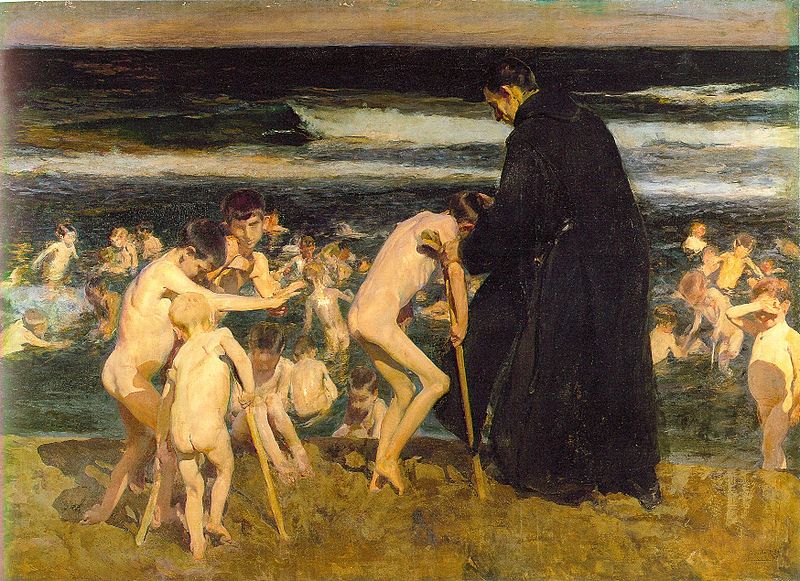
Sad Inheritance by Joaquín Sorolla

Sad Inheritance by Joaquín Sorolla (1900)

 My Daily Art Display artist of the day is the Spanish prolific painter and illustrator, Joaquín Sorolla y Bastida who was born in Valencia in 1863.  Both his father, also named Joaquin and his mother Concepción died of cholera when he was only two years of age, leaving him and his younger sister Concha orphaned and brought up by their maternal aunt and uncle.  From an early age Joaquín acquired a great love for art and developed into a fine young artist, winning major prizes for his works at the Academy of Valencia.  At the age of 18 he travelled to Madrid and spent time studying the works of art of the Masters at the Museo del Prado.   Military service temporarily put an end to his art studies but on its completion, he applied for, and was granted a four year scholarship to study painting in Rome

In 1888 he returned to his home town, Valencia and married Clotilde García del Castillo a girl he had met almost nine years earlier when he was working at her father’s studio.  At this time Joaquín had established himself as an artist in Spain and by the age of 30 his paintings had been exhibited in Madrid, Paris, Venice, Munich, Berlin and Chicago.  He won  numerous gold medals in major international art exhibitions and by the time the twentieth century had arrived, he was recognized as one of the world’s greatest living artist

My Daily Art Display today was Joaquín Sorolla’s painting Sad Inheritance which he completed in 1899.  This was a very large oil on canvas painting measuring 284cms wide and 208cms high.  The painting was in tune with Sorolla’s desire of capturing the immediacy of everyday life, warts and all.  This is often termed Social Realism.  Social Realist artists try to illustrate people and their lives in a realistic way and because of this it is often the case that people in their paintings are not continually shown as beautiful, attractive and happy.  It is often the case that these Social Realism artists will focus on the elderly and the sick, the sad and the insane or those people who have to endure a disability.

The subject matter of the painting Sad Inheritance is a party of crippled children bathing at the sea in Valencia under the watchful eye of a monk.  It was in the late nineteenth century that a polio epidemic struck the Valencia area and in the painting one can see two of the boys affected by this affliction.  When Sorolla exhibited this painting in the Universal Exhibition in Paris in 1900 he was awarded the Grand Prix and a medal of honour.  A year later he received the medal of honour at the National Exhibition in Madrid.  Award after award followed for Sorolla and in 1906 following a special exhibition of over five hundred of his paintings in Paris, he was appointed Officer of the Legion of Honour.  From then on Sorolla was inundated with commissions.

Sorolla suffered a paralysing stroke in 1920 and he died three years later in 1923 aged 60.  His former home in Madrid is now a museum dedicated to his work.