Marriage à la Mode: The Toilette by William Hogarth

Marriage a la Mode The Toilette by William Hogarth (c.1743)

This is the fourth day of My Daily Art Display which looks at the set of six Hogarth paintings entitled collectively as Marriage à la Mode.  To follow the story in chronological order you should start at my blog of May 4th.  Today we are at Episode Four of this pictorial soap opera, a veritable tragic-comedy about a doomed marriage.  Today’s painting is the fourth in William Hogarth’s series and is entitled The Toilette. 

There has been a passage of time between the happenings in the first painting in the series when the two young people became husband and wife and the setting for this fourth painting.   We are in the house of the Viscount and his wife.  We are in the ante-chamber of her boudoir as she prepares herself for the trials and tribulations of the coming day.  What is happening is a morning ritual that the nobility copied from the life of the monarch and which was developed in the French Court.  It was known as the lever du roi.  The royal morning toilette unfolded in two phases. The king was joined for the petit lever by his most senior officials, who gave him the day’s news. While they talked to him, the king was given his dressing gown, was shaved and powdered, and relieved himself on his commode. This was followed by the grand lever, a more public morning reception, during which the king took his chocolate, was given his wig and dressed.

If we look above the pink-curtained alcove we see a coronet which signifies the Viscount has become an Earl and means he has inherited the title from his late father.  The Viscount is now the new Earl of Squander and his wife is now Countess of Squander.   This painting is bursting with all the characters Hogarth has added.  Let me introduce them to you.  The now Countess of Squander is the lady on the right, wearing the yellow and silver morning gown sitting at her dressing table.  On the back of her chair, tied to a red ribbon is a child’s teething coral so we know that she has become a mother.  She has her back to her guests with the exception of Silvertongue, the lawyer, who she is in animated conversation with.    Silvertongue is the lawyer whom we saw in the first painting as he carried out the duties of an adviser to the late Earl and consoled the unhappy viscountess.  Behind her stands her hairdresser who is testing the heat of his curling tongs. 

The invitation

The lawyer seems to have become very “close” to the Countess and seems to have made himself quite at home as he lies full length on a sofa.  In his right hand are some tickets – but for what and why?  If we look at his left hand, it is pointing towards a folding-screen which is illustrating a masked company and we can assume that his conversation with the Countess involves inviting her to come with him to some sort of masquerade. As people wore masks at these events they could not be identified and any dubious behaviour carried out by the revellers was done so without the fear of identification.  Such masquerades in those days often went on right through the night and often the men and their partners would slip away to a bagnio, which was a place where rooms could be hired with no questions asked, and where lovers could “consummate their relationship”.  We now begin to realise that the lawyer, Silvertongue, is not just the Countess’ legal adviser.   Another hint at the sexual nature of their relationship is the book which lies against the back of the sofa on which he lies sprawled.  It is La Sopha a 1742 libertine novel by French author Claude Prosper Jolyot de Crébillon.  It is a story concerning a young courtier, Amanzéï, whose soul in a previous life was condemned by Brahma to inhabit a series of sofas, and not to be reincarnated in a human body until two virgin lovers had consummated their passion on him.  It became the favourite reading of all, male and female alike, who enjoyed indulging in erotic fantasies.

The entourage

To the left, on the sofa we have a singer, probably a castrato, a type of male singer which was very popular at the time.  He is sumptuously dressed with his silken waistcoat which is somewhat spoiled by his corpulence.   He wears rings on his ear and all of his fingers.  His profession has brought him great wealth.  Look at his diamond-encrusted tie pin and the buckles on his shoes and on his knees.  The Countess will have paid dearly for this “morning serenade.  Her female companion is mesmerised by the singing and seems about to fall to her knees in homage to the singer.  At the opposite end of the sofa to the fat singer we see a strange looking man with curl papers in his hair.  We know it is not the husband as we have seen him in the three previous paintings and from what we know of his character we know he was unlikely to give up his time to be with his wife at her petit leve.   Behind the sofa we see a very thin flautist who accompanies the singer.  In the background we see two other gentlemen, part of her ladyship’s entourage.  One holds a cup with what looks like a chocolate biscuit dunked in it.  He has the cursed black patch on his lower lip which could mean he is yet another person carrying a sexually-transmitted disease.  Looking at his facial expression, he too seems much enamoured by the singer’s rendition.  His companion, seated behind him, on the other hand, seems less taken by the music as he is sound asleep albeit still clutching hold of his riding crop.

In the background of this painting we see a black servant handing out a cup of possibly tea or hot chocolate to the Countess’ companion.  On the floor, in front of the countess and Silvertongue we see a small black boy wearing an Indian turban.  It was very fashionable in those days to have at least one coloured servant or pageboy and by the way this small child is allowed to be present at the petit leve  he must have been one of the household. 
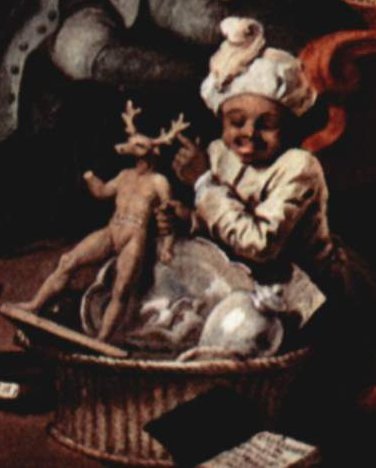
The Indian boy and Actaeon

It is interesting to note that he is smiling as he holds a figure of a naked man who is wearing antlers on his head.  This symbolises a cuckold – a deceived husband.  The figure is almost certainly Actaeon, the mythical hunter who surprised the goddess Diana while she was bathing naked and who was turned into a stag in punishment and torn to pieces by his own dogs.   This must have been bought at auction by the countess as it still has the lot number affixed to it.  More erotic items can be seen in the basket the boy is rummaging through – the picture on the tray also recalls forbidden erotic pleasures: the married Zeus, in the shape of a swan, approaches the similarly married Queen Leda. 

Scattered on the floor are various invitations received by the Countess along with a number of ugly ornaments, similar to those we saw on the mantelpiece in the second painting of the series.  On the walls there are a number of paintings which we can recognise. Such as Lot and his Daughters, which was a Biblical reference to incest and Jupiter and Io, a Greek mythological tale of seduction concerning Io who was a river goddess.  Jupiter fell in love with the beautiful maiden, and one day, as she rested on the banks of the River, he changed his shape into that of a cloud, and embraced her. He whispered words of love to her, and then planted an immortal kiss upon her upturned cheek.  However the strangest painting on the wall of the Countess’ room is a portrait of Silvertongue himself!   I wonder how she explained that away to her husband!

There are so many things in this painting which leads us to believe that the Countess has or is about to be unfaithful to her husband.  Prior to this painting, we have just looked at the first three paintings in Hogarth’s six piece cycle and we have surely felt sympathy for the young wife.   Let us examine her lot in life.   Forced into a marriage by her father, who was willing to do anything to join the nobility.  Married to a wastrel who we learn was suffering from a sexually transmitted disease and who spends his evening in the company of whores.  However after examining today’s painting, the fourth episode of the story, maybe we are having doubts about our unconditional love for the young woman.  Can we justify her actions by saying it is purely an act of revenge on her wayward husband?

Marriage à la Mode: The Inspection by William Hogarth

Marriage a la Mode The Inspection by William Hogarth (c.1743)

For anybody who has just clicked on to this page, be warned, we are now almost half way through William Hogarth’s pictorial saga entitled Marriage à la Mode and I suggest you click on to the May 4th blog which is the starting point to this cycle of paintings.  This is painting number three in the cycle and is entitled The Inspection.  In My Daily Art Display on the two previous days we looked at the coming together of the young couple and then the onset of the deterioration of the relationship.  Today things take a turn for the worse in the marriage saga.

Today, the setting for the painting is not the Viscount and Viscountess’s house but the consulting rooms of the French doctor, M. De LaPillule.  In the surgery we see the doctor to the left, the Viscount, with his young mistress, who stands on his left hand side and in the centre a rather large woman in a voluminous maroon hooped dress.  There is no sign of the Viscountess and as the story unfolds you will know the reason for her absence.

In the two previous paintings in the cycle we have noted that the Viscount has a black patch on his neck, a way Hogarth signified that the Viscount has contracted the sexually transmitted disease, syphilis.  It is for that very reason that he now appears at the doctor’s surgery.  The Viscounts voracious sexual appetite has been the undoing of him and now he is paying the penalty for his many indiscretions and sexual liaisons.  He, however, seems unabashed by his predicament.  In fact he seems quite good humoured, which is in stark contrast to the worried look on the face of his very young mistress.  She is but a mere child.  They have come to the doctor for a cure for his ailment.  He had originally been prescribed mercury tablets, which at the time were the only known cure for the disease, but they have had not achieved the desired effect so we can see the Viscount handing back the pill to the doctor and asking for an alternative medication.  I say “asking” but we see that in his left hand he is brandishing a cane.  Is this a threatening move on his part towards the doctor?  Is it his belief that his confrontational action will get him a more potent and successful remedy?

I am not sure how much faith I would have in a doctor who looks like the one in the painting.  He looks unclean and unshaven and is dressed in shabby brown clothes.  Maybe he is what was termed a “back-street” doctor.  Maybe the Viscount dare not go to his regular physician in case his plight became known to his social circle.  The surgery, like the doctor, is dirty and full of masks and bones and on the table next to Doctor La Pillule is a skull.  In the cupboard at the rear of the painting we see a skeleton which almost appears to be groping the genitals of a musculature model or is it an embalmed body !!!!   If we look to the side of the cabinet we can see a narwal tusk which is a classic phallic symbol.  On the cabinet we observe a plethora of pill boxes, a scalloped-sided bleeding basin, a glass urinal, a giant plaster head with a huge femur behind, an alchemist’s tripod for holding flasks over burners, a broken mediaeval comb, a tall red Jacobean hat, two mismatched mediaeval shoes, a spur buckler and a sword and shield, all of which are covered in dust.  So what does this tell us about the doctor and his practice?   Georg Christoph Lichtenberg, the German scientist and artist wrote in his book entitled Hogarth on High Life. The Marriage à la Mode Series,

“…The Doctor’s collection, commenting as it does both historically and prophetically on his career, might be interpreted as follows: he began as a beard trimmer; graduated to piss-analyst; barely skirting the gallows (by virtue of his curative powers) he grabbed for himself a doctor’s hat; and is now counting on a knighthood, if he has not one already…” 

Hardly a resounding recommendation on the good doctor’s ability to cure the Viscount and his mistresses.

The large irate lady at the centre of the painting, which we are presuming is the young mistress’s mother, has similar black patches on her face and we can only surmise that she too is suffering from syphilis.  It is thus a matter of conjecture as to whether the lady is purely the mother of the Viscount’s young mistress or is she the mistress as well, as the Viscount seems to be very relaxed in her company and not fearful of the consequences of having given her young daughter a sexually transmitted disease.  Also, if she was the child’s mother would she and the child be standing together?   Maybe they are not related and they are just two females of vastly different ages plying the same trade.  I am not sure whether, if I was the Earl, I would be feeling relaxed as him,  especially as in her hand we see her opening up a clasp knife as she stares down malevolently at him. 

We look at the young girl.  She is but a child.  She looks worried and sad knowing what has befallen her.  It is a pathetic sight.  For a supposed mistress she seems so young, too demure, too prim and proper but we see her dabbing a sore on her mouth with a handkerchief and this is probably the early signs of the onset of syphilis.  In her other hand is a pill box.  Maybe she too is seeking an alternative remedy to her illness.

That’s the end of Episode Three of Marriage à la Mode.  Tomorrow we will take a look at the next part of the Hogarth’s saga, entitled The Toilette.

Marriage à la Mode: The Tête à Tête by William Hogarth

Marriage à la Mode: The Tête à Tête by William Hogarth

For those of you who have just alighted on this page, I would suggest you start by looking at yesterday’s offering, which is the first in a series of six paintings by William Hogarth, which together were entitled Marriage à-la-mode.  My Daily Art Display today is the second painting in the series entitled The Tête à Tête.  The six paintings tell a story, in chronological order, (hence my suggestion to start at yesterday’s blog) of the consequences of an ill-conceived marriage.

In the painting we see four characters.  The newly married Viscount and his bride, the Viscountess,  and two servants, one who is just taking his leave of the couple and the other we can spot in the ante-room.  The setting is the drawing room of their palatial home.  If we look above the Viscount’s head we can see a clock showing a time of 1:20 and this has generated two lines of thought as to whether we are viewing this scene in the early afternoon or in the early hours of the morning.  I will leave you to decide.

The Viscount - Lost in thought

The Viscount sits slumped in his chair with his hands stuffed in his pocket.  He is disheveled and completely lost in thought.  It is as if he has just returned from a night out with the lads and is now feeling ill from the onset of a hangover and a night of debauchery.  He looks exhausted and maybe his night out was not just a tour of the inns with his male friends but maybe his fatigue has been brought on by their visiting a brothel.   So maybe 1:20 in the morning is a better bet!  

He pays no attention to his wife who sits across from him in a separate chair.  A dog can be seen at his side.  It is quite animated as it sniffs at something sticking out of his pocket, possibly a woman’s lace cap which he obtained as a “trophy” during his sojourn in the brothel. Once again, we see in this picture a large black patch on the Viscount’s neck, which Hogarth used to signify that the Viscount has contracted syphilis.  It should be remembered that this patch was there in the first picture and therefore he had this affliction prior to his marriage.  However Hogarth has cast doubt on the Viscount’s sexual prowess as lying by his feet is his sword still in its scabbard but the tip has broken off which alludes to the fact that he may be impotent.

The Viscountess - Contented look of pleasure

So let us take a look at the Viscountess.  To her right we see some playing cards scattered on the floor.   In front of her, on the ground, is the book entitled Hoyle on Whist suggesting that her evening entertainment has been simply playing cards, but maybe the question we should be asking ourselves is, with whom?  Am I adding intrigue when there is none to be savoured?  Observe the young woman more closely.  Her pose lacks dignity.  She sits with her legs apart,  a not very lady-like pose. Her arms are outstretched and she is lost in thought.  In contrast to her husband’s thoughts, her thoughts seem to be very pleasurable.  Look at her dress.  Look at the stain or damp patch on it.  Why has Hogarth painted it like this?  What is the artist trying to convey to the viewer?  Her facial expression is one of contentment and joy and we know that this is not the result of a happy marriage or the fact of being left at home alone, whilst her husband is off gadding about.  She is probably aware of his womanizing, so what has brought about this expression of happiness?  There is something sly and devious about her expression as she furtively peeks under eyelashes at her husband.  Take a look at what she is holding above her head in her right hand.  It is a mirror.  Maybe she is using it just before she stretched out her hands or maybe she is signaling to somebody just out of picture – maybe her lover with whom she has spent an evening of pleasure?  Maybe that is what has put the contented expression on her face.  Hogarth has given us one other clue to a possible meeting of lovers.  Look on the floor in the foreground.  We see an upturned chair and an abandoned musical instrument and sheets of music.  Was the lover of the Viscountess seranading her and on hearing the arrival home of her husband, dashed out of the room, knocking over the chair in his haste? 

The frustrated steward and the unpaid bills

We see the steward just about to take his leave of the couple.  He does not seem best pleased.  He is portrayed by Hogarth as a pious Methodist and in the pocket of his coat we can just see a book sticking out with the title “Regeneration” a book on Christian theology.  A quill pen is behind his ear.  In his left hand he is grasping a stack of unpaid bills and a ledger is tucked under his arm.   Hanging from the little finger of his left hand is a spike upon which are the paid bills.  Alas, there would appear to be only one, which fades into insignificance if we contrast that to the sheaf of unpaid bills.  It is quite obvious that the young Viscount likes to spend and is treading the same perilous path his father took – the road to financial ruin.    The steward is leaving them with his right hand thrown upwards in a sign of despair that neither of the couple will take their financial situation seriously.

Mishmash of ornaments

Over the fireplace we see a painting of Cupid amongst ruins playing what looks like a set of bagpipes.  This symbolizes the inharmonious and flawed state of the young couple’s marriage.  Below the painting of cupid we see a bust which has, at one time, had its nose broken off and this once again this symbolizes impotence – maybe alluding once again to the impotency of the Viscount.  On the mantlepiece there is a terrible mishmash of ornaments, jars, statuettes and figurines.  This probably alludes to the chaotic existence of the couple’s lifestyle.

That painting !!!!

Do you know what amuses me the most?  It is is in the other room.   Look at the paintings on the wall.  We can see three paintings, portraits of the apostles, but look at the fourth painting, the one to the right.  A green cover almost hides the subject from view but we can see a naked foot.  I will leave you to decide what the rest of the painting was about.  It had to be something too risqué for us to see!

We are left in no doubt by this second painting that the marriage of the Viscount and the Viscountess is heading for the rocks and you will have to wait until tomorrow to see the third “episode” of this pictorial soap opera to find out what happens next!

Marriage à la Mode: The Marriage Settlement by William Hogarth

Marriage à la mode: The Marriage Settlement by William Hogarth (c.1743)

A couple of days ago I featured a portrait of a couple by Thomas Gainsborough.  The type of portrait was known as an “outdoor conversation piece” with it being a group portrait of real people in a landscape setting.  Today I am going to introduce you to another form of art known as “the modern moral subject”.  This form of art was developed by the English artist William Hogarth.  Hogarth had a great desire to be an English painter of grand manner history subjects.  He wanted to break the foreigner’s monopoly in high art. However, unlike the up and coming portrait painter, Joshua Reynolds, he rejected the idea of travelling to Rome where that manner was to be acquired.

Hogarth believed there was enough evidence of the “foreigners’ work” in England without him having to make them pilgrimage to Italy.  The Raphael cartoons, which were considered to be among the greatest treasures of the High Renaissance, were in England.  They had been painted by Raphael as designs for the tapestries that were made to cover the lower walls of the Vatican Sistine Chapel had been brought to England in 1623.  There were also many engravings of great art at hand in England and Hogarth considered travelling through Europe to study High Renaissance art was unnecessary.  Hogarth had created a different role for himself, painting narrative series of “modern moral subjects”.  The novelist and dramatist Henry Fielding called them “comic history paintings”.

My Daily Art Display for today is The Marriage Settlement, the first painting of a set of six entitled Marriage à-la-mode which Hogarth painted between 1743 and 1745.  It is a moralistic warning, which gives us a clear vision of what happens as a result of an ill-conceived marriage, which only took place for financial reasons and not for love.  Art historians believe that this project of Hogarth was his finest.   It is a finely crafted story divided into six parts and I like to consider it as a six-episode pictorial soap opera.

The main protaganists

So now let me introduce you to the characters that are all assembled in this, the first painting of the series.  Seated at the far right of the foreground we have the Earl of Squander.  The index finger of his left hand points to an unfurled parchment depicting his family tree, which shows his family being direct descendents of William, Duke of Normandy (William the Conqueror).    Hogarth has cynically incorporated a broken branch in to the family tree, which was indicative of  a prior marriage, but one outside the nobility and was thus disowned, hence the break from the main tree.  Obviously one would not have shown such a thing on a real family tree but it is reminding the viewers that this great noble’s set of descendents were not quite as noble as the earl would have us believe!   Although titled, the man is almost penniless and heavily in debt due to his foolish ways and needs urgently to replenish his wealth.  Despite his poverty look at the luxurious and costly clothes he is wearing.  There is an arrogance about the man.  He has surrounded himself with symbols of his nobility.  There are coronets everywhere.  If you look carefully you can see how Hogarth has painted them on his foot stool, on the canopy above his head, and even on the head of his crutches.     Observe how Hogarth has painted him with his right foot resting on a stool which is a tell-tale symptom of gout, and which is often associated with overindulgence in alcohol and rich foods.

Sitting across from the Earl, in his red frock coat is The Alderman.  He, unlike the Earl, is extremely rich.  He is what we would now term, the nouveau riche.  However, he is not of the “noble class” and all he wants is to become the grandfather to a noble son.  He has what the Earl needs – money.  The Alderman has what the Alderman needs – nobility and so they have hatched up the plan of a marriage between the Alderman’s daughter and the Earl’s son.

Bride and groom with Silvertongue the lawyer

We can see the bride and groom sitting in the background.  Note how they are not looking at each other, which is Hogarth’s way of illustrating that there is no “love” in this union.  The young girl looks despondent but resigned.  Her clothes are quite plain in comparison to those of her new husband.  She is fiddling nervously with her handkerchief through which she has threaded her wedding ring.  We feel a little sorry for her.  Next to her stands Silveretongue, the lawyer.  He has a somewhat fawning appearance as he is outlines the terms of the marriage to her.

On the other hand, there is nothing about the groom’s appearance and demeanour that we can possibly like.  The young man, the Viscount, has a foppish air about him.  He sits with his back to his new wife.  He is dressed expensively in a French-style wearing a powdered wig with a black bow in the back of it.  His high heeled shoes and open spindly-legged posture give him a distinctly effeminate look.  There is a black spot on his neck which some believe indicates that he may have syphilis or scrofula.  He vainly stares at his reflection in the mirror in a narcissistic manner.

The tethered couple

On the floor at the feet of the Viscount we can see two unhappily-looking animals tethered together, a bitch and a dog.  Despite being tied together, they seem to be ignoring each other.   This is how Hogarth cleverly insinuates and compares pictorially the entrapment that the marriage has brought to the newly-married couple.  It is a tethering together of the man and the woman in a loveless arrangement.  The arrangement is purely something the Earl and the Alderman wanted. For the Earl it would be a future heir and for the Alderman it would mean and entry to the noble class.

The sixth character in this composition is the man standing looking out of the window, between the Earl and the Alderman.  He is the architect.  He holds in his hands a set of architectural plans and as we look through the window we can make out an un-finished building the cost of which has probably bled the Earl dry of his money.  The architect in a way is part of this ill thought out marriage as he needs the Earl to have his coffers refilled so that he can get back to work on this grand building project.

The final player in this scene is the man leaning over the table handing back to the Earl his mortgage papers which have been signed in return for the bill of exchange provided by the Alderman, which was his daughter’s dowry.  On the table we see a pile of gold coins which the Earl has just received from the Alderman.

Hogarth has amusingly given us one more clue that this marriage is doomed to failure.   Around the room he has added a number of paintings all of which depict scenes of devastation, tragedy or martyrdom.  We see David killing Goliath, St Lawrence being burnt at the stake, The Massacre of the Innocent, Cain slaying Abel and Judith decapitating Holofernes.

Obviously the artist has no doubt as to how this story will unfold!

Tomorrow we will look at the second painting in the series and see how the tale unfolds

Saint Francis in Meditation by Francisco de Zurbarán

Saint Francis in Meditation by Francisco de Zurbaran (1635-9)

Francisco de Zubarán was a Spanish painter whose painting genre was that of religious works depicting monks, nuns, saints and martyrs.  He was also a popular still-life painter.  He was an artist who was renowned for his use of chiaroscuro, a form of art which is characterised by strong and bold contrasts between light and dark, which affected the whole composition.  It was for this use of chiaroscuro that he was known as the Spanish Caravaggio, named after the Italian Master and his use of the technique to dramatic effect.

Francisco was born in Fuente de Cantos in Extremadura in 1598.  As a child he liked to draw images in charcoal and at the age of sixteen his father sent him to Seville to train as an artist.  It was whilst he was a student that he took up Caravaggio’s realistic use of chiaroscuro and tenebrism, a style of painting using a very pronounced chiaroscuro in which there are violent contrasts of light and dark and in fact the darkness becomes a dominating feature of the image.  Because of Caravaggio’s frequent use of tenebrism in his paintings the word Caravaggism or Caravaggesque tenebrism are often used synonymously for the term.

My Daily Art Display for today is a perfect example of this style used by Zurbarán.  It is a painting he completed in 1639 entitled Saint Francis in Meditation.  It is not what you would expect of a painting of a saint. It is one of the most bleak and gravest of Zurbarán’s paintings of saints.   To me, there is an air of menace about the work of art.  It is a matter of conjecture as to whether it was the artist’s idea or that of the people who commissioned the painting, to make the work dark and sinister.   It has to be remembered that at the time Zurbarán painted this picture several monastic orders in Spain had gone out and challenged both painters and sculptors to bring more life to the religious figures in their works and by doing so the religious orders believed that viewers would be inspired to imitate the saints they came across in art.  The viewers were coming face to face with their religious heroes.  In those days many Spanish artists studied the polychromatic wooden sculptures by the likes of of Martínez Montañés, Gregorio Fernández, Juan de Mesa, Pedro de Mena and Alonso Cano and by doing so were able to add an austere realism to their paintings.  In fact many of the young Spanish artists, including Zurbarán and the young Velazquez, learned how to paint the surfaces of these sculptures as part of their artistic training.

Let us now look more closely at the portrait of Saint Francis.  The background is plain and dark adding to the intensity of the painting.  Nothing is allowed to detract from this solitary figure at prayer.  We see him on his knees.  It is a lifesize portrait.  As he clasps a skull to his chest,  the artist would have us believe that he is meditating on the subject of death.   Such meditation on death was looked upon, especially by the Jesuits, as a religious exercise,  as it was considered to be the probable point of union with the ultimate truth.  Saints contemplating skulls was often seen in Spanish and Italian paintings in the early 17th century.  Saint Francis is lost in meditation and does not see us, the viewers,  as we stare in at him. 

We cannot see his face clearly as although there is light eminating from the left hand side, his face is almost in darkness due to the deep shadow cast  from his cowl.  We can barely make out his eyes and so we are deprived of his facial expression.  Actually there is a similarity to the eye-sockets of the upturned skull he is holding and what we can make of the eyes of the saint.  Just a coincidence ?  We can just make out his mouth.  His lips are parted as he utters the words of his prayer.

Look at his habit.  It is patched and well worn and looks to be made from a coarse  material, which would not afford the wearer any comfort.  It is held together by a dark brown knotted rope.  See how the light falls on the threadbare part around the elbow.  Zurbarán is reminding us of the Saints vows of poverty.  We are also to believe that this is a ‘working man’ by the way the artist has shown his hands and his dirty fingernails.

This is both a moving and disturbing painting but, at the same time, one I will make sure to go and see the next time I visit the National Gallery in London.  This abrasive style of Zurbarán made him very popular in the mid sixteenth century but then along came another artist from Seville with a much gentler and softer style of painting which then became more fashionable.  The artist was Bartolomé Esteban Murillo and his rise to fame and fortune was in direct contrast to Zurbarán’s fall from favour and his last days were spent in poverty.  Like life in general, I suppose one should clasp hold of the good times as you never know when they are about to end.

Mr and Mrs Andrews by Thomas Gainsborough

Mr and Mrs Andrews by Thomas Gainsborough (c.1750)

Have you ever thought that you might like to have your portrait painted by an artist?  Maybe just you or maybe you and your partner.  How do you visualise your pose and the setting for this great work of art?   What do you want to portray to the viewers about yourself and your partner.  Obviously you want to be seen in the best light and bring out all your beauty but how will you get the artist to communicate to us, the viewer,  your status and wealth?  Should the background of this portrait be just a simple plain coloured background so that it in no way detracts from your presence in the painting.  You of course will wear the most expensive clothes to give the air of wealth whether it is true or not.  Maybe you will be a little more daring and have your prized possession in the background of your portrait.  You could be painted standing by your expensive car or you could stand in front of your house but of course if your house is of little value then it may detract from your image, for remember even though the camera may never lie, the artist and his paintbrush can certainly mask the truth.

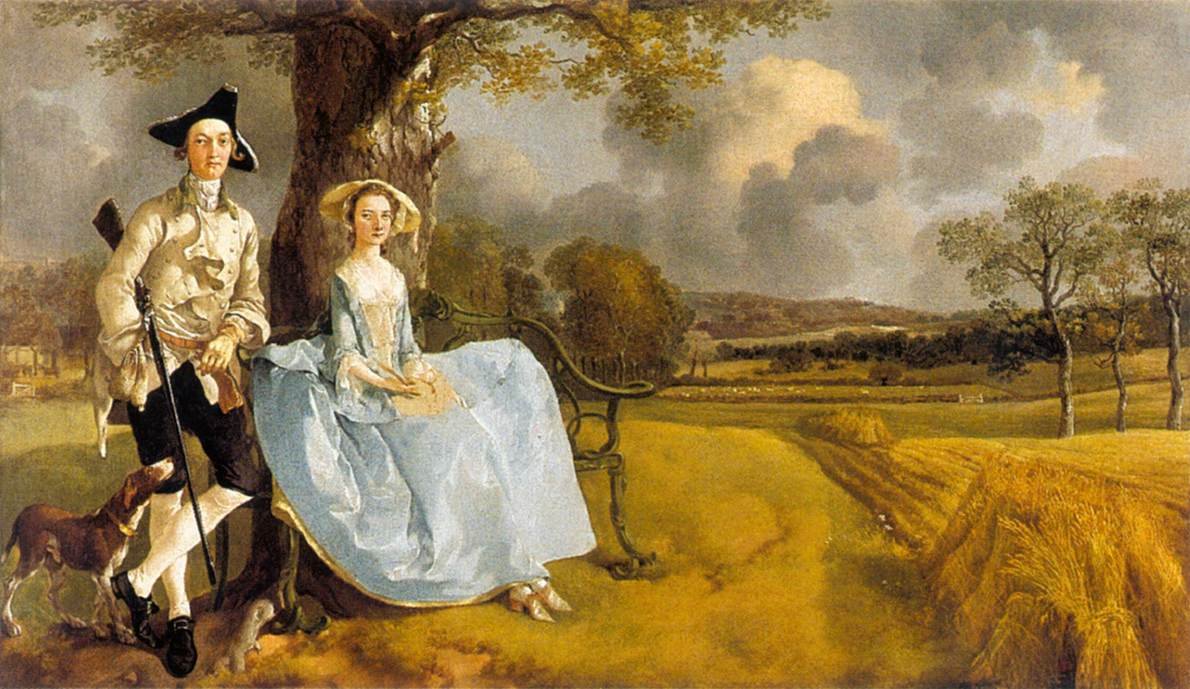
So that brings me nicely to today’s My Daily Art Display which is a portrait of a wealthy couple on their huge estate.  The portrait is simply entitled Mr and Mrs Andrews and was painted by the great English landscape and portrait Thomas Gainsborough in 1749.  This was one of Gainsborough’s earliest portraits.  The subjects of the painting are the English country squire, Robert Andrews and his wife Frances Mary, née Carter who he had married a year earlier and this work by Gainsborough was commissioned to celebrate the marriage.    Both bride and bridegroom came from wealthy families.  Robert’s family owned land on the Essex-Sussex border around the town of Bulmer.  Frances was the daughter of William Carter a wealthy cloth merchant who owned a large estate in the parish of Bulmer and the joining in matrimony of the two meant the coming together of two large estates.  This is a portrait, which not only celebrates the coming together of the young lovers, but demonstrates that this union has brought about the considerable wealth of property they now jointly owned.

This delightful portrait of the pair posing on their country estate in the summer sunshine is full of charm.  The church in the background is St Peter’s, Sudbury, and the tower to the left is that of Lavenham church. The gold and green of their fertile fields and their well-kept estate is beautifully painted.  It is interesting to note that this type of portraiture was known as “outdoor conversation pieces”.  The term was given to portraits showing two or more full length figures engaged in conversation or other polite social activity and were generally part of a domestic or landscape painting.  This idea of having a country scene as a backdrop to a portrait probably came from the French and their fêtes galantes, which was a French term used to describe a type of painting which first came to prominence with Antoine Watteau but unlike outdoor conversation pieces, they normally featured fictional characters.

Let us now have a close look at the painting.  The first thing that strikes me is that although it is a portrait, the landscape take up more than half of the space of this oil on canvas painting.  Maybe the couple wanted to subtly highlight their wealth by having their vast estate featured as a backdrop to their portrait.  This you must remember is not an idealistic landscape concocted to enhance the painting.  This is the real thing.  This is their own estate which was a joining together of the two lands of their parents.  This vast estate was now a celebration of their union.

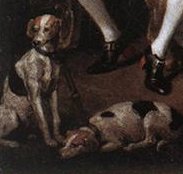
Robert Andrews stands straight.  His faithful gun-dog at his side looking lovingly up at his Master.   There is an air of relaxed nonchalance about his pose.  He looks to have “not a care in the world”.  His hand is in his pocket but even so it is a somewhat formal pose.  His frock-coat is unbuttoned at the top and by the way he holds his hunting gun under his arm, is to have us believe he has just returned from a shoot.  He is, by depiction, one of the landed gentry and the way he is at ease shows he is happy to show off his good fortune and his possessions, namely his large estate and of course, his wife.  We can have no doubt of his standing in society.  His character and future are like the well established oak tree which they shelter under – solid.  It is easy for us to understand that his wife will want for nothing

The genteel Mrs Andrews sits primly next to her husband on an ornate Rococo-style bench.  She was about eighteen at the time of this portrait.  She is dressed in her finest clothes and her demeanour, like that of her husband, oozes wealth and respectability.  She, in some ways, appears doll-like in her bright blue hooped skirt and pointed silver-coloured shoes.  I am sure the couple didn’t pose for the artist in the fields of their estate and this painting is likely to have been carried out in the artist’s studio and Gainsborough may have used tailor’s dummies to hang their clothes on and then later gone out to study the landscape of their estate.  Still I am sure the couple were happy with this work of art and it would have pleased them to see how it portrays them and their land.  There has been some conjecture as to whether the original intention was to have Mrs Andrews hold a book or maybe a brace of pheasants which her husband had just shot as there seems to be a space on her lap left unfilled.  It was also surmised that the space was left empty in order that, at a later date, one of her children may have been added, sitting on her lap.

So the couple had everything.  Sadly however, after giving her husband nine children, Mary Andrews died at the relatively young age of forty-eight.  Robert Andrews went on to re-marry and lived a long life surviving to the good old age of eighty.  They now rest together, side by side, in the graveyard of Saint Andrews in Bulmer.

The Four Elements: Fire by Joachim Beuckelaer

The Four Elements: Fire by Joachim Beuckelaer

My Daily Art Display offering for today is the fourth and final painting in Joachim Beuckelaer’s set of pictures, which he painted in 1569-1570 entitled The Four Elements.   Today’s painting is entitled The Four Elements: Fire.  The Ancient Greeks believed that the cosmos was made up of four elements, namely, Earth, Air, Fire and Water and thus the reasoning behind the artist’s four-picture set.   The painting today moves away from the market stalls where we saw women buying vegetables, poultry and fish and that were featured in the previous three works of art.  Instead, today we move to a kitchen scene in which the produce that has been bought at the various market stalls will be cooked.  To do the cooking one needs fire, hence the subtitle to this painting.

This painting, like the other three was completed in Beuckelaer’s studio for an Italian patron.  This genre of painting was very popular with the local populace.  The abundance of food in the paintings did not mirror life in the Netherlands at the time as the locals lived under the oppressive regime of the Duke of Alba, a Spanish general who was the governor of the Spanish Netherlands and who was renowned for his cruelty and atrocities against the Flemish and Dutch people.

We look at the kitchen scene from a slightly elevated position.  This is a busy kitchen.   Probably more than just busy, I think it borders on disarray, almost chaos by the look at the tumbling kitchen bowls in the centre of the composition.   Whilst the women are hard at work, the only male in the picture, who is probably a servant or steward drinks to excess and if not careful will end up in the fire!  The two women with him seem less than amused at his antics.  Beuckelaer’s forte is his still life paintings.  Look carefully at the produce.  See how he has exquisitely painted the various dead poultry and the sides of ham.  No detail has been spared.  Look at the way he has painted the earthenware kitchen utensils, some glistening in the sunlight which streams through the kitchen window.

On the floor we can see mussel shells.  These sometimes have erotic connotations when seen in paintings.  However there may be another meaning to the scattering of these shells in the kitchen scene.  The Dutch Golden Age painter of allegories, Adriaen van de Venne said that because mussels stay in their shells they “can be compared to the blessed women-folk who speak modestly and virtuously and always look after their household.   So maybe Beuckelaer’s inclusion of the shells on the floor was a tribute to the hard working women in his kitchen scene.

Jesus at the house of Martha and Mary

Finally if you look through the door on the left-hand side, you can see another kitchen scene.  This is the Biblical story which Beuckelaer has introduced into each of his four paintings.  This scene is set in the kitchen of the house of Mary and her sister Martha in which we see Jesus who has come to visit them.  The story according to the Bible is that Martha complains to Jesus that although she is working hard in the kitchen, all Mary does is stand around listening to his words.  Jesus reproached her saying that Mary’s contemplation was in fact a more important form of her work.

This biblical story was often told to servants in the sixteenth century with sole purpose of stopping them complaining about the amount of servile work they had to carry out.  I am not sure that this “parable” would find much favour in present day workers!

So now you have seen all four paintings in The Four Elements set.  Some may think the colours rather garish and the scenes at the produce stalls and in the kitchen somewhat chaotic but this painting genre was very popular at the time of Beuckelaer and to be honest I find them both fascinating and of great quality.

The Four Elements: Air by Joachim Beuckelaer

The Four Elements: Air by Joachim Beucklaer (1570)

Over the last few days I have featured the set of four paintings by the Flemish artist Joachim Beuckelaer entitled The Four Elements.  On the first day the painting was subtitled “Water” and yesterday the subtitle of the painting was “Earth”.  Today I am featuring the third painting of the set with the subtitle “Air”  which was painted in 1570.

In the “Water” painting we were shown a fish market and the connection with the Element of Water was that of the habitat of the food.  The same went for the “Earth” painting when we saw the fruits and vegetables of the earth.  Today with the subject “Air” we are treated to the sight of the “food” which occupies the air above ground, namely birds, fowl and rabbits.  We are also treated to the sight of products which come indirectly from the land such as eggs and cheeses.  We are at a poultry market and there is an abundance of food on offer.  During Beuckelaer’s lifetime he painted numerous “market scenes” and at that time the art market was flooded with such a genre.  Unfortunately for the artist once the art market became saturated with such paintings their value declined and the real value of Beuckelaer’s work did not become apparent until after his death.

In the painting we see the rosy-cheeked stall holder sitting alongside the produce.  It is a well-stocked market stall with a variety of dead fowl and small birds.  We can also see inside a green wicker cage some live hens.  The man at the stall, wearing the leather jerkin, has hold of a hen by its feet having just taken it out of the cage to show it to a would-be purchaser.  To the left we observe a well dressed woman.  She too is holding a hen in her right hand whilst her left hand rests atop a copper flagon which may contain milk or wine.

In the central background we see a road leading to the sea with a small cargo boat just setting sail with the crewman starting to hoist the sails.  On the quay we can just make out some barrels which have been off-loaded from the craft.

The Prodigal Son

So where is the Biblical story, which the artist is known to have incorporated into each of the four paintings?   In this painting it is not as obvious.  If however you concentrate on this road leading to the sea you will spot on the left hand side just behind some baskets of produce a man and a woman.  She has her hand on his arm greeting him.  He is leaning backwards against her, almost slumped.  This was the Biblical addition of the painting by Beuckelaer, symbolising the Prodigal Son returning home.  To me it seems as if he is inebriated and has just about made back home!

Once again we have before us a very colourful painting, full of activity.  I get great pleasure looking around the painting at the various charactyers and their expressions and try and work out what is happening and what the artist had in his mind as he put paintbrush to canvas.

To get a much better view of this painting I suggest you try the National Gallery Website (below) and then you can zoom in on aspects of the painting.  The website is:

http://www.nationalgallery.org.uk/paintings/joachim-beuckelaer-the-four-elements-air

The Four Elements: Earth by Joachim Beuckelaer

The Four Elements Earth by Joachim Beuckelaer (1569)

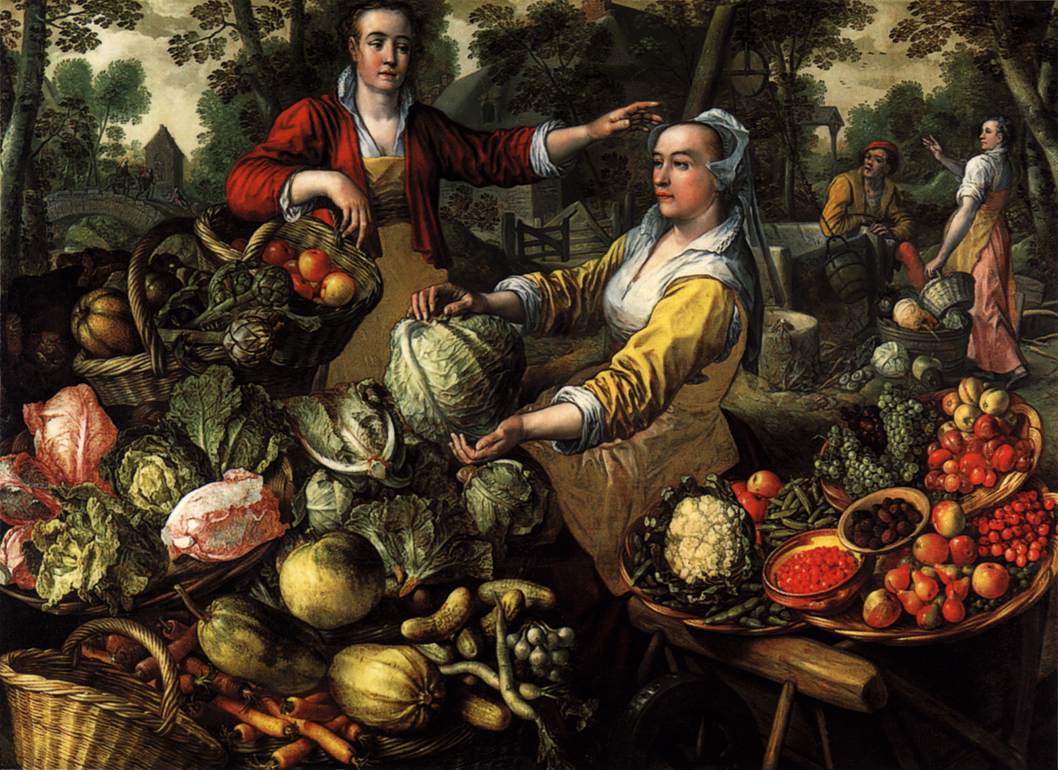
Today I am featuring the second of a set of four paintings entitled The Four Elements.  This painting completed by Joachim Buckelaer in 1569 is entitled The Four Elements: Earth.  In this painting we are again standing in front of a market stall.   This time the scene is set in the countryside, outside a large thatched-roof farmhouse, and before us we can see laid out an abundance of fruit and vegetables, symbolising “Earth” as this is where the produce has come from.  It was common practice in Dutch and Flemish paintings of the 16th and 17th century to symbolise the Elements by reference to the natural world.  Although I have not attempted to count them, I believe there are sixteen different varieties of fruit and vegetables on display in the painting.  The painter has used some “artistic licence” when he painted the various fruit and vegetables as not all would be available at the same time of year and of course there was no such thing as refrigeration in the seventeenth century.  It is truly a depiction of a “land of plenty” where there is no place for hunger.

The spectrum of colours used by the artist has enhanced the painting.  The fruit is painted with such realism.  They look so succulent and they lay there tilted slightly towards us to give us an even better view of everything and tempt us to try some of the produce.   You almost want to move forward and pick a grape or sample a mulberry.  All seems so mouth-watering which is a testament to the artist’s great ability to paint still-life subjects.

It is difficult to decide who are the buyers and who are the sellers in the painting.  Before us, we have the two young females in their colourful attire.  The lady in the red jacket with her sleeves rolled up has rosy cheeks which has probably come from working outside so much.  The lady with the lace cap and yellow sleeved dress would seem to be dressed slightly better than the others and may hold the position of head cook in a wealthy household who has come down to choose the best produce for the ingredients needed for the meals she is about to prepare.  I love the way the way Beuckelaer depicts the vegetables tumbling from her hands.  It makes you almost want to rush forward and catch the errant cabbage before it hits the ground.  To the right of the main figures we see a young man and woman by a well and one wonders if they are the stall holders who use the water from the well to wash the fruit before putting it on display.  The man stares out at us with his elbow on the edge of the well as he takes a rest.

Mary and Joseph crossing the bridge.

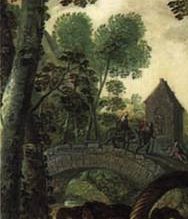
Once again the artist has included a scene from the bible into the painting.  Look to the left background and you can see in the distance, a small arched bridge, on which Mary and Joseph are crossing.  Joseph leads the way on foot guiding the mule on which sits Mary with the infant Jesus and is a portrayal of the Holy Family’s Flight into Egypt to avoid the clutches of King Herod.

I love this painting and I love how Beuckelaer has painted the produce.  It is so life-like.  The colours he has used enhance the painting and make it look so real.

The Four Elements: Water by Joachim Beuckelaer

The Four Elements: Water by Joachim Beuckelaer (1569)

Over the next four days I want to show you a set of four paintings by the Flemish painter Joachim Beuckelaer.  His favoured painting genres were still lifes and market and kitchen scenes.  Beuckelaer was born in Antwerp in 1533 and was the nephew of Pieter Aertsen the Dutch historical painter whom he trained under.  By his late twenties Beucklaer was a master painter in his own right although a number of his paintings were based on themes used by Aertsen, the general opinion was that the standard of the former pupil’s work was greater than that of his master.  Both Aersten and Beuckelaer were renowned for their paintings depicting scenes from inside a kitchen and of scenes at the market both of which always included many still-life depictions of food.  As is the case of my featured paintings over the following days, Beuckelaer would also include a relevant biblical subject within the painting of domestic life and maybe it was intention to compare the stress of physical life on this earth and spiritual life.  It is interesting to note that the religious subject in each painting is consigned to the background of each work of art.
The set of paintings I am featuring over the next few days is entitled The Four Elements,  which Beuckelaer painted between 1569 and 1570 and they take as their theme the four classical elements of Earth,  Water,  Air and Fire.  It is thought that the set of paintings  were destined for an Italian patron.
Today I am featuring The Four Elements: Water, which was completed by Beuckelaer in 1569.  Here in front of us is a scene at a fish market.  The artist has depicted twelve different identifiable varieties of fish.  Some art historians believe that the twelve represent the twelve disciples.  It is thought that he was the first painter to depict the market fish stalls at Antwerp.  Before us we gaze at the stall holders and we start to feel a little uncomfortable with the way they stare out at us.  The older lady to the left has a resigned expression on her face as if it is “just another day selling fish”.  She is not smiling.  She looks tired as she holds out the tray of fish for us to examine.  The man to the right, who maybe her son, rests his right hand on a trestle table as he proudly shows us the underbelly of a large fish.  It is interesting to look at the left background and see how Beuckelaer has used steep perspective in the way he depicts the bustling street going off into the distance.

However what is more fascinating and in some ways more bizarre is what we see though the central arch in the background.  This is not part of the landscape to the rear of the fish market but is in fact a scene from the bible.  It is the time when Christ appeared to the disciples.  This was the third sighting of Christ since the Resurrection and the scene is based on the Gospel by Luke 5: 1-11, in which we are told that Jesus told the despondent fishermen, including Simon Peter, who were washing their nets after a fruitless days fishing, to “put out to the deep water and once again let down their nets”.  Peter questioned the merit of this advice but did so and they caught innumerable fish and this has been referred to as the Miracle of the Fishermen.

This is a picture, which has a wonderful array of colours , fascinating characters and  along with the other three works makes for a beautiful set of paintings.