
Part 1. The Beginning – America and Germany
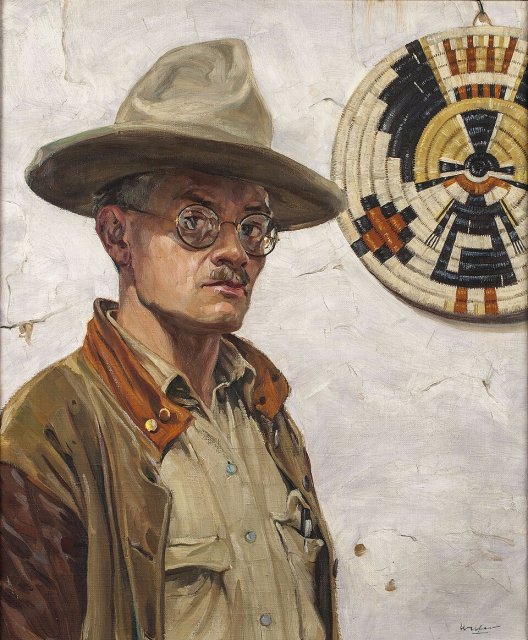
Self portrait by Walter Ufer (1920)
In the next two blogs I am going to look at an artist and his work, who started life in Germany, emigrated to America with his family where his artistic journey began. He returned to Germany for a few years before returning to New York and Chicago. In the second part of the blog we follow his journey to the American Wild West where he spent the rest of his life. Let me introduce you to Walter Ufer.
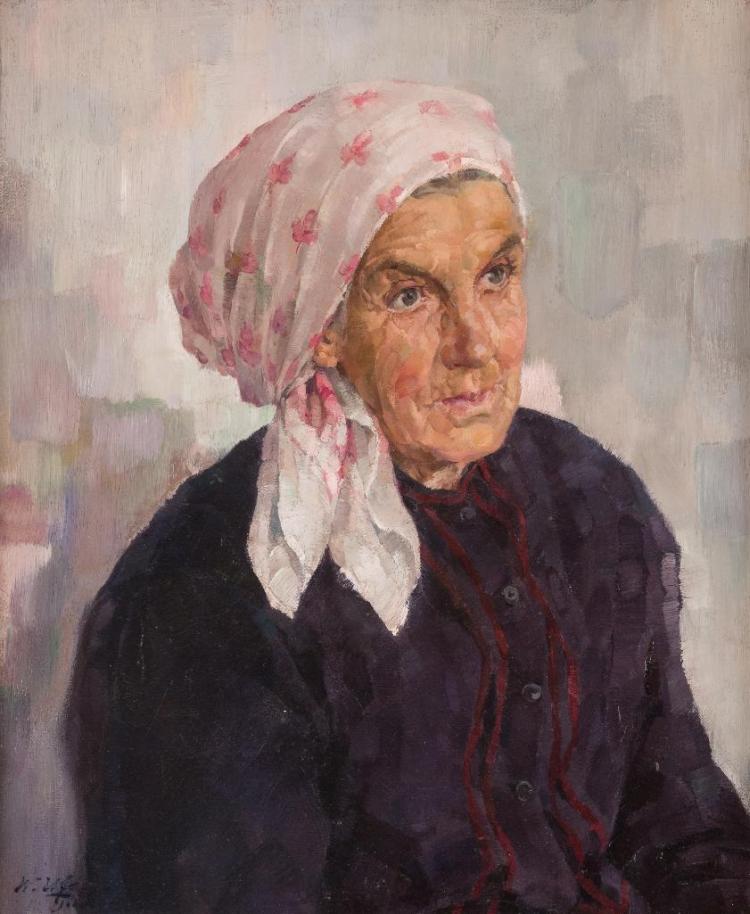
French Peasant Woman by Walter Ufer
Walter Ufer was born on July 22nd, 1876, in Hückeswagen, in North Rhine-Westphalia, Germany, four years before his parents, Peter, who was an metal engraver of hunting scenes and carver of meerschaum pipes. His wife, the former Alvina Meuser, along with Walter and their sons crossed the Atlantic in search of a new life in 1880. His parents and his older brother Otto had headed for the Kentucky city of Louisville hoping to achieve a better life for the family. In 1881 a year after arriving in America, Alvina gave birth to a third child, Herman. Life proved difficult as his father failed to find a market for his work in Louisville and so, to make ends meet, he turned to carving furniture and, appropriately for a community relying heavily on the tobacco industry, corncob pipes. Eventually, he established himself, making fishing reels, while developing a talent for engraving metalic gun stocks, an occupation he practiced until his death.
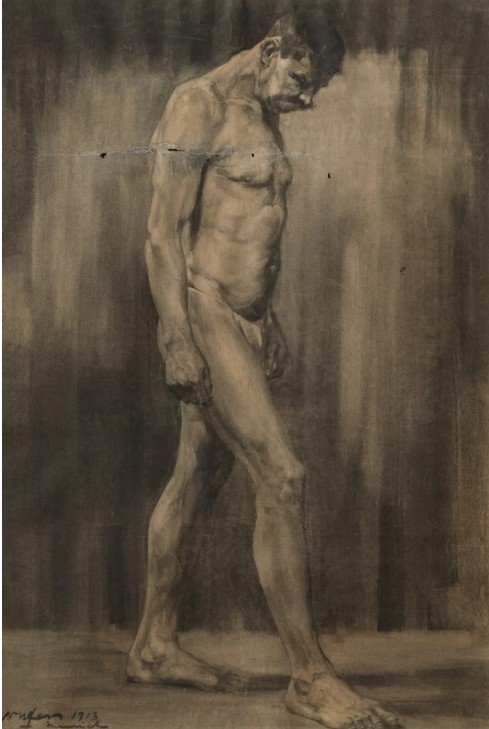
Academic figure drawing by Walter Ufer (1913)
Walter Ufer, whilst growing up, was a child who suffered many illnesses, nevertheless, he had to work to help with the family finances. He sold newspapers and, at age twelve, and later earned money by lighting gas lamps on the streets of Louisville. As a teenager, his father, taught Walter the art of engraving, and the headmaster of his Fourth Ward Grammar School in Louisville encouraged him to pursue art. Walter enjoyed sketching and painting and would often give his classmates pictures of plants, birds, animals, and maps he had drawn.

Old Munich by Walter Ufer
At sixteen, Walter Ufer became an apprentice to Johann Juergens, an engraver for the Courier Journal Job Printing Company, one of Louisville’s major lithographic firms. There he learned the craft of lithography and, importantly, design, on the job as well as receiving private tutelage three nights a week in Juergens’s home.
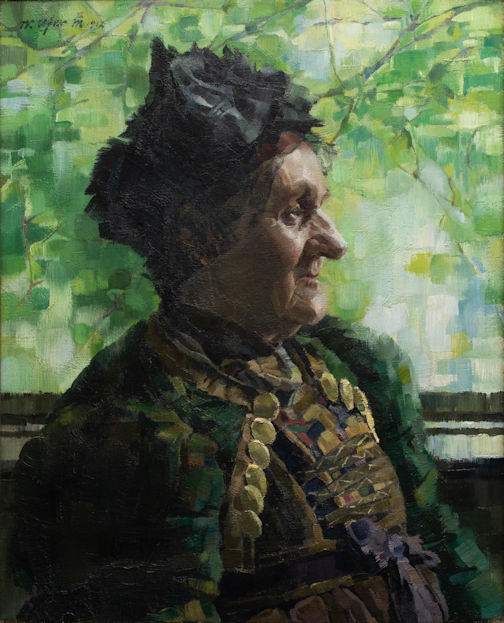
Woman from Dachau by Walter Ufer (1912)
In 1893, seventeen-year-old Ufer travelled for the first time to Chicago in order to catch a glimpse of “real art” at the World’s Colombian Exposition. Walter was mesmerised by sculptures, paintings, drawings, and engravings, which filled eighty galleries and over a hundred alcoves. Depictions varied from domestic and historical, landscapes, portraits, still lives, mythological and religious. This visual profusion of art excited him and he knew his future lay in the world of art and he believed that Chicago was the place to be for his future artistic career.
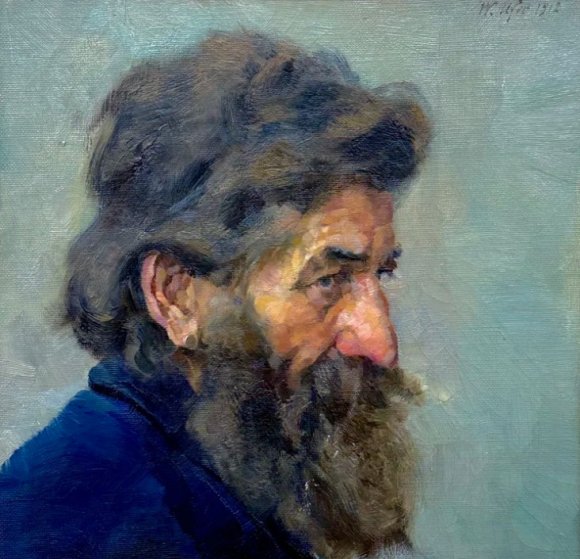
Portrait of a Man by Walter Ufer (1912)
And yet Walter Ufer was drawn to Europe and this coincided with Johann Juergens opening his own lithographic firm, Langebartels and Juergens Lithographers, in Hamburg and he was looking for a hardworking young man to work there. The position was offered to Walter Ufer who jumped at the chance to travel to Europe and on November 2nd 1893 seventeen-years-old Walter crossed the Atlantic on the liner SS. Columbia.
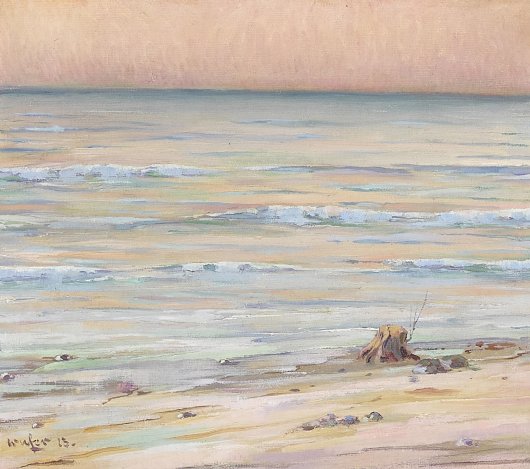
One October Evening by Walter Ufer (1913)
His work as an apprentice lithographer and typesetter in Hamburg, allowed him to gain practical skills in graphic arts. He would also study in the evenings at the Hamburg Applied Art School. It is thought that this early introduction to printmaking techniques influenced his later strong sense of design and composition in his artwork but his real desire was to have a future in fine art, and so he embarked on more formal academic instruction in art which led him to Dresden and the city’s Royal Academy of Fine Art. Alas, Ufer’s three-year stay at the Royal Academy ended when he ran out of money and his mother persuaded him to return home. He hated being forced to return but he managed to get a position as an engraver at the Louisville Courier Journal where Walter remained for two years.
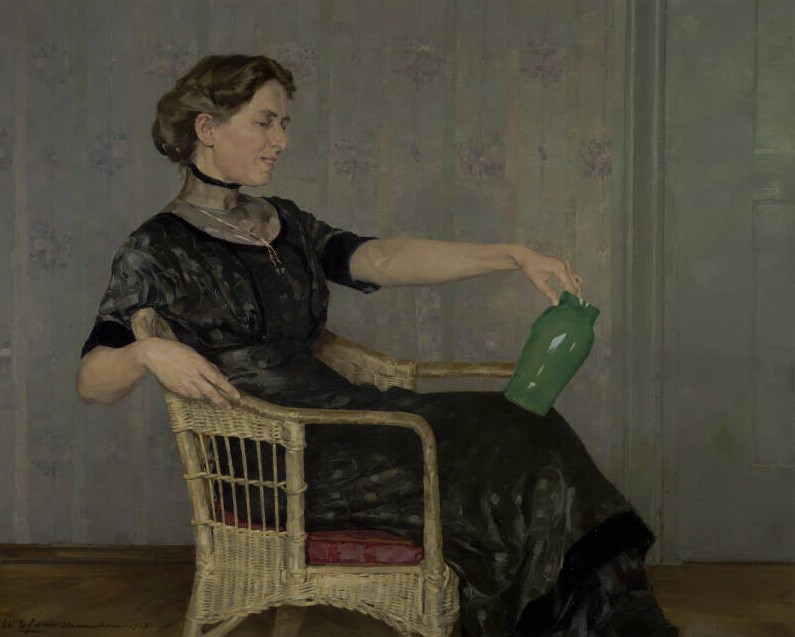
Portrait of Mary (1913)
By 1900, Ufer had had enough of Louisville and returned to Chicago where he found employment as a commercial designer at Barnes-Crosby Company during the day and still allowing him time in the evenings to attend the Francis J. Smith School which was affiliated with the Académie Julien in Paris. In 1904, Walter became an art instructor at the school where a mutual friend introduced him to student, Mary Monrad Frederiksen. Friendship turned to love and on April 26th, 1906, twenty-nine-year-old Walter Ufer married his thirty-six-year-old bride. Was it true love ? It was a strange coupling as Mary was a woman who came from a socially and culturally prominent background while Walter came from a working-class upbringing, and a man who was said to have an ill-temper. Was Walter happy with the marriage or was there some doubt in Ufer’s mind as he began to look upon his wife not as an asset and supporter but as someone who would stand in the way of his artistic development. He once wrote about his misgivings:
“…I was falling in love. Gracious this wouldn’t do — I wanted to get to Europe again. Terrible battles went on within me. I wanted to tell her this, yet I didn’t have the nerve to do it. This was agony …. I wanted to tell her …. that I only wanted to paint …. I admitted to myself that I loved her — but my career — Gone to Hell…!
In 1911 the Walter and his wife returned to Germany and the city of Munich where he resumed his artistic studies at the city’s Academy of Fine Arts, and here he studied under the German painter and illustrator, Walter Thor. Two years later, in July 1913, Walter Ufer went back to America on the SS Kaiser Franz Joseph I. He travelled alone having persuaded his wife to go and live with her mother in Denmark until he had got settled in America. Maybe he believed he needed to establish himself in the art world of Chicago before she joined him or maybe it is all about how he believed his wife was becoming burdensome and affecting his artistic output but whatever the reason he and Mary lived apart for the next six months.
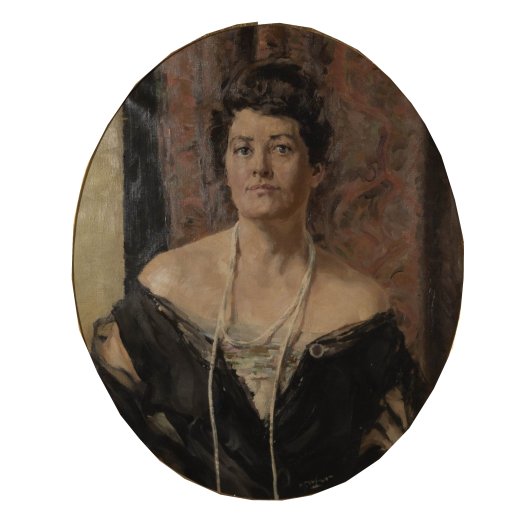
Portrait of Mrs Walter Wardrop by Walter Ufer (1916) Mrs. Walter Wardrop (Harriet Sullivan Wardrop) was born in Chicago in 1872 to Irish immigrants. In 1895 she married Walter Wardrop, who began his career in the bicycle industry and eventually became a publisher and authority on commercial vehicles in the early days of motoring.
Walter Ufer disembarked at New York and set about trying to sell his paintings, many of which he had completed whilst in Europe. According to his biographer Stephen Good, Ufer hung up a number of his paintings at the Artists Packing and Shipping Company premises and then invited a number of well-known art dealers to attend and view his work. It didn’t work out for Ufer as these dealers were looking for work by established painters and were not interested in a thirty-seven-year-old painter who had spent much of his professional career in Germany’s academies. Ufer was upset at their lack of interest for his work.
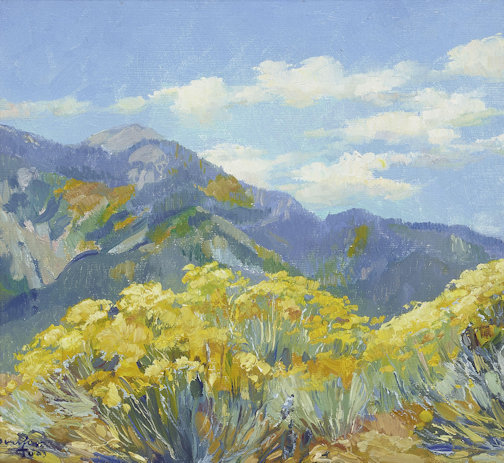
Taos Peak by Walter Ufer (1914)
Ufer left New York and returned to Chicago, leasing a studio in the Beil Atelier Building at 19 East Pearson Street for $50 a month. In 1913, he submitted some of his work to the jury of the Chicago Art Institute’s exhibition, but all were rejected. This and the lack of sales for his work depressed Ufer and suddenly he was starting to question his own ability and although his wife continued to offer support, he would not invite her to join him in America. Mary eventually returned to Chicago in February of 1914, and her husband’s fortunes began to recover and, in that year, Ufer finally had four of his paintings (Old Munich, Portrait, Munich Au, and Coletta) accepted in that year’s Art Institute Exhibition. Ufer still had to gain financial security, and his wife advised him to paint portraits of the Chicago wealthy dignitaries and for once he heeded her advice. It was taking his wife’s advice and visiting the Chicago mayor to offer to paint his portrait that would change his whole life
………to be continued.
Most of the details for this blog came from two excellent websites:
Walter Ufer (1876-1936) Essay by Dean Porter, Ph.D. © Illinois Historical Art Project

 my daily art display