During a period of very low temperatures and snowy conditions, it might seem appropriate to focus on art depicting sunshine, blue skies, and warm azure-coloured seas. However, today’s blog will start with featuring beautiful depictions of snow and ice and explore how people who experienced these conditions seemed to find enjoyment in them. Many such depictions are conjured up by nineteenth century Dutch artists and today’s blog is all about Fredrik Marinus Kruseman the Dutch painter who specialized in Romantic-style landscapes, and winter scenes, which made up about two thirds of his oeuvre.
Fredrik Kruseman was born in the Netherlands city of Haarlem on July 12th, 1816. He was the fourth son of Jacoba Mooij and her husband Benjamin Philip Kruseman, a Lutheran hat-maker. Fredrik had two older brothers, Hendrik and Jakob and a younger brother Benjamin. He also had two cousins who became famous painters. Cornelis Kruseman a painter of historical and biblical subjects who later became Director of the Royal Academy of Fine Arts of Amsterdam and Jan Adam Kruseman, a historical painter and portraitist.
A Winter’s Scene with Skaters on a Frozen Waterway by Fredrik Kruser (1858)
Fredrik was tutored by many of the great Dutch landscape artists of the nineteenth century school. In 1833, aged seventeen, he was apprenticed to Jan Reekers who taught him the skills required to draw from nature and the intricacies of perspective. Between 1832 and 1833 he also attended classes at the Vocational City Drawing School in Haarlem and studied painting with Nicholas Roosenboom, who had a studio near where Fredrik lived. It was in September 1833 that Fredrik Kruseman first exhibited his landscape work. It was at the Exhibition for Living Masters in The Hague. In 1835, Fredrik moved to the Gooi, an area around Hilversum, in the centre of the Netherlands. Here he took advanced studies with Jan van Ravenswaay. He also studied briefly with the landscape painter, Barend Cornelis Koekkoek.
During his twenties and thirties, Kruseman travelled widely throughout Northern Europe before finally setting up home in Brussels in 1841. He returned to the Netherlands and lived, between 1852 and 1856, on the outskirts of Haarlem. After that four-year sojourn he returned to the Belgian capital where he remained for the rest of his life.
Winter Landscape with Skaters and Wood Gatherers at a Ruinby Fredrik Kruseman
Kruseman’s 1845 painting entitled Winter Landscape with Skaters and Wood Gatherers at a Ruin depicts a frozen canal with skaters, walkers on a path along the shore, a picturesque castle and strange bare trees. Men scavenge for wood for their home fires. Life is hard at this time of year.
A Winter Landscape with Skaters on a Frozen Riverby Fredrik Kruseman (1862)
Kruseman’s painting entitled A Winter Landscape with Skaters on a Frozen River is a beautiful depiction and is a Romantic observance and veneration of nature. The sky dominates the paintingfxf. Before us we have a frozen waterway on which are a number of skaters bordered by snow-covered banks. On the right bank there is a refreshment table. We can also pick out a fallen skater in the left of the foreground and a young couple with their dog crossing the centre of the frozen river close to a wide crack in the ice. In the left middle-ground we can just make out a sailing boat frozen to the riverbank. The colours Kruseman has used are cool blue-grey tonality over the black mirror-like surface of the ice.
Wintry River Landscape with Windmill by Fredrik Kruseman (1844)
Although Kruseman is best known for his Romantic wintry landscape paintings he completed many other landscape works.
Monk Meditating near a Ruin by Moonlight by Fredrik Kruseman (1862)
One notable romantic piece is his 1862 painting titled Monk Meditating near a Ruin by Moonlight. The ruin of the title is the abbey in Villers-la-Ville near Brussels, which used to be one of the most significant Cistercian abbeys in Europe and close to where the painter lived for a while. In the right foreground of this nocturnal scene, we see a monk meditating near the overgrown ruin. The abbey was founded in 1146 and was a former Cistercian Abbey located in the very heart of Walloon Brabant.
Village Street on a Sunny Day by Fredrik Kruseman (ca. 1835)
Landscape with two Farmers by Fredrik Kruseman
In the foreground of this atmospheric work, we see two peasants talking to each other. One holds on to his ox, while the other is accompanied by his dog. The background consists of a wide landscape with a few hills. Once again the sky plays a dominant part of the painting.
Tranquil Landscape with Women Washing by a Stream with Cattle and Sheep by Fredrik Kruseman
A River Landscape with Cows and Sheep by Fredrik Kruseman
In his winter scenes of frozen rivers, Fredrik Kruseman cleverly produced jet-black mirror surface of the ice and the marks left by skaters. Some of his most famous depictions were set in the fading light of early evening and combined the wintry scene with a background glow of a setting sun or a bright light emanating from the interior of a cottage or house.
Fredrik Marinus Kruseman worked well into the late 1870s and died in St Gilles, a suburb of Brussels, on May 25th 1882.
Max Liebermann was Jewish, not a strict Orthodox Jew, but more of a secular Jew who regarded himself through assimilationist eyes. Maybe because of this he avoided painting religious subjects with the exception of a painting he completed in 1879 entitled The 12-Year-Old Jesus in the Temple With the Scholars.
Der zwölfjährige Jesus im Tempel (The Twelve-year-old Jesus in the Temple) by Max Liebermann (1879)
The painting depicts twelve-year-old Jesus in the temple, having been at the Festival of Passover in Jerusalem with his parents, but unbeknown to them, he had stayed behind in the city when they had set off to return home. The story continues as per the biblical tale (Luke 2:43-48):
“…After the festival was over, while his parents were returning home, the boy Jesus stayed behind in Jerusalem, but they were unaware of it. Thinking he was in their company, they travelled on for a day. Then they began looking for him among their relatives and friends. When they did not find him, they went back to Jerusalem to look for him. After three days they found him in the temple courts, sitting among the teachers, listening to them and asking them questions. Everyone who heard him was amazed at his understanding and his answers. When his parents saw him, they were astonished. His mother said to him, “Son, why have you treated us like this? Your father and I have been anxiously searching for you…”
The setting for this painting is derived from Max’s visit to the Jewish quarter of Amsterdam in 1876 when he made architectural sketches of the Portuguese Synagogue of Amsterdam. The curved staircase, which he later depicted as a spiral staircase in the painting, is a reference to the 16th-century Levantine Synagogue in Venice. The paned window on the upper edge of the painting also echoes the windows of the Portuguese Synagogue of Amsterdam.
Liebermann originally depicted Jesus, not as a holy figure, but as a dark-haired boy with Semitic features and mannerisms, arguing the doctrine with his elders. The painting was first exhibited at the First International Art Show in Munich in 1879, at a time when antisemitic activism and propaganda was just starting to break out in Germany. The artwork caused a major outcry with critics terming the depiction blasphemous. The art critic for the Augsburger Allgemeine Zeitung, Friedrich Pecht, asserted that Liebermann had painted “the ugliest, know-it-all Jewish boy imaginable,” and went on to state that the artist had shown the Jewish elders as “a rabble of the filthiest haggling Jews.” More criticism rained down from upon high with the Crown Prince of Bavaria declaring that he was scandalised, and the Bavarian State Parliament even spent time debating the painting and Pecht’s comments. One Catholic MPs criticised the fact that it had been admitted into a State establishment knowing that the country had inhabitants who were overwhelmingly devout Christians. One deputy pronounced that Liebermann, being a Jew, should have known better than to paint such a scene and that the painting was reviled as “a stench in the nostrils of decent people” It seemed that Lieberman’s mistake was simply that as Liebermann was a Jew, he had depicted an overtly Jewish Jesus.
Preliminary Sketch
And yet in the painting we cannot understand the violent criticism of the detractors regarding Liebermann’s Jesus who is depicted as a long-haired, slightly effeminate, blond boy. However, this was not the original depiction as this is because Liebermann, in response to unrelenting criticism, repainted the figure before it was included in a Paris exhibition in 1884. Art historians know this as a sketch of the untouched 1879 version has been preserved, in which it can be seen that Liebermann had originally depicted a barefoot boy with short, unkempt dark hair and a stereotypical Jewish profile. Liebermann changed the young Jesus’s appearance with the figure once described as an “urchin” now appears as a serious, intelligent, perhaps slightly deferential child. However, the changes, did not change the mood of the German critics and the work was not exhibited again in Germany until the Berlin Secession exhibition of 1907.
Sewing School by Max Liebermann (1876)
In 1875 Liebermann left Paris and spent three months in Zandvoort in Holland. It was in this Dutch town that Max acquired a brighter and more less planned style by copying paintings by one of his favourite artists, Frans Hals. Max developed a practice of setting aside time between the idea for a motif coming to him and the implementation of the larger finished painting. When he returned to Paris in the autumn of 1875 he moved into a more spacious studio and began to convert his Dutch sketches into full sized works. He returned to the Netherlands in the summer of 1876 where he remained for several months. During this stay he met the etcher William Unger, who brought him into contact with Jozef Israëls and the Hague School. One example of this change of painting style was Liebermann’s work entitled Sewing School which he completed in 1876. The sewing school depicted in this painting was in an orphanage in Amsterdam. Liebermann had started his career as a realist painter, but by the time of this work, he was already establishing himself as an Impressionist-style painter.
Schusterwerkstatt (Cobbler’s Workshop) by Max Liebermann (1881)
During his visit to the Netherlands in the summer of 1880, Liebermann travelled to the small village of Dongen in North Brabant, in the southern Netherlands. It was here that he made a number of studies that would be used when completing the work in his studio. One example of this was his depiction of a cobbler in his workshop. At the workshop, he created studies that he later used for his 1881 painting Schusterwerkstatt, (Cobbler’s Workshop).
Altmännerhaus (Old Men’s Home) in Amsterdam by Max Liebermann (1881)
Having completed the Cobbler’s Workshop painting he travelled to Amsterdam on his way to returning to Munich. It was whilst in Amsterdam that he came across the Catholic Altmännerhaus (Old Men’s Home). He happened to glance into the garden of the establishment and saw a large group of older gentlemen dressed in black sitting on benches in the dappled sunlight. According to Erich Hancke’s 1914 book, Max Liebermann. Sein Leben und seine Werke:
“…He [Liebermann] had visited a friend at the Rembrandt Hotel, and when he looked out of the corridor window descending the stairs, his gaze fell down into a garden where many old men dressed in black were standing and sitting in a corridor bathed in sunlight […]. He later used a drastic analogy to characterize that moment: ‘It was as if someone were walking on a level path and suddenly stepped on a spiral spring that shot him up…”
Study for Old Men’s Home in Amsterdamby Max Liebermann (1881)
Liebermann immediately began to paint the scene and concentrated on the effect of light which was being filtered through a canopy of leaves and this dappled effect became known as “Liebermann’s sunspots” and would be seen in Liebermann’s later Impressionist depictions. He made two on-site portrait-format studies of the scene, one in oil and one in pastel, after which Liebermann painted the final picture in his Munich studio later that year. The painting was exhibited at the Paris Salon and received an honourable mention. Furthermore, Léon Maître, a well-known collector of Impressionism, acquired several of Liebermann’s paintings.
Recreation Time in the Amsterdam Orphanage by Max Liebermann (1884)
Life in Paris was taking its toll on Liebermann. He needed to sell his artwork to prove to himself and his parents that he had not wasted his life. This continual pressure caused Lieberman to fall into periods of deep depression and his painting output declined, furthermore, the works he put into the Paris Salon were not getting the recognition he believed he had deserved. There was also still the anti-Prussian sentiment amongst the French and this did not help him sell his work. In all, he realised that the Netherlands or Germany were much more acceptable places to work and live. He left Paris and spent a couple of months in Venice before returning to Munich in 1878. It was here that he was able to enhance his status as an important progressive artist. Munich had everything Liebermann required – the artistic culture and patrons who supported him. He spent hours visiting the city’s museums and art galleries and creating everlasting and important friendships. He eventually left Munich and relocated to Berlin, his birthplace, in 1884, where he remained for the rest of his life.
Martha Marckwald by Anders Zorn (1896)
In that same year, 1884, that Max moved to Berlin he married Martha Marckwald, the fourth child of the German Jewish couple Ottilie and Heinrich Benjamin Marckwald, who ran a wool store in Berlin. When Martha’s father died in 1870, Max’s father Louis became the thirteen-year-old Martha’s guardian. The Marckwald and Liebermann families became even closer when Max’s elder brother Georg Liebermann married Martha’s elder sister Elsbeth. On September 14th 1884, thirty-seven-year-old Max Liebermann married twenty-six-year-old Martha. It was a marriage that would last more than fifty years until Max died in 1935. In August 1885 Max and Martha’s only child, Käthe, was born and in 1892.
Max’s mother died on August 12th 1892, aged 70 and his father died two years later on April 29th 1894, aged 75. Although the death of his parents was a sad time for Max, he was finally released from their unrelenting words of warning as to the perilous status of an artist. Max moved into his family’s Berlin home in Pariser Platz where he lived out the remainder of his life.
Liebermann Villa at Wannsee
In 1909, overwhelmed by the noisy life in the German city, the Liebermann family bought a plot of land in the Alsen summer villa colony on the northern shore of the Kleiner and western shore of the Großer Wannsee at Wannsee, some twenty kms south-west of Berlin, close to Potsdam. It was here that they built themselves a summer home, somewhere to retire to during the hot summer months when city life became very oppressive. The Villa was designed by the architect Paul Otto Baumgarten, the garden by Liebermann in collaboration with the then-director of the Hamburger Kunsthalle, Alfred Lichtwark.
Martha Liebermann in the garden at Wannsee
Their summer home was situated amidst the magnificent villas of this impressive Berlin colony, embedded in a park, and represented a unique cultural landscape of the time of the German Empire and the Weimar Republic.
The Villa at Wannsee by Max Liebermann (1930)
Flowering Shrubs by the Gardner’s Cottage by Max Liebermann (1928)
The Flower Terrace at Wannsee by Max Liebermann (1915)
During the following years, Liebermann had designed a beautiful garden at the Villa Wannsee. He was so proud of the finishing results that the garden became the subject of many of Liebermann’s painting.
The Artist in His Studio by Max Liebermann (1932)
During the latter decade of the nineteenth century Liebermann continued living and painting in Berlin and would spend his summers at Wannsee or the Netherlands. Liebermann, like many of his contemporary Berlin artists, were dissatisfied with how they were being treated by the Association of Berlin Artists and the restrictions on contemporary art imposed by Kaiser Wilhelm II, so sixty-five of them seceded as a demonstration against the standards set by the Association and the government endorsed art. This break-away became known as the Berlin Secession and its aim was to form a “free association for the organization of artistic exhibitions”. In 1898, Liebermann became the President of the Berlin Secession, which was simply a group of artists that was formed as an alternative to the conservative arts establishment.
Two Riders on the Beach by Max Liebermann (1901)
The Berlin Secession championed new forms of modern art and were not be tied down to and be dominated by the old-fashioned academic art favoured by the Berlin Academy. These break-away groups from the art establishments were not new occurrences as the same happened with the Munich Secession in 1892 and the Vienna Secession in 1897. The initial breakaway took place in Paris in 1890 when the Société Nationale des Beaux-Arts along with its exhibition arm, the Salon au Champs-de-Mars, was formed as a modern alternative to the official Société des Artistes Français and its exhibition arm, the Salon de Champs-Élysées. These break-away groups all wanted the same thing – the rejection of the official arts governing bodies due to their aversion of avant-garde art such as Impressionism, forms of Post-Impressionist painting and Naturalism, as well as their obstructive exhibition policies, which were inclined to support time-honoured painters and sculptors over their younger, more modernist contemporaries.
Marthe Liebermann with her grand-daughter Maria by Max Liebermann (1922)
In 1920, Liebermann became president of the Prussian Academy of Arts in Berlin, which was the highpoint of his career and signified how the Academy had changed over since the time of the Berlin Secession.
Portrait of President Paul von Hindenburg by Max Liebermann (1927)
Being a Jew, Liebermann had got used to the anti-Semitism in his homeland but by the early 30s with the rise and coming to power of the National Socialists it had noticeably worsened. In a way, it was a good thing that Liebermann died quietly in his sleep at the family home on February 8th 1935 aged 87 as he avoided bearing witness to the atrocities which followed. In 1938, his daughter Käthe her husband Kurt Riezler and their twenty-one-year-old daughter Maria were forced to flee the country and go to America.
The Graves of Max and Martha Liebermann at the Senerfelderplatz Jewish Cemetery, Berlin
They tried to persuade Max’s widow, Martha, to also emigrate but she refused to leave the land where her husband was buried. Martha Liebermann remained in Berlin, ultimately committing suicide in 1943 to escape her impending deportation to a concentration camp.
Most of the information for this blog came from the excellent website Liebermann Villa am Wannsee which goes into detail about his life and works.
I also consulted the informative website on all things art: The Art Story
Information regarding the painting, A Twelve-Year-Old Jewish Boy, came from the website: Art and Faith Matter/s
My artist today is the German painter Max Liebermann. Liebermann was a key figure in the nineteenth century German art scene, who was well-known for his part in bringing Impressionism to the German art world and was one of the founder members of the Berlin Secession.
Photograph ofMax Liebermann by Jacob Hilsdorf (1904)
Max Liebermann was born in Berlin on July 20th 1847. He was the second born child of Louis Liebermann and Philippine Liebermann (née Haller). He had an elder sister, Anna and two younger brothers, Georg and Felix. His father was a wealthy Jewish fabric manufacturer who later became a banker. Max’s paternal grandfather Josef Liebermann was a textile entrepreneur and in 1860, the Liebermann family bought the Dannenberg’sche Kattun-Fabrik, which was one of the foremost companies for the production of cotton in Europe. Max was brought up in a very wealthy family environment.
Dorotheenstädtische Realschule, Berlin.
In 1851, aged 4, Max attended the local humanistic nursery school. He was not impressed with the school and throughout his school days, he had an aversion for his teaching establishments. On completion of his time at primary school he attended the Berlin Dorotheenstädtische Realschule. Max was not a great scholar and spent most of his time drawing rather than studying.
Palais Liebermann at Pariser Platz 7, to the right of the Brandenburg Gate (1892)
In 1857, when Max was ten years old, his father Louis bought the impressive Palais Liebermann, located in Berlin-Mitte at Pariser Platz 7, north of the Brandenburg Gate. Although Max’s family were Jewish his parents decided to bring Max up in the Jewish denomination known as Reform Judaism which was a highly liberal strand of Judaism and is characterized by little stress on ritual and personal observance, rather than the stricter orthodox way of life of their grandfather. The family attended church services in the reform community but increasingly turned away from the more orthodox way of life of their ancestors.
The Shoemaker by Max Liebermann (1881)
In 1859 Max’s father commissioned a portrait of his wife by the artist Antonie Volkmar. During one of the sittings Philippine Liebermann had her son Max accompany her to the artist’s studio. The story goes that Max asked the artist for a pen and paper so he could pass the time sketching. Antonie Volkmar was so impressed with Max’s sketching that she told his mother that Max would become a fine artist. Max’s parents, although aware of that prediction, wanted their son to carry on with his normal schooling and a compromise was reached that if he carried on attending school and did well, they would enrol him in private painting lessons from Eduard Holbein and Carl Steffeck. Upon finishing primary school, his father, Louis Liebermann, chose for Max and his brothers. the Friedrichwerdersche Gymnasium, a prestigious humanistic grammar school, where the sons of Bismarck had studied.
Workers on the Beet Field by Max Liebermann (1876)
Max graduated from the Gymnasium in 1866 and carried out his parent’s wishes by enrolling at the Friedrich Wilhelm University in Berlin where he studied chemistry, like his brother before him. However he was still more interested in his painting and would often miss lectures to go off on painting trips or helping out at Carl Steffeck’s studio. Later he attended the University of Berlin and studied law and philosophy but once again his mind was solely on art and in January 1868, following little progress with his studies, he was asked to leave. One can only imagine how his parents took this turn of events. They were furious as to how their son had wasted this golden opportunity. Whether it was the case that they had to make the best of a dire situation and realised that their son was only interested in his art, they arranged for Max to enrol at the Grand Ducal Saxon Art School in Weimar where he studied under the Belgian history painter, Ferdinand Pauwels. Pauwels took his students on a visit to the Fridercianum (Kassel’s Gemaeldegalerie), which has one of the world’s best collections of early German and Flemish paintings, amongst which are nineteen works by Rembrandts. These works were to influence Liebermann for the rest of his life.
Amsterdam Orphanage by Max Liebermann (1876)
The Franco-Prussian War broke out in 1870 and twenty-three-year-old Max was captivated by the general population’s patriotic fury and passion. However, Max was unable to join up for military service on medical grounds and so volunteered as a medic for the Johannitern, the Order of St. John and he witnessed the war at the Siege of Metz. The battlefield carnage during the siege distressed Max and his patriotic war fervour waned rapidly.
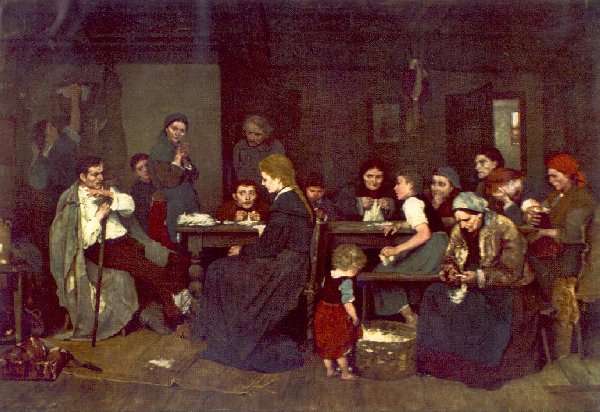
Tépéscsinálók (Tear Makers) by Mihály von Munkácsy (1871)
In the Spring of 1871, Liebermann lived in Düsseldorf, where the influence of French art was greater than in Berlin. Whilst in the city he met Mihály von Munkácsy, a Hungarian painter, who had earned international reputation with his genre pictures and large-scale biblical paintings. His paintings often featured scenes from the daily lives of peasants and poor people. Max saw Mihály von Munkácsy’s recently completed work entitled Tépéscsinálók and this stimulated his interest in genre painting. The subject of Munkácsy’s painting comes from memories of the 1848 Hungarian Revolution also known as the War of Independence and it depicts a wounded soldier, leaning on his crutches in a dark interior, recounting the story of life on the front line and the difficult battles he had experienced. Whilst the men were at war the girls, women, old people, and children remained at home in their villages looking after returning wounded soldiers, their kinfolk, who had suffered mentally and physically on the battle front. In this depiction the villagers listen attentively to the soldier’s emotional story and many cry (hence the painting’s title “Tearing Up”). Mihály von Munkácsy depicted the scene with particularly sympathetic memories, since the War of Independence and the tragic events that followed caused his sad childhood and saw him orphanhood at the age of six.
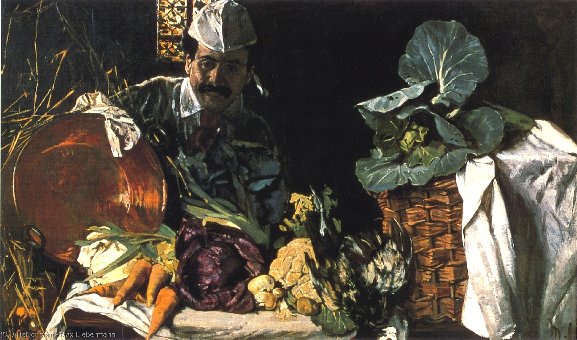
Self portrait in Kitchen with Still Life by Max Liebermann (1873)
Realising that the Netherlands was a place he had to visit to satiate his appetite for genre painting, Max, thanks to financial assistance from his brother, travelled to Amsterdam and Scheveningen. It was the first of many trips he made to the the Netherlands, a country he said inspired him.
Die Gänserupferinnen (Goose Pluckers) by Max Liebermann (1872)
When Max returned home in 1872 to continue with his studies at Weimar, his studio colleague Thomas Herbst had brought back a drawing of geese-plucking women from a study trip. Liebermann decided to use this motif and merge it with the style of Munkácsy and realised that this would be the basis of his next work. He then started on his large (120x170cms) painting entitled Die Gänserupferinnen (Goose Pluckers), which is now part of Berlin’s Alte Nationalgalerie collection. The work is painted in dark tones and depicts the simple task of goose plucking but the scene bears a resemblance to Mihály von Munkácsy’s work, Tépéscsinálók. It was the first painting that the twenty-five-year-old Liebermann exhibited in public at a Hamburg art exhibition. The art critics acknowledged the skilful painting style of Liebermann but were highly critical of the subject calling it distasteful and labelling him as the “painter of the ugly”. The painting was then exhibited that same year in Berlin but the critics were again fervently critical as they had been in Hamburg. However, the work found a buyer in the railway millionaire Bethel Henry Strousberg and with the money from the sale of the painting Liebermann travelled to Paris. His time in Paris was spent looking at the works of French artists such as Millais and Courbet and he was impressed by their style and motifs. Bethel Henry Strousberg’s empire later collapsed and he became bankrupt and had to sell some of the paintings he had collected over the years. Louis Liebermann, Max’s father, bought the Gänserupferinnen (Goose Pluckers) painting from him.
Potato Harvest in Barbizon by Max Liebermann (1875)
Liebermann had now discovered his first and favoured style, one which was both a realistic and unsentimental depiction of working people, and yet a style which avoided disdain, shaming of the subjects but also shied away from false romanticising of the people depicted. It was Realism. Liebermann became disillusioned with the German art scene which he believed had become too old-fashioned and somewhat retrograde and he was even disenchanted with Germany itself, so in December 1873 Liebermann travelled to Paris where he set up home and studio in Montmartre. Once settled in the French capital he sought out the artists who were looked upon as leading Realism artists of the day as well as the plein air Impressionism painters but many refused to meet with him due to the sour taste the Franco-Prussian War had left and the bitterness the defeat by the Prussian forces had caused and it had only ended three years earlier.
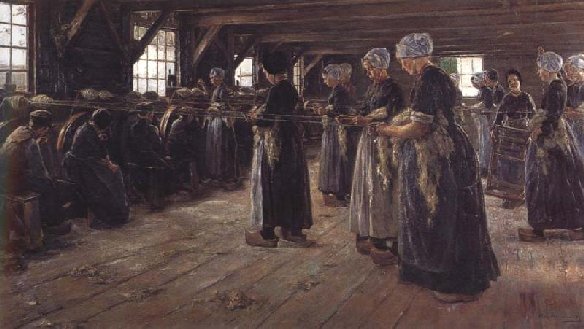
Flax Spinners by Max Liebermann (1889)
Besides still being influenced by Munkácsy, Liebermann had fallen in love with the art of French Barbizon painters Constant Troyon, Charles-François Daubigny, Camille Corot but above all Jean-François Millet. It was in 1874 that he submitted and had accepted his Die Gänserupferinnen (Goose Pluckers) painting to the Salon de Paris. However, this received negative reviews in the Parisian press, especially those newspapers which held nationalist views following the Franco-Prussian war. The first summer Liebermann spent in Paris it saw him travel to Barbizon, situated near the Forest of Fontainebleau, the home of the Barbizon School of artists, whose painters practiced en plein air painting which proved to be of great importance for the development of Impressionism. Liebermann decided to revert from the old-fashioned, heavy painting of Munkácsy, and became more engrossed in the methods used by the artists of the Barbizon School.
From 1874 Max Liebermann continued his studies in Paris and it was during thus time that he became increasingly interested in rural motifs, in “simple” people working on the land.
………to be continued.
Much of the information was found in various Wikipedia sites but also in:
Arnold and Louise settled down to living in the Colorado town of Denver in 1926. Soon the couple became active in the Denver art community and both were founding members of the Denver Artists Guild in 1928. Whilst living in Denver during the 1920s and 1930s, they would regularly visit Santa Fe in New Mexico and when in Taos would be guests at Mabel Luhan’s Los Gallos compound.
The Rönnerbeck Family (1937)
The help Louise received from the WPA was just what she needed as her portrait commissions had dwindled due to the Depression and the little savings she had left from a family inheritance was quickly diminishing. Besides her portraiture she had always been interested in painting murals and accordingly she worked long and hard and entered a number of WPA competitions to win mural commissions in various US States. In all, she entered sixteen mural commission competitions for the Treasury Department Section of Painting and Sculpture, a New Deal art project established on October 16, 1934, and administered by the Procurement Division of the United States Department of the Treasury.
The Fertile Land Remembers, oil on canvas mural by Louise Rönnebeck for the Worland, Wyoming Post Office, now in the Dick Cheney Federal Building, Casper, Wyoming, (1938)
In many of her submissions she focused on the power of women in striving for their goals but also depicted the plight of women and the children who were forced to work at a young age. In the end, she was awarded two commissions. In November 1937 she was invited to submit sketches for a mural that would decorate a wall in the post office of the Wyoming town of Worland. The Worland commission was for $570 and the artist was allowed 119 days for its completion. The organisers wrote Ronnebeck that the mural called for a “simple and vital design” based on a theme appropriate to the locale. Awarding Louise the Wyoming commission was a controversial decision as she was living in Colorado and many believed the commission should have gone to a Wyoming-based artist but the organisers stated bluntly that no Wyoming artist reached the standards they required. Louise commenced her oil on canvas mural entitled The Fertile Land Remembers in 1938. The mural depicts a white American couple with their child sitting in a wagon being pulled by two large oxen. These three figures, all looking towards us, are painted in a variety of rich colours whilst the native Indian horseback riders seen chasing buffalo are portrayed cloud-like figures in the sky above the wagon and are depicted in pale monochromatic luminous grey. None cast their eyes towards us. They are probably Cheyenne or Sioux, the forgotten people of Wyoming, who lived a nomadic lifestyle in order to pursue buffalo herds and were subdued and placed in reservations. Unlike the colourful people in the wagon being the present and future the pale grey figures are symbolic of the past. In the background we see the emerging elements of the white American future. Louise wrote about her thought process that went into the mural design:
“…The work is a romantic recollection of the covered wagon and the wild Indian and bison of the Old West, who still in retrospect hover over the irrigated fields and oil wells of the present. The covered wagon drawn by oxen is shown inexorably pressing through the galloping figures of a vanishing culture, whose form becomes shadowy and disappear into the past under the white man’s determination to open new lands. The landscapes on either side depict the present which was created by these pioneers. The way in which the idea is presented was suggested by the device of the double exposure used in many motion pictures to show the past and the present merging into one dramatic unit…”
Harvest by Louise Rönnebeck (1940)
Louise Rönnebeck’s second commission was for the post office and courthouse in the Colorado town of Grand Junction but which is now housed in the city’s Wayne N. Aspinwall Federal Building United States Courthouse. Louise won the opportunity to paint The Harvest through entering a contest anonymously, for fear of gender prejudice, and submitting a sample sketch. In 1940, with the enlargement of the Wayne N. Aspinall Federal Building, Rönnebeck’s mural was placed to embellish the postmaster’s office door pediment with its conspicuous V-shaped bottom. Her depiction represented the plight of the Native American Ute people who prior to the 1860s had lived in southwest Colorado for centuries and it was here that they had their seasonal hunting grounds. However, despite a Treaty which granted the Utes absolute and undisturbed use and occupation of their land, the lure of rich mineral deposits lured prospectors on to their land. The tribe was squeezed into an ever-smaller parcel of land by the incoming miners. The matter came to a head in 1881 when the Utes refused to leave the territory and were forced to the south-western border of Colorado. The six million acres of land once owned by the Utes was now up for grabs and settlers poured in establishing local industries such as orcharding in the form of growing peaches. In the foreground of Louise Rönnebeck’s large mural we see the harvesting of the peach crop by a young couple, modelled by Louise’s two children. To the left of the painting, we see settlers moving into the Ute’s land with their horses and to the right we see the result of this influx as the Ute people are forced out. This is a painting depicting a thriving local industry and acts as a counterpoint to the hard times of the Great Depression.
Unveiling of “missing” painting.
In a January 18th, 1992, article by Ginger Rice in Grand Junction’s Daily Sentinel, it describes the mural’s mysterious disappearance for more than twenty-five years. Workers removed the oil-on-canvas painting for conservation work, and it subsequently went missing. Fortunately, a General Services Administration building manager, Tim Gasparani, re-discovered the mural and in 1992, The Harvest finally returned to its original home.
The People vs Mary Elizabeth Smith. by Louise Emerson Rönnerbeck (1936)
In 1936, Louise Rönnerbeck completed a dramatic painting entitled The People vs Mary Elizabeth Smith. The depiction was based upon an emotional trial of an eighteen-year-old mother of a eight-month old child, Mary Elizabeth Smith, in January 1936. She, whom the press termed “the girl mother” had been accused of murdering her husband in the previous November. She had accused her estranged husband, nineteen-year-old Robert Dwight Smith, who was unemployed, as being abusive towards her. Just prior to the shooting he had petitioned the court to annul their three-year-old marriage which would result in their child being looked upon as being illegitimate. For Mary Elizabeth, this was too much to bear and so she took her brother’s hunting rifle, marched along to her sister-in-law’s house where her husband was staying and shot him. She told the police that she did not know why she did it. She just knew she had to protect her baby’s name. Her defence lawyers stated that having been deserted by her husband and struggling to bring up their son it had taken its toll on her mental health. Louise Rönnerbeck depicted the theatrical trial scene which she had witnessed.
The defence lawyer mitigated the actions of his client by reminding the jury of her personal history. Her father had deserted her leaving her mother to struggle to provide for her two children. Her own eight-month-old son, Rodney, born after a particular long and painful labour was the centre of her life. The courtroom was filled throughout the trial and the press feasted on the events. In his article, Jack Carberry of the Denver Post wrote:
“…”they met love, and in their ignorance of life, it engulfed them…”
Rönnebeck’s painting depicts the dramatic trial scene. In the witness box, at the centre of the legal proceedings, we see the frail reed-headed defendant, wearing a dark dress with a white collar, handkerchief in hand, as she grasps the side of the witness box. She is barely able to stand and is fully aware that if the all-male jury (at this time women were not allowed to be jury members) convicts her, she faces either the death penalty or life imprisonment. It was reported in the Denver Post that her testimony was one of child-like simplicity. On the left in the front row of the courtroom we see the girl’s mother holding her daughter’s infant son. She had come every day to offer support to her daughter. After Mary’s testimony it was reported that there was not one person in the courtroom who wasn’t crying, moved by the young woman’s simplistic testimony. Also in the scene we see the prosecutor waving the murder weapon and on a table to his right are the deceased bloodied shirt and trousers. The jury retired for five hours before returning and acquitting her for reasons of insanity.
The Children by Louise Emerson Rönnebeck (c.1935)
Following the end of World War II, Louise lectured at the University of Denver from 1945 to 1951 as well as providing some magazine illustrations. Her husband Arnold died of cancer on November 14th 1947, aged 62 and with her two children marrying, Arnold in 1950 and Ursula in 1953, she was left on her own. In 1954 she went to live in Bermuda where she and her family had spent many holidays. Here she taught art at the Bermuda High School for Girls between 1955 and 1959 and continued to paint. In the Autumn of 1973 she returned to Denver where she spent the rest of her life.
Louise Emerson Rönnebeck died in Denver on February 17th 1980, aged 78.
I collected information regarding the life and art of Louise Emerson Rönnerbeck from various sources. The main ones were:









 my daily art display