The Fourteenth Street School. Part 1.

When talking about American Urban Realism in art one thinks of The Ashcan School, which was an artistic movement in America during the late 19th and early 20th century. The name given to the group originated from a criticism written in the graphically pioneering American magazine of socialist politics, The Masses, in March 1916 by the cartoonist Art Young, who asserted that there were too many “pictures of ashcans and girls hitching up their skirts on Horatio Street.” The artists associated with this school of painting that produced works portraying scenes of daily life in New York, especially in the city’s poorer neighbourhoods, were Robert Henri, George Luks, William James Glackens, Everett Shinn, George Bellows and John Sloan.

Today I want to look at another group of American realist painters who were also based in New York city and who also focused on everyday life in the city. For them it was all about the bustling area which centred around 14th Street and around Union Square in Lower Manhattan during the Depression era. During the 1920s and the 1930s, these artists continued the tradition established by the Ashcan School. They became known as the Fourteenth Street School of Artists. This group of painters were inspired by the legacy of the Ashcan School artists who depicted urban life and this new group established studios in the Fourteenth Street area and were inspired by the crowds that would daily swamp the nearby streets.

Reginald Marsh sketching on 14th Street, New York, 1941.

The first of the artists of the Fourteenth Street School I am looking at is Reginald Marsh. He was born on March 14th, 1898, in an apartment in Paris above the Café du Dome. He was the second son born to American parents who were both artists. His father was Frederick Dana Marsh, who attended the School of the Art Institute of Chicago, where he worked with artists preparing murals for the Chicago World’s Fair in 1893. He went to Paris where in 1895 he married Alice Randall, a fellow Chicago art student and miniature painter. Whilst living in Paris, the couple had two sons, James in 1896 and Reginald two years later. Reginald’s father was one of the earliest American painters to depict modern industrialisation in America. The family lived affluently due to Reginald’s paternal grandfather. James Marsh, who had made a fortune in the Chicago meat packing business.
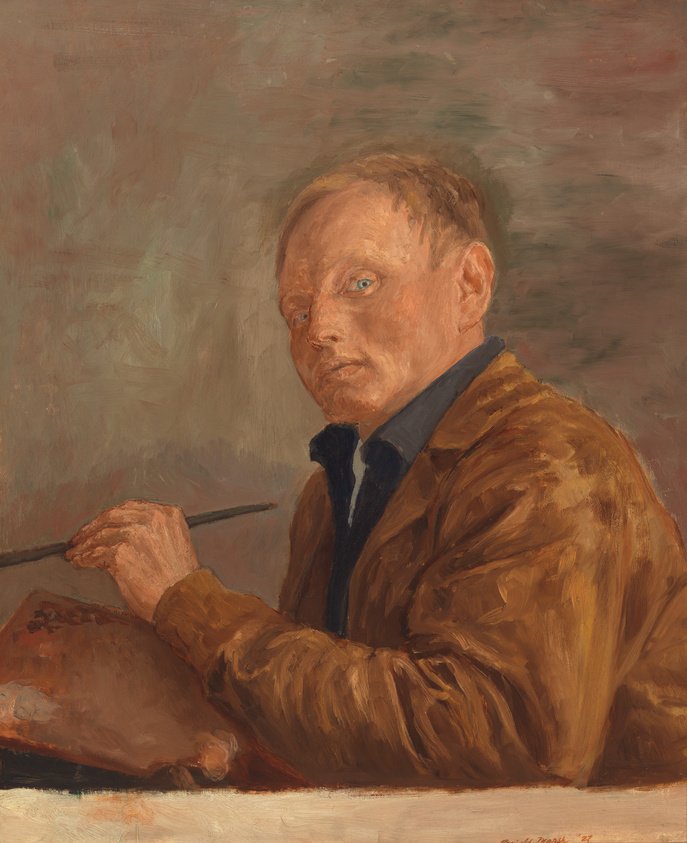
Self Portrait by Reginald Marsh (1927)

Reginald Marsh’s family moved to America in 1900 and relocated to Nutley, New Jersey where they set up a studio/home at No. 16 The Enclosure, a street that had been established as an artists’ colony some decades earlier by the American painter Frank Fowler, who had once owned their house. This resulted in Reginald being immersed in the world of art and painters who nurtured his love of painting and sketching. It was not just that art could be a good outlet for the teenager but it helped him to socialise with others and as he was a somewhat introverted and often tongue-tied boy, and so this was a bonus.
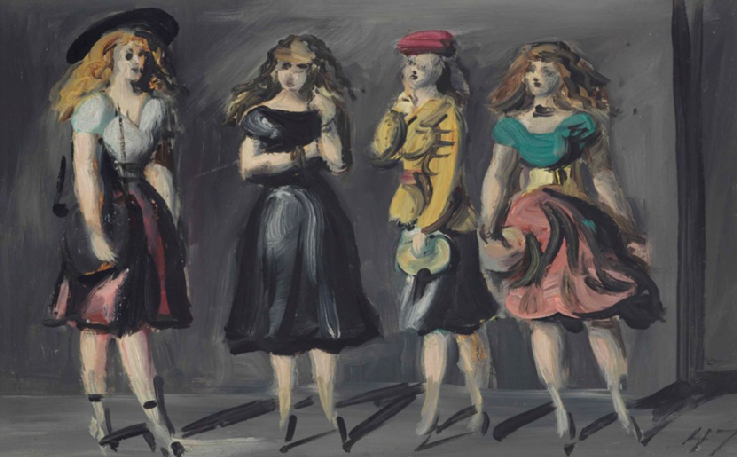
Four Women by Reginald Marsh (1947)

In 1914, the family moved to New Rochelle, in New York State. The family went on to buy an estate in Woodstock, New York, where they spent most of their summers. Reginald Marsh attended various schools including the Riverview Military Academy in Poughkeepsie and the Lawrenceville Preparatory School in New Jersey. After graduating from high school he enrolled at the Yale School of Art, the art school of Yale University, where he made a name for himself as an illustrator and cartoonist for the Art School’s humour magazine, The Yale Record

Figures on the Beach by Reginald Marsh (1921)

After graduating from Yale in 1920, Marsh re-located to New York, where, in 1922, he enrolled for a short period at the Art Students League. It was while studying art at this establishment that he gained a great deal of experience in painting and drawing from his skilled tutors, especially Kenneth Hayes Miller, an American painter and printmaker. Whilst at the Art Student League he became friends with fellow artist, Betty Burroughs. Their relationship grew and twelve months later, the couple married and as Betty’s father, Bryson Burroughs, was a curator at the Metropolitan Museum of Art he was able to introduce his son-in-law to important figures in the art world. Reginald Marsh was now the family’s breadwinner, and so he began painting seriously.
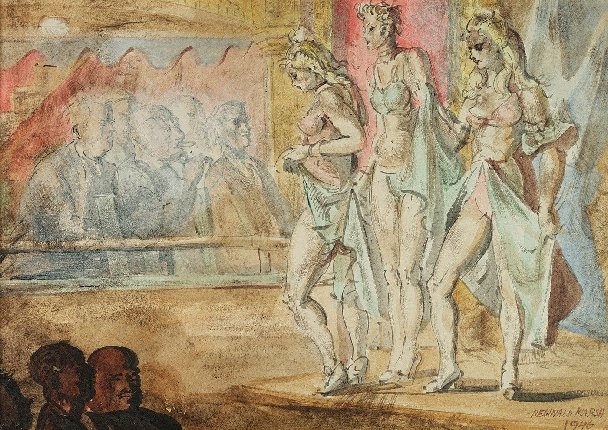
Burlesque by Reginald Marsh

Gaiety Burlesque by Reginald Marsh (1930)

Once Marsh had graduated from Yale School of Art he moved to New York in his search for employment as a freelance illustrator. His first opportunity came when the New York Daily News commissioned him to produce depictions of vaudeville and burlesque performers. Burlesque and vaudeville shows were at the height of their popularity and Marsh’s depictions of burlesque dancers, chorus girls and strippers. Although some people often criticised them for their raunchiness and vulgarity, others were delighted by the comedy and satire emanating from his portrayals. In Edward Laning’s 1973 book, The Sketchbooks of Reginald Marsh, he described burlesque as:

“… the theater of the common man; it expressed the humor, and fantasies of the poor, the old, and the ill-favored…”
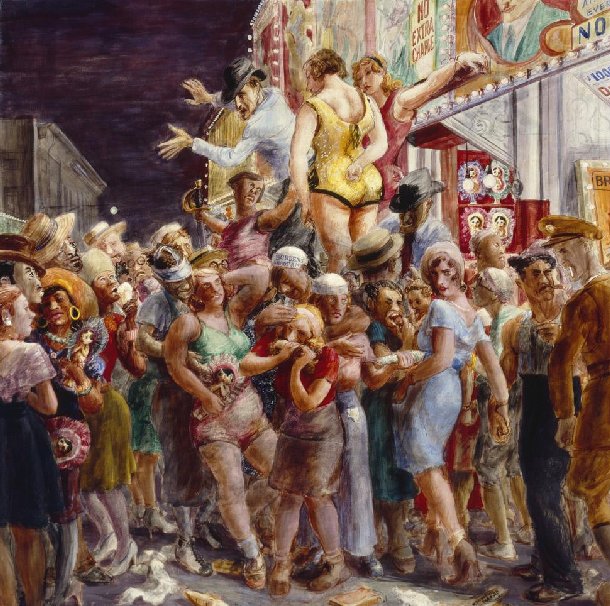
Wonderland Circus, Sideshow Coney Island by Reginald Marsh (1930)

Coney Island by Reginald Marsh (1933)

Mrsh’s job as a staff artist for the New York Daily News gave him the opportunity to explore the underbelly of society: He would wander the streets of Lower Manhattan, and gain inspiration from the burlesque shows along Bowery Street, the storefront windows and advertisements, and the beaches of Coney Island. Marsh also captured the throngs of theatre goers at these shows or outside the theatres and side-shows.
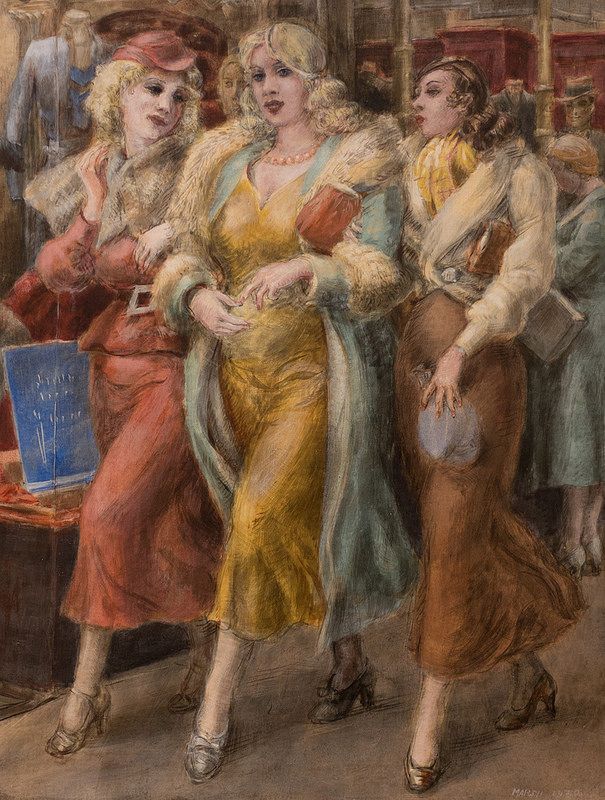
Ten Cents a Dance by Reginald Marsh
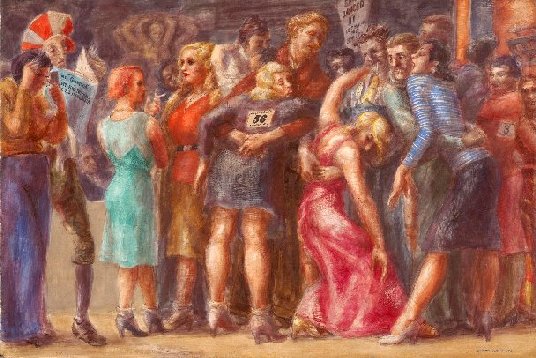
 Zeke Youngblood’s Dance Marathon by Reginald Marsh (1932)

And there was the ever-popular but brutal Dance Marathons !

The New Deal was formulated by President Franklin Delano Roosevelt’s administration which came up with ideas on how to alleviate the suffering of those who had neither jobs nor any money to support themselves. For the artistic community, Roosevelt came up with a number of schemes such as the Public Works of Art Project, the Treasury Section of Painting and Sculpture and the Treasury Relief Art Project. The Federal Art Project (FAP), which was created in 1935 as part of the Work Progress Administration (WPA), was one which directly funded visual artists and provided posters for other agencies like the Social Security Administration and the National Park Service. The William Jefferson Clinton Federal Building in Washington DC, which is a complex of several historic buildings, one of which was originally called the New Post Office, was completed in 1934. It housed the headquarters of the Post Office Department. The Clinton Federal Building was one of the initial locations that integrated various New Deal artworks that were originally commissioned and displayed in federally constructed buildings by the Treasury Department Section of Fine Arts during the 1930s and 1940s. In 1936, Reginald Marsh completed two murals for the interior of the building.
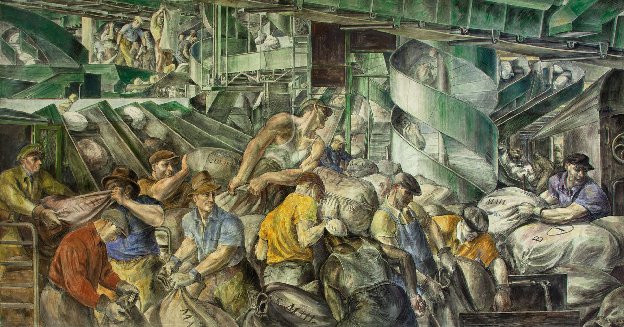
Sorting the Mail by Reginald Marsh (1936)   This mural was for the Ariel Rios Federal Building, Washington, D.C.

In preparation for his mural, Sorting the Mail, Marsh completed a number of preliminary sketches of the railway mail service which was located under the old Penn Station in New York, as well as the New York post office department building. He observed the new and modern technology, talked to the postal workers and watched them unloading and sorting the mail. Marsh’s depiction conveys the feverish dynamism of the workers. We see swarthy-skinned muscular men lifting and lugging large bags of mail. The various skin tones of the men allude to it being a diverse workforce of differing nationalities

Unloading the Mail by Reginald Marsh (1936)

Marsh’s other mural Unloading the Mail was also completed in 1936. The depiction in this mural was all about the international movement of mail from country to country. Marsh visited the Cunard liner RMS Berengaria which had docked in New York harbour. The Cunard line vessel, as well as carrying passengers across the Atlantic, brought mail to America from Europe and further afield. He made many sketches of the ship itself but the mural depicts the activities that occurred in the harbour boat which was used to bring the mail from the liner ashore for distribution. To the left we can catch a glimpse of the Manhattan shoreline whilst to the right we can see the officers of the liner handing the sacks of mail to the crew of the harbour tender. At the bottom left of the painting we can see a man, seated, tallying the sacks of mail that had been offloaded from the liner.

The Bowery by Reginald Marsh (1930)

By 1930, Reginald Marsh’s career was well established and thanks to inheriting some money from his late grandfather was comfortably well-off. Despite his wealth Marsh began to focus his work on depicting those who were less fortunate. It was his poignant depictions of the poverty suffered by the lower classes during the Great Depression that featured in many of his works, such as his 1930 work entitled The Bowery. In this painting Marsh has depicted the plight of the people hit hard by being out of work and in some cases, homeless. The scene before us has been created using a brown palette. We see large groups of men, who had suffered financially due to the financial crash, loitering along Bowery Street underneath many neon signs advertising cheap hotel accommodation. Above and to the right we catch a glimpse of the Third Avenue overhead railway.
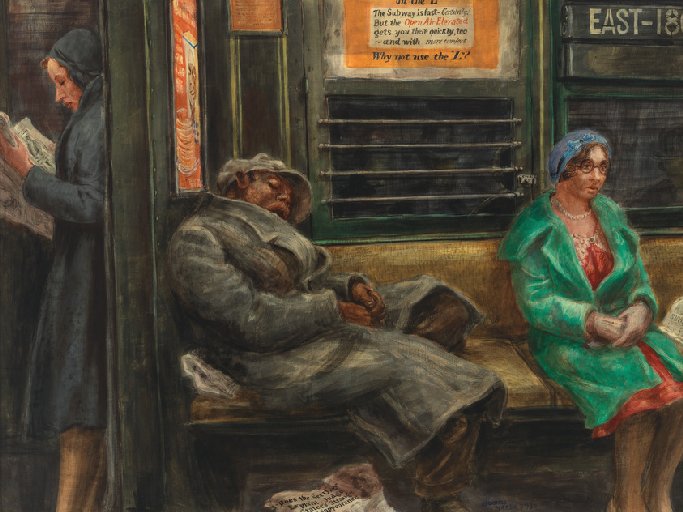
Why Not Use The L by Reginald Marsh (1930)

A fascinating painting with and equally fascinating title is Reginald Marsh’s 1930 work, Why Not Use the “L”. The “L”—or “el”, is an elevated train that rose above the city streets. The western end started at Eight Avenue and 14th Street, ran through Union Square to the opposite end of the line at Rockaway Parkway, Brooklyn. The painting depicts three people in the railway carriage during the Depression. The woman to the right looks out apprehensively whilst the man seems exhausted. A second women to the left seems oblivious to her surroundings as she reads the newspaper. There are a number of advertising posters attached to the wall of the carriage. Reginald Marsh had accurately copied the adverts into his sketch books and added them to his final work.

One such advert extols the joys of Buckwheat Pancakes while another asserts that this form of transport is the best, using the title of this painting:


“…The subway is fast—certainly! But the open Air Elevated gets you there quickly, too—and with more comfort. Why not use the “L”?…”
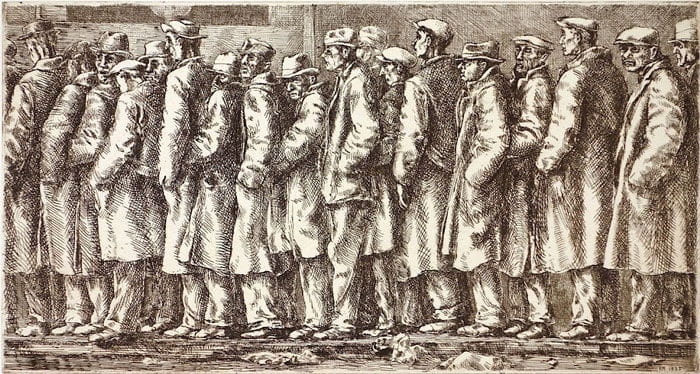
Bread Line – No One has Starved by Reginald Marsh (1932)

For my last offering of a Reginald Marsh work I am looking at his very poignant etching entitled Bread Line–No One Has Starved. He completed this in 1932, at the height of the Great American Depression. It depicts a line of destitute men as they stand waiting in resignation for some sort of public assistance. The men are crowded into the black and white depiction and there is little to differentiate them. It is a depiction that represents poverty in general rather than an individual’s poverty. Marsh favoured depictions of the poor and down-and-out people and dismissed depicting the affluent saying that well-bred people were no fun to paint.
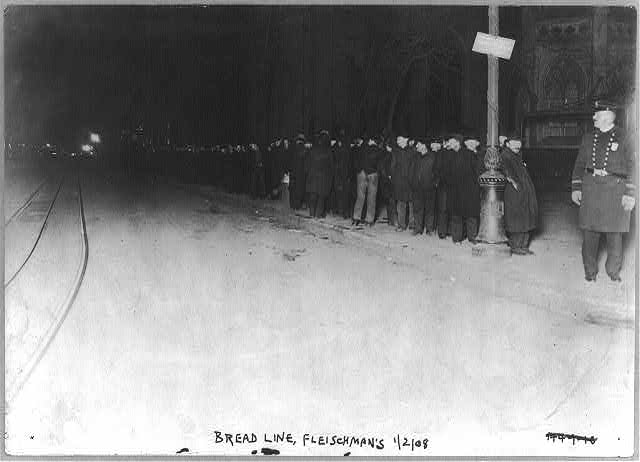
The Bread Line – the stark reality. Bowery men in bread line at Fleischman’s Restaurant, N.Y.C. – Thursday 2nd January 1908

By 1932, the unemployment figure in America had risen to unparalleled levels and President Herbert Hoover was forced to admit to a congressional committee that no one, not even the federal government, really knew how many people were unemployed. Nevertheless, President Hoover, who at the time was seeking re-election, insisted that the underlying conditions of the American economy were sound and that no one has starved, and this phrase was incorporated into the title of Marsh’s p[ainting.
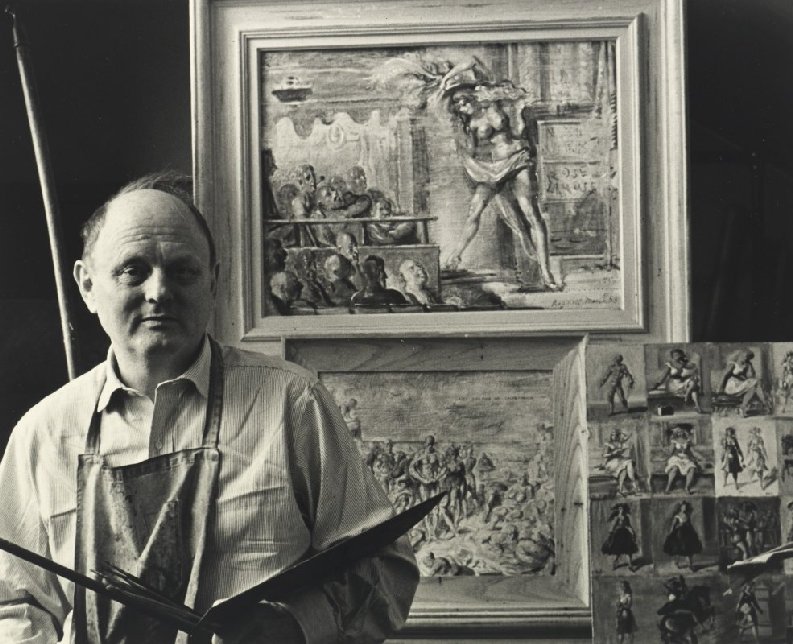
Reginald Marsh at work (1954)

In the 1940s Reginald, Marsh became an important teacher at the Art Students League of New York, whilst carrying on his work as a magazine illustrator for well-known magazines such as Life, Fortune, and Esquire. Sadly for Marsh his style of art became less appreciated and this affected him. Shortly before his death, he was awarded the Gold Medal for Graphic Arts by the American Academy and the National Institute for Arts and Letters. His disillusionment at the lack of appreciation of his art at that time became apparent when he received the award and said that I am not a man of this century.

Reginald Marsh died from a heart attack in Dorset, Vermont, on July 3rd, 1954, aged 56.


As usual, a great deal of information came from various Wikipedia sites but most came from the excellent sites below:

ART CONTRARIAN
incollect
ART HISTORY
QUEST ROYAL FINE ARTS
INSIDE THE APPLE
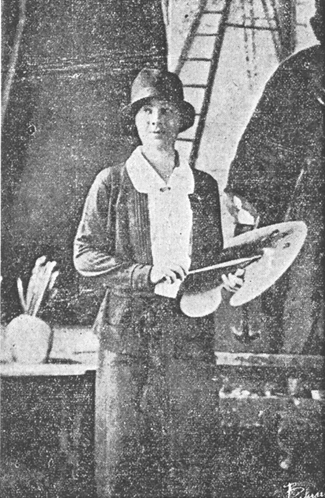
Gertrude Horsford Fiske

Gertrude Horsford Fiske

The artist I am looking at today is the nineteenth century American painter Gertrude Horsford Fiske who was famous for painting people, still life, and landscapes. Gertrude Fiske was born into an established New England family that can trace their family history way back to the Governor of Plymouth Colony, William Bradford an English Puritan Separatist originally from the West Riding of Yorkshire in Northern England who moved to Leiden in Holland in order to escape persecution from King James I of England, and then emigrated to the Plymouth Colony on the Mayflower in 1620. Gertrude, born in 1879, was one of six children born into a wealthy Boston family, her father being an eminent lawyer. She was educated in Boston’s best schools but during her teenage years she showed little interest in art as much of her free time was taken up with horse riding and golf. She proved herself to be an extremely skilled professional golfer.

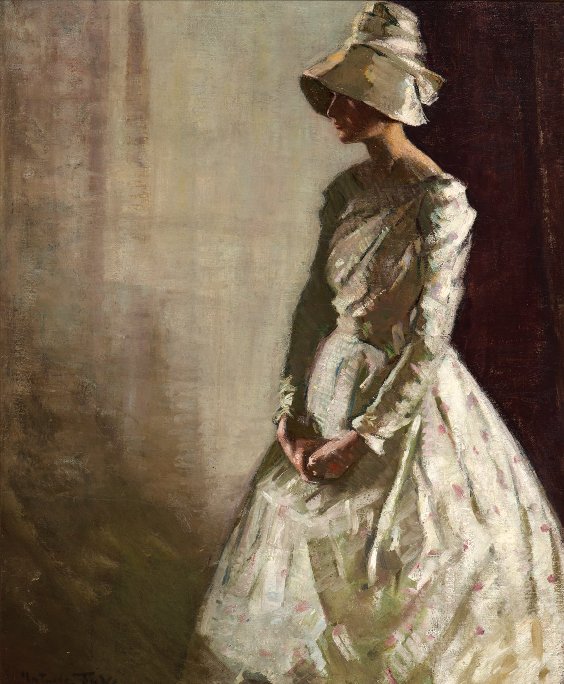
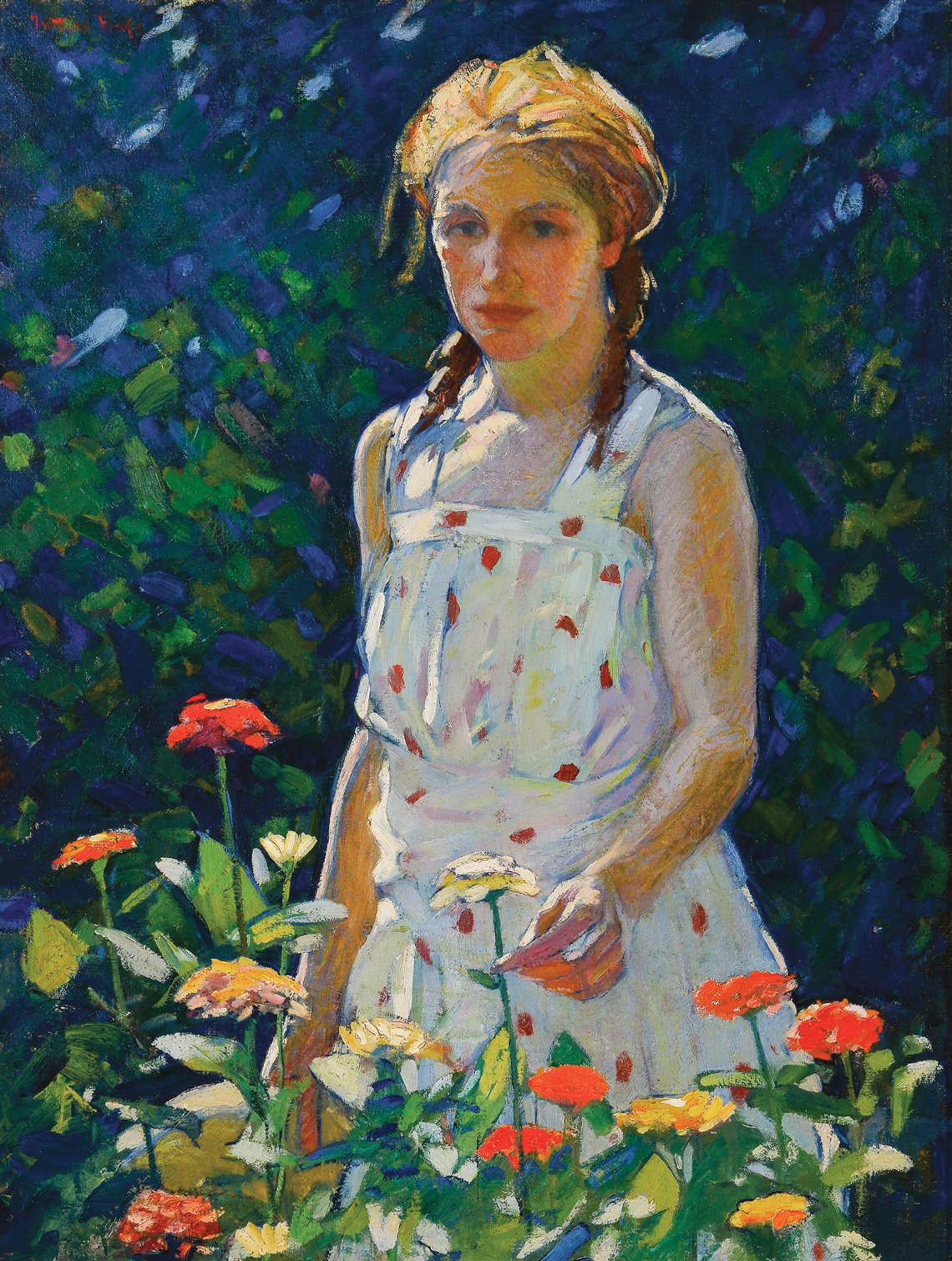
Woman in White by Gertrude Fiske

It was not until she was twenty-five years old that she took an interest in art and began to look at the possibility that her future could be as a professional artist. In 1904 she enrolled on a seven-year course at the School of the Museum of Fine Arts, Boston, (now the art school of Tufts University), where her tutors included Edmund C. Tarbell, an American Impressionist painter, Frank Weston Benson, known for his Realistic portraits, American Impressionist paintings, watercolours and etchings and Philip Leslie Hale, an American Impressionist artist, writer and teacher.

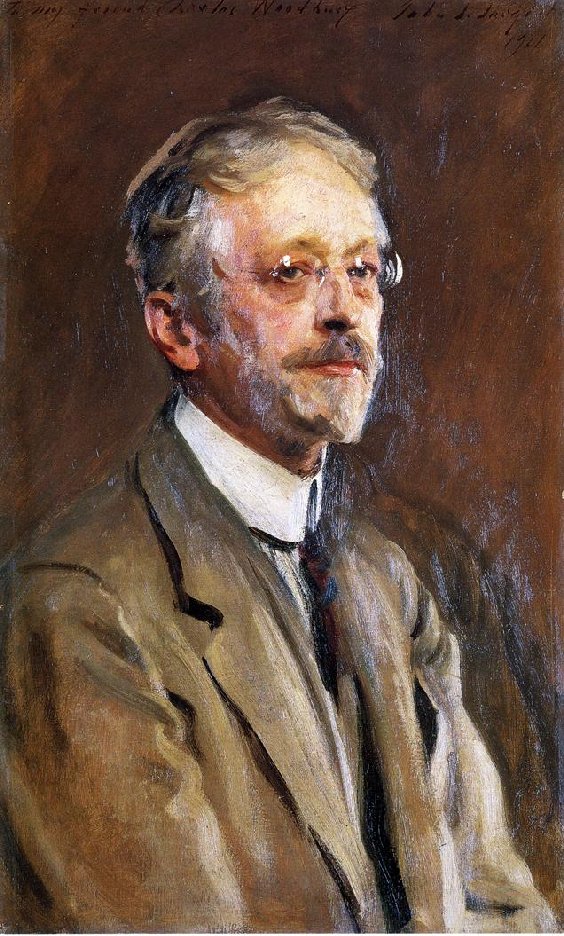
Charles Herbert Woodbury by John Singer Sargent (1921)


During the summers, she attended Charles Herbert Woodbury’s art classes in Ogunquit, Maine. Ogunquit was originally populated by The Abenaki indigenous people of the Northeastern Woodlands of Canada and the United States and in their language the name of the town means “beautiful place by the sea”. In the early years of the twentieth century, it had become a popular destination for artists who wanted to capture the landscape’s natural elegance.

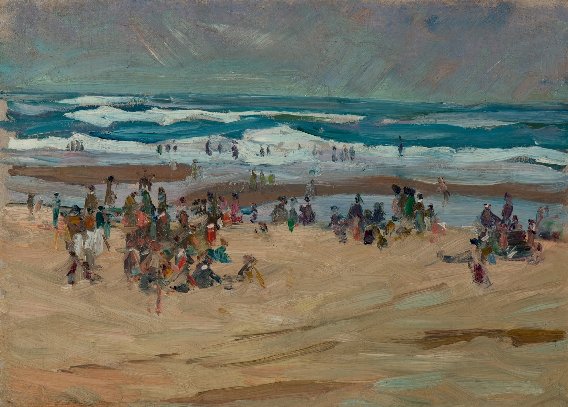
Ogunquit Beach by Gertrude Fiske (1914)

Ogunquit Beach by Gertrude Fiske

Soon, a community of artists formed the Ogunquit Summer School of Drawing and Painting which was founded by Charles Woodbury. Woodbury was a great influence on Gertrude Fiske’s informative years and he encouraged her and her fellow students to “paint in verbs, not in nouns.” By this, he meant that his students should enter into the life of the things they painted. He wanted to inspire them to fresh, “active” seeing and expressive creativity and told them that in seascapes they did not draw what they saw of the wave – you draw what it does. The phrase implied that painting is perceptual and that realism is evidence of the felt and the seen and not just of what’s visible.

Bettina by Gertrude Fiske (1925)

Because of the family’s wealth, Fiske had the financial freedom to pursue her painting career and after she completed her time at the School of the Museum of Fine Arts, Boston in 1912, she spent time in France, continually sketching as she travelled. Her artistic style was a blend of the light-filled, classical, portrait style she had mastered under Edmund C. Tarbell with the freer, inventive, and colour-rich landscapes she had learnt during her summers spent at the Ogunquit school.

Nude in Interior by Gertrude Fiske (c.1922)

Gertrude Fiske painted a number of works featuring nudes. Her painting entitled Nude in Interior was completed around 1922. The subject of this work, the nude female, is shown posing for the artist, the image of whom we see in the background, reflected in a mirror. Gertrude often used this inclusion as a means to put over to the viewers the importance of the painter.

Bird of Paradise, Sleeping Nude by Gertrude Fiske (c.1916)

Another controversial nude work was her 1916 painting entitled Bird of Paradise, Sleeping Nude which received mixed reviews. It was praised for its honesty but more conservative critics said it was a scandalous depiction. Before us we see a foreshortened figure of a naked woman who appears supremely relaxed and unaware of us, the viewers. It is simply an honest depiction of a real woman.

Zinnias by Gertrude Fiske (c.1920)

Gertrude returned to America but tragedy struck her family with the deaths of a sister, brother and mother around the time that the First World War was raging in Europe. Fiske then had to care for her aging father. However, despite the tragic losses and her new role as a carer she continued to be a prolific and much-admired painter. She kept a studio in Boston as well as at her family’s longtime home, Stadhaugh, in the town of Weston, fifteen miles west of Boston. It was at Stadhaugh that she worked in her studio which was located on the top floor of a converted barn. It had a picturesque setting overlooking woods and this vista served as the backdrop for several of her works.

By the Pond by Gertrude Fiske (c.1916)

In 1914, she, along with prominent painters of the day, including Edmund Tarbell, William Paxton and Frank Benson, helped create the Guild of Boston Artists. Its mission was to promote both emerging and established artists who lived in the region. The Guild developed a reputation for excellence in quality and presentation. Later, in 1917, Gertrude was part of setting up the Boston Society of Etchers and in 1918 Fiske became a member of the National Association of Women Artists.

Strollers by Gertrude Fiske (c.1926)

After the end of the First World War, America staged a rapidly growing industrial way of life and along with waves of immigration in the last quarter of the nineteenth century, elements of a new national consciousness arose in the United States. It was considered to be part of the colonial revival, which found expression in architecture, decorative arts, paintings, and all types of material life which represented an effort to regain a sense of an earlier time in America. Boston was in the forefront of colonial revivalism, and it was the Boston School of Painting, led by Edmund C. Tarbell, that is closely identified with the movement. Gertrude Fiske, who had spent seven years there as a full-time student at the School of the Museum of Fine Arts, Boston, was trained in this artistic dream of the future.

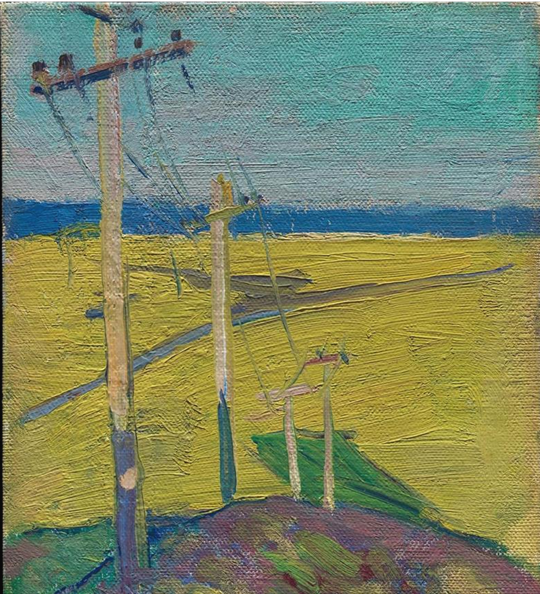
Wells, Maine by Gertrude Fiske


However Fiske was an independently minded and instead of blindly following social convention and the strong direction proposed by the Boston school with its more genteel mannerisms, she ploughed her own furrow and in her landscape depictions instead of removing signs of industry and technology from her work, she made a conscious decision to include them. A good example of this can be seen in her painting entitled Wells, Maine, in which she has retained depictions of a line of utility poles, with a secondary electrical line running across the painting. Her composition with utility poles set against the background of a seascape demonstrates the artist’s interest in juxtaposing signs of modernity with scenes more traditionally considered beautiful.

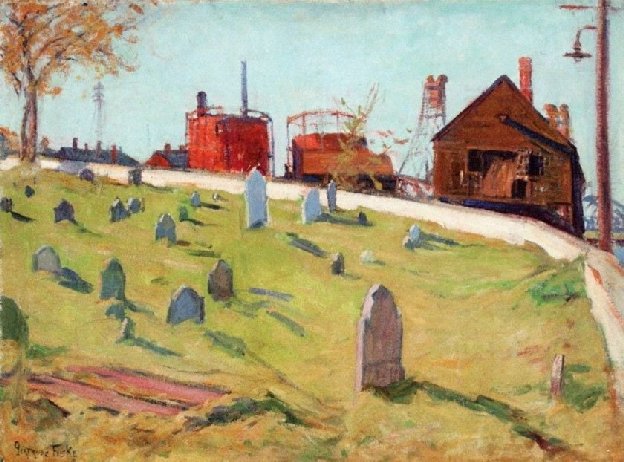
Portsmouth Burying Ground by Gertrude Fiske (c.1925)

Another example of Fiske’s urban landscape work is one she completed around 1932 entitled Portsmouth Burying Ground which depicts Portsmouth, New Hampshire’s oldest cemetery, known as the Point of Graves, which is situated on the banks of the Piscataqua River in the south end of town. This small historic cemetery dating to the 17th century was the final resting place for many of Portsmouth’s prominent residents. It is the oldest known surviving cemetery in Portsmouth, and one of the oldest in the state, which has about 125 gravestones. Whereas many landscape painters would have spent time amidst the beauty of the countryside Gertrude has chosen this discordant, working waterfront to position her easel to take in the surrounding land. Fiske confounded viewers of this work when she depicted the bright red gasometers and the Sheafe warehouse as a backdrop to the ancient burial ground.

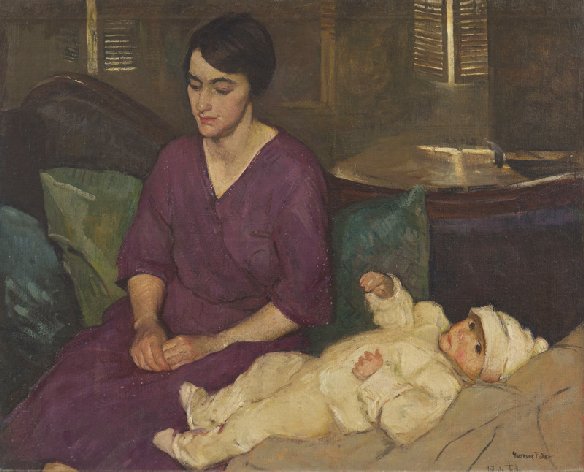
Portrait of William by Gertrude Fiske (1930)

One of her best-known figurative works was one Gertrude completed in 1930 entitled Portrait of William which she exhibited at both the Boston Art Club’s Annual Winter Exhibition of Contemporary American Painting and at the National Academy of Design’s 105th Annual Exhibition. It is part figurative and part an interior depiction which was a popular concept favoured by many of the early Boston School teachers and yet she put her own mark on the composition by her use of colours, such as the juxtaposition of the green of the fabric on the pillows with the dotted Swiss cotton of the woman’s purple dress. She also adopts an unusual placement of figures and objects in the work.

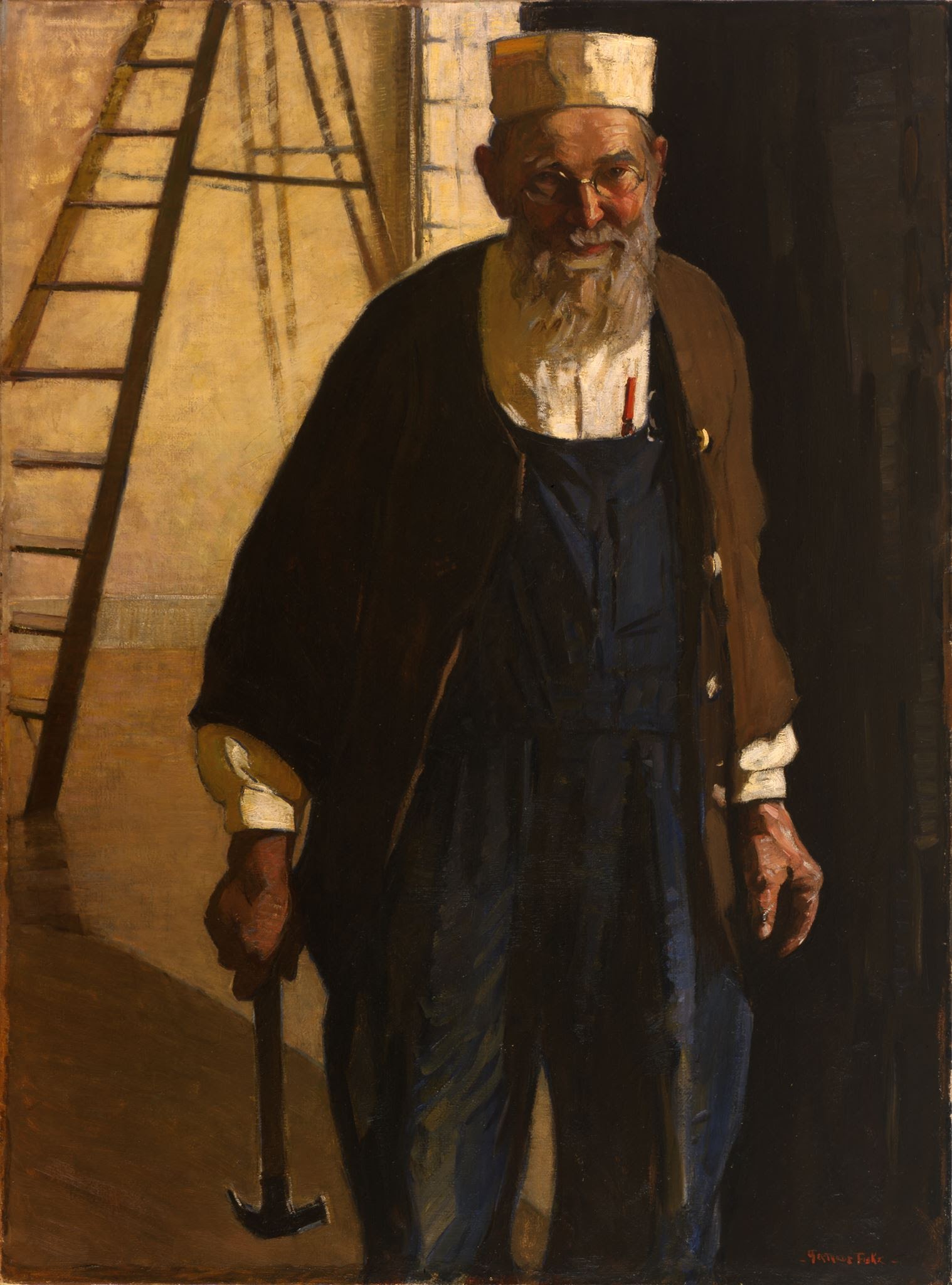
The Carpenter by Gertrude Fiske (1922)

Gertrude Fiske was appointed as the first woman ever to the Massachusetts State Art Commission in January 1930. She was also the the founder of the Concord Art Association. In an article in January 1930’s Boston Globe it was written that she had always had a strong artistic individuality of her own, and there is a note of personal distinction in all of her work—a virile note.

Fiske died in 1961 in Weston, Massachusetts aged 82.

Jean-Jacques Henner

In my previous blog regarding the Dutch painter Thérèse Schwartze I mentioned that one of her early art tutors was Jean-Jacques Henner, the French painter famed for his portraiture.  Today I am going to focus on his life and his many artworks.

Jean-Jacques Henner

Henner was born on March 5th 1829 at the Alsatian town of Bernwiller.  Henner came from a family of Alsatian farmers who had settled in Bernwiller in the Haut-Rhin. He was the youngest of six siblings of George Guillaume Polycarpe Henner and Madeleine Henner (née Wadel).  He had two older sisters, Maria Anne and Madeleine and three older brothers, Séraphin, Grégoire and Ignace. He grew up in this farming community, but despite their modest financial situation, his parents sent him to the College of Altkirch where he studied drawing. His teacher was Charles Goutzwiller who noticed his rapid progress and encouraged him to move to Strasbourg and study at the studio of Gabriel-Christophe Guérin. His artistic studies continued when he enroled at the Ecole des Beaux-Arts in Paris as a pupil of Michel-Martin Drolling,  a neoclassic French painter noted especially as a history painter and portraitist. In 1851 he was tutored by another French artist, François-Édouard Picot, famed for his mythological, religious and historical paintings.   

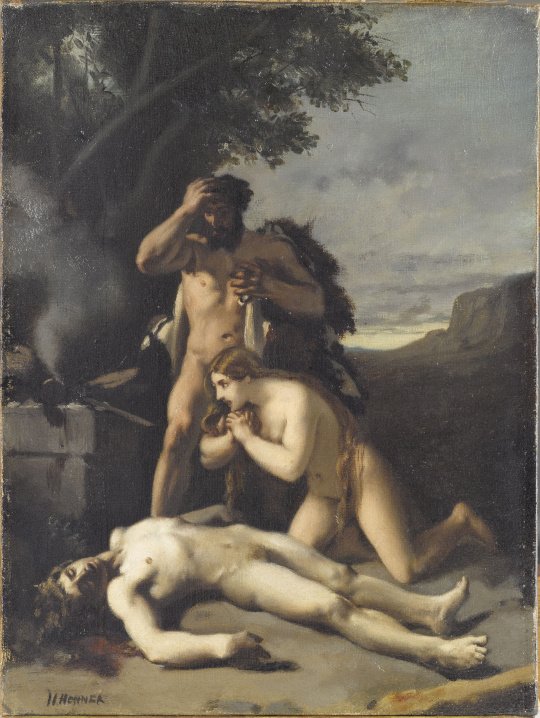
Adam and Eve find the Body of Abel by Jean-Jacques Henner (1858)

In 1848, he entered the École des Beaux Arts in Paris and in 1858 after two failed attempts he won the coveted Grand Prix de Rome award, which was a French scholarship for arts students.  His submission was his painting entitled Adam and Eve find the Body of Abel.  The prize for the winner was a bursary that allowed them to stay at the Villa Medici in Rome, for three to five years at the expense of the state. The painting can be seen at the Musée d’Orsay.

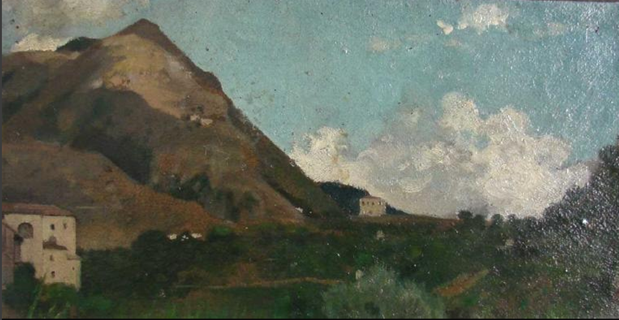
Mountains on the Outskirts of Rome by Jean-Jacques Henner (c.1861)

During his five-year stay in Rome, he was guided by Jean-Hippolyte Flandrin, a French Neoclassical painter.  Like many artists, Henner was captivated by Italy and spent many hours in museums reproducing the works of the painters that he respected. He also had plenty of time during his five-year stay to travel around the country, visiting Florence, Venice and Naples in which time he completed a number of small landscape paintings.  His works at that time showed his appreciation of past masters and it was Titian and Correggio who influenced him the most. In 1864 Henner returned to Paris and brought back copies of works by masters and a number of luminous landscapes.

Rome from the terrace of the Villa Medici by Jean-Jacques Henner (1860)

During those five years in Rome Henner painted this work at the Villa Medici where he stayed between 1859 and 1864. This is not simply a view of the Eternal City as observed from the villa. Once he had painted the garden, Henner then populated the terrace with groups of what he believed were “typical” characters, which he had often seen in real life and are simply identifiable by their clothes, monks, peasants, and elegant ladies. All are depicted in front of the classical panorama of the city, in which one can see the silhouette of Saint Peter’s Basilica in the background.

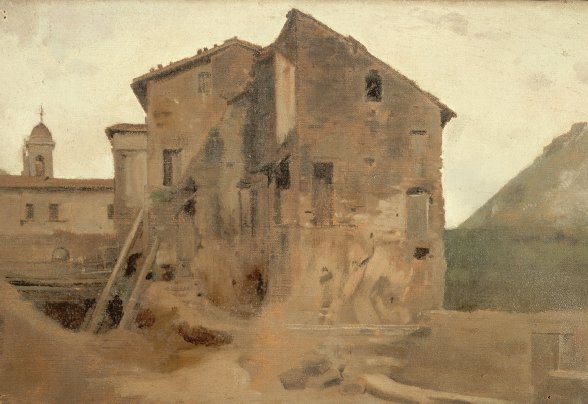
Masure dans la campagne de Rome (Dilapiated House in the Countryside of Rome) by Jean-Jacques Henner (c.1863)

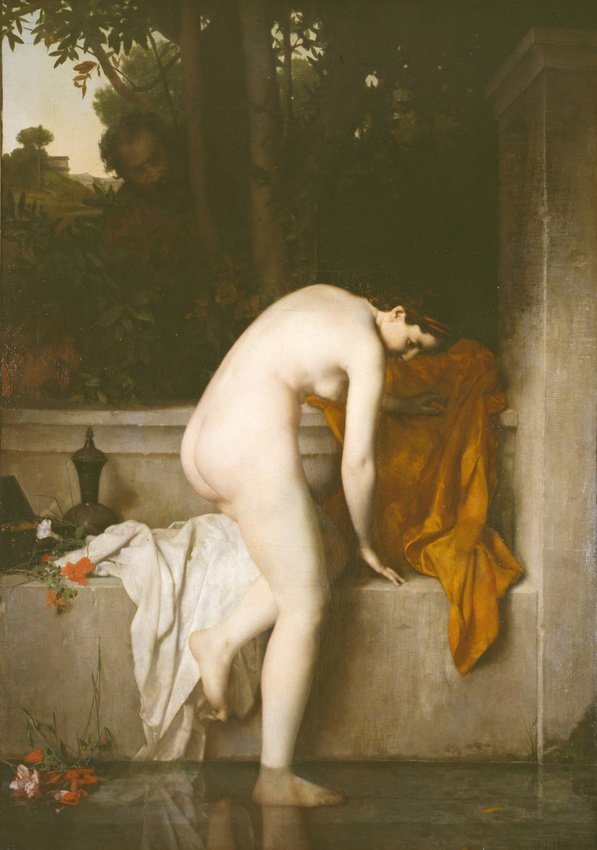
La Chaste Suzanne by Jean-Jacques Henner (1864)

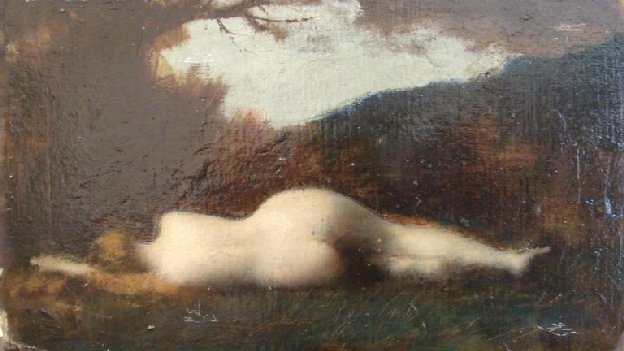
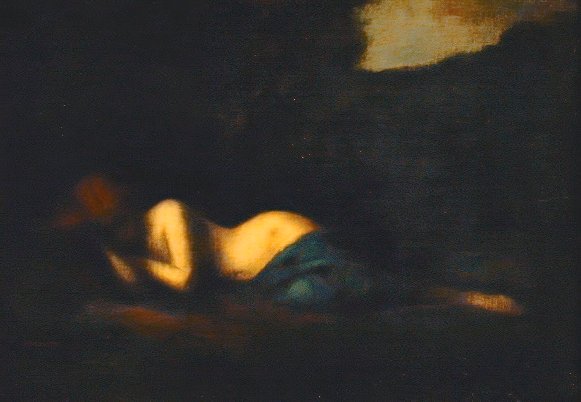
Henner had his painting Bather Asleep exhibited at the Salon in 1863 and at the following year’s Salon his painting La Chaste Suzanne was exhibited. The Biblical episode depicting Suzanne bathing was a popular one for painters and it was above all an opportunity for various artists to paint a beautiful nude. Jean-Jacques Henner sent back his version to the French Academy which he completed whilst in his last year of his residence at the Villa Medici in Rome. For Henner, this was a compulsory exercise, supposed to demonstrate the student’s progress and their skill in execution, and for the Academy to see if their prize winner was advancing artistically.

Sacred Love and Profane Love by Titian (1514)

Henner almost certainly took his inspiration from respected examples left by the great masters’ depiction of nudes which he had seen whilst in the Italian capital. It is thought that Henner was influenced Titian’s 1514 painting entitled Sacred Love and Profane Love which was at the Galleria Borghese in Rome. Henner’s work was not well-received and was harshly criticised for the heaviness and lack of graciousness in the model’s body. It was also criticised for the artificiality of the subject which although being put forward as a history/biblical painting offered little more than a depiction of a bather. However the propensity of ridding any narrative self-justification in painting the nude, and so giving it as a subject in itself, was becoming more common in the work of many contemporary artists, such as Courbet.

Séraphin Henner (brother) by Jean-Jacques Henner (c.1881)

Grégoir Henner (brother) by Jean-Jacques Henner (1889)

While a student in Paris Henner was particularly interested in portraiture, and during his frequent visits home to Alsace he would complete many portraits of his family as well as local dignitaries and scenes of Alsatian peasant life.

Eugénie and Jules Henner by Jean-Jacques Henner (c.1865)

Eugénie and Jules were two of the three children of his brother, Séraphin and his wife, Madeleine. Henner was very close to his nephew and niece and he paid for violin lessons for Jules and piano lessons for Eugenie when they were little. Henner had no children of his own, and on his death, he bequeathed them all that he possessed. Here, Eugénie and Jules are depicted together in their childhood.

Paul Henner by Jean-Jacques Henner (before 1867)

A rather sad portrait. Paul Henner was the third child of Séraphin and Madeleine Henner. He was born in 1860, but sadly died seven years later.

Byblis by Jean-Jacques Henner (c.1870)

In 1864 Henner returned to France and exhibited with great success at the Paris Salon between 1865 and 1903. During his early days back in France his works were of quasi-mythological subjects, such as his 1867 work entitled Byblis, which was exhibited at the 1867 Salon.

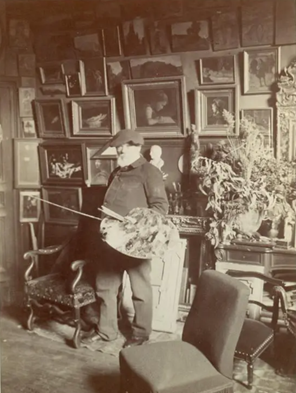
Jean-Jacques Henner in his Paris studio at 11 place Pigalle

Jean-Jacques Henner lived in rue La Bruyère and his studio was at 11 place Pigalle, where he lived from 1867.

L’Alsace. Elle Attend (Alsace, She Waits) by Jean-Jacques Henner (1871)

Jean-Jacques Henner’s birthplace was the region of Alsace and this north-east area of France borders Germany. With the defeat of France in the Franco-Prussian War in 1871, Alsace and northern Lorraine were annexed to the new German Empire. At the conclusion of the First World War, the defeat of Germany, and the Treaty of Versailles, Alsace once again came under French control. In 1940, during the Second World War Alsace–Lorraine was occupied by Germany during the Second World War. Although it was never formally annexed, Alsace–Lorraine was incorporated into the Greater German Reich. With the defeat of Germany in 1945 Alsace returned to French rule. Henner’s 1871 painting entitled L’Alsace. Elle Attend had political overtones. It depicts a young Alsatian woman in mourning and is a political comment on the German annexation of the province after the Franco-Prussian War. The patriotic image was very popular and achieved a wide circulation when it was engraved by Léopold Flameng.
L’Alsace. Elle Attend meaning Alsace, she awaits, was commissioned on the initiative of Eugénie Kestner, a member of the Thann industrial family from Alsace. On completion it was given Léon Gambetta, a French lawyer and republican politician, who was one of the fiercest opponents of the relinquishment of the Alsace-Lorraine region to the new German Empire following the war of 1870. Following the defeat of France by the Prussian armies a sense of fervent and heightened patriotism followed. Henner’s painting quickly became looked upon as a symbol of Alsace’s suffering, a pain shared by the painter who was very attached to the region of his birth. The painting depicts a young Alsatian woman in mourning, unassuming but gracious.

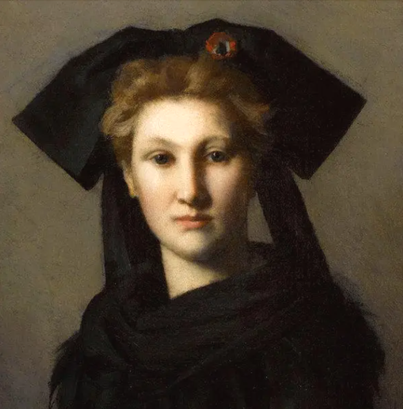
Donna sul divano nero (Woman on Black Divan) by Jean-Jacques Henner (1869)

At that time, Henner had assumed a naturalistic style which can be seen in his painting entitled Woman on a Black Divan, which was exhibited at the Salon of 1869 and now is housed at the Mulhouse, Musée des Beaux-Arts. A smaller version of this painting also included a rosette in the red, white and blue colours of France, pinned onto the traditional black Alsatian bow, gives the painting its patriotic significance without being pompous or anecdotal.

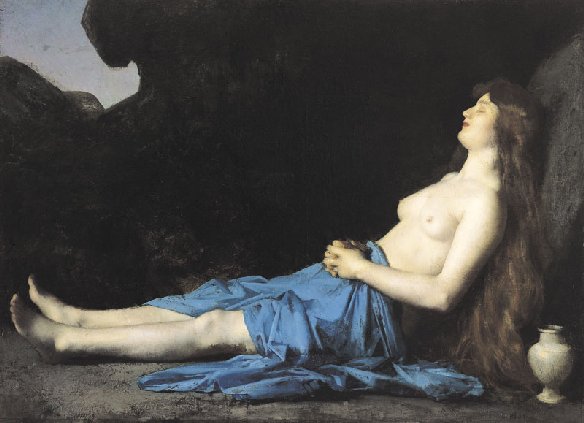
Magdalene in the Desert by Jean-Jacques Henner (1874)

After 1870 Henner’s entire work became a deliberation on the theme of death in various appearances. There were the depictions of Mary Magdalene in what became known as the Magdalene Series, such as Magdalene in the Desert, which was exhibited at the 1874 Salon, and Magdalene Weeping, which he completed in 1885.

Die Magadalena by Jean-Jacques Henner (Exhibited at the 1878 Salon)

La Magdaleine by Jean-Jacques Henner

Henner complted many more Magdalene paintings.

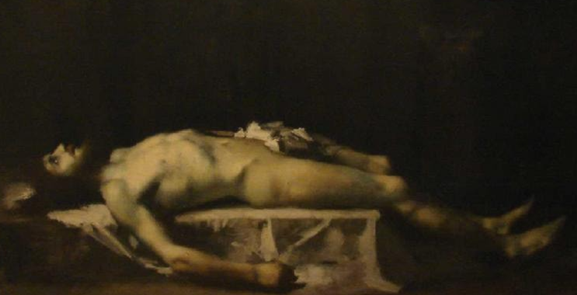
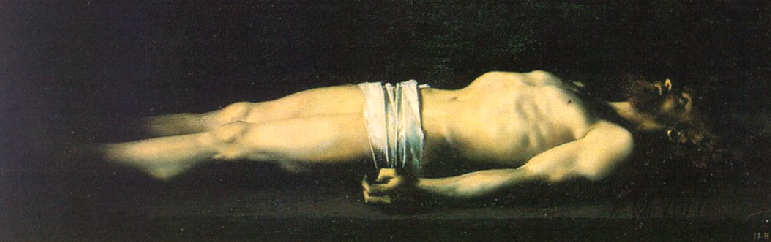
The Dead Christ by Jean-Jacques Henner (c.1884)

Jesus at the Tomb by Jean-Jacques Henner (c.1879)

There was also a number of works in Henner’s Dead Christ series with paintings such as Jesus at the Tomb, which was exhibited at the 1879 Salon and is now part of the Musée d’Orsay collection and the painting entitled Dead Christ which was exhibited at the 1884 Salon and now hangs at the Musée Beaux-Arts in Lille.

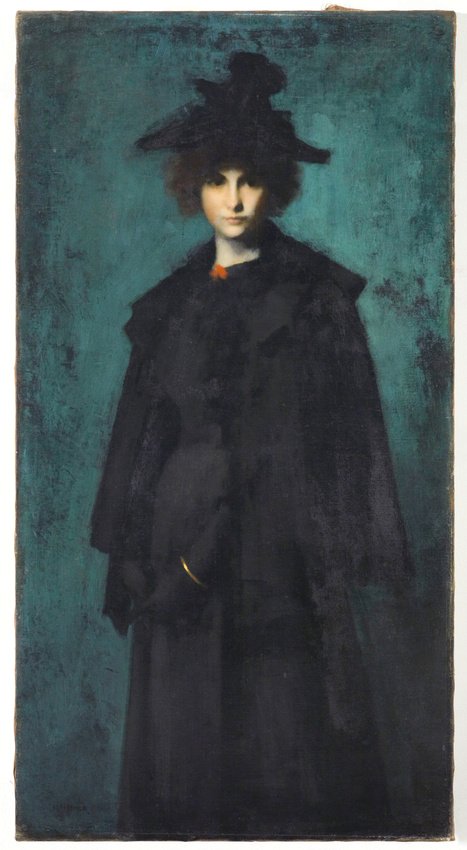
Portrait of Madame Laura Leroux by Jean-Jacques Henner

Jean-Jacques Henner will best be remembered for his portraiture which would provide him with financial stability. During his lifetime he completed many portraits of his family and famous people like his Portrait of Madame Laura Leroux. Laura Leroux-Revault was a French artist and painter. Her first teacher was her father, the painter Louis Hector Leroux and she later trained at the Académie Julian art school in Paris. She also trained under Jules Lefebvre and in Jean-Jacques Henner’s studio. The two artists were friends of her father.

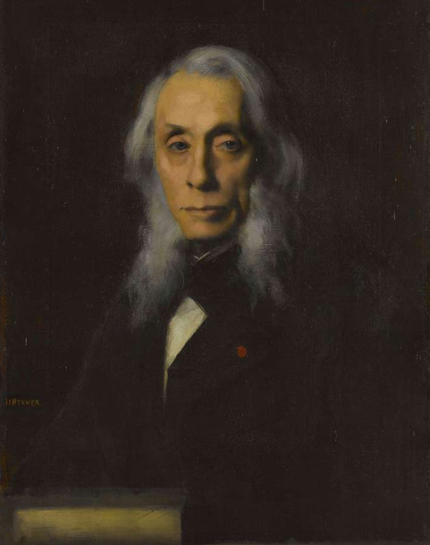
Portrait of Jean-Gaspard-Félix Laché Ravaisson-Mollien by Jean-Jacques Henner (1889)

Another famous person to be immortalised by Henner was Jean-Gaspard-Félix Laché Ravaisson-Mollien, a French philosopher, said to be France’s most influential philosopher in the second half of the nineteenth century.

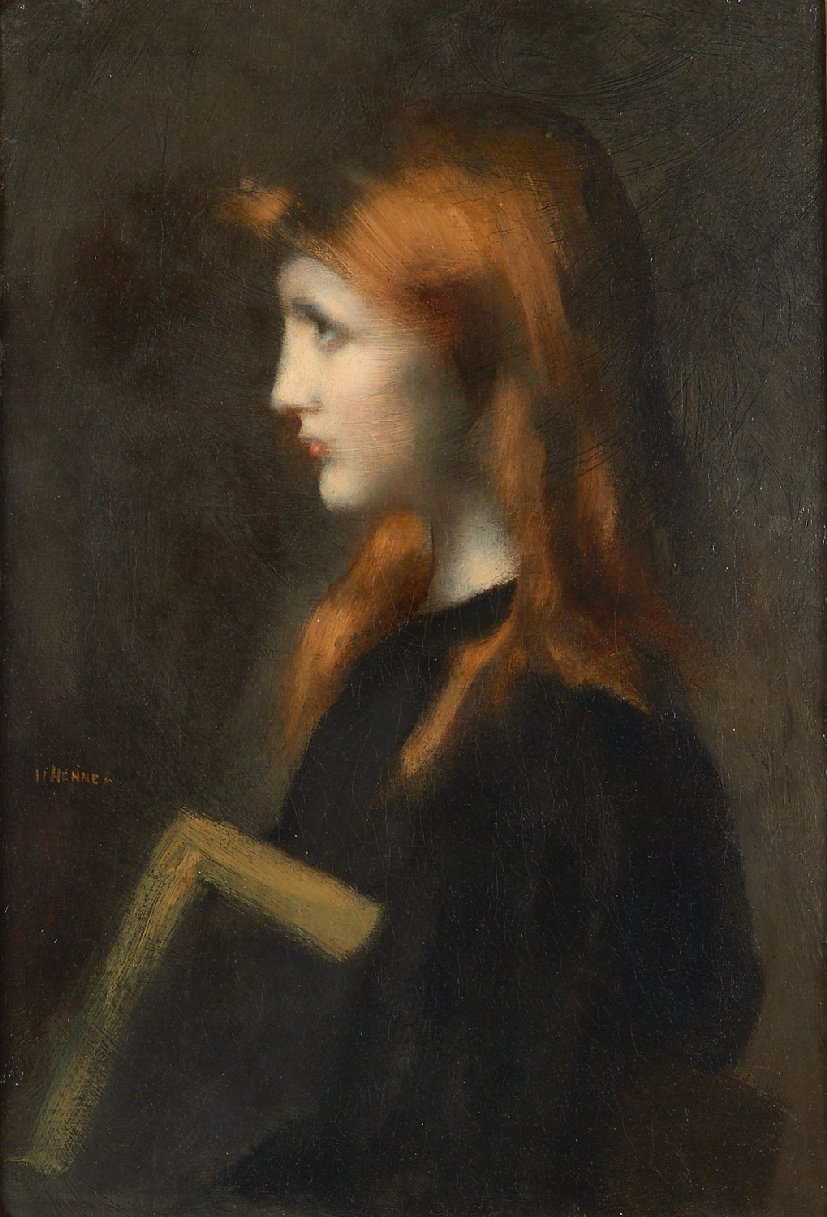
The Reader by Jean-Jacques Henner

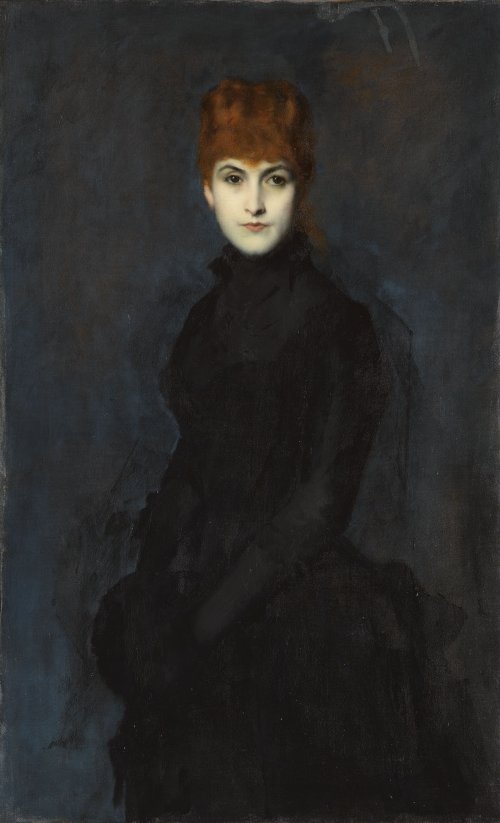
La comtesse Kessler by Jean-Jacques Henner (c.1886)

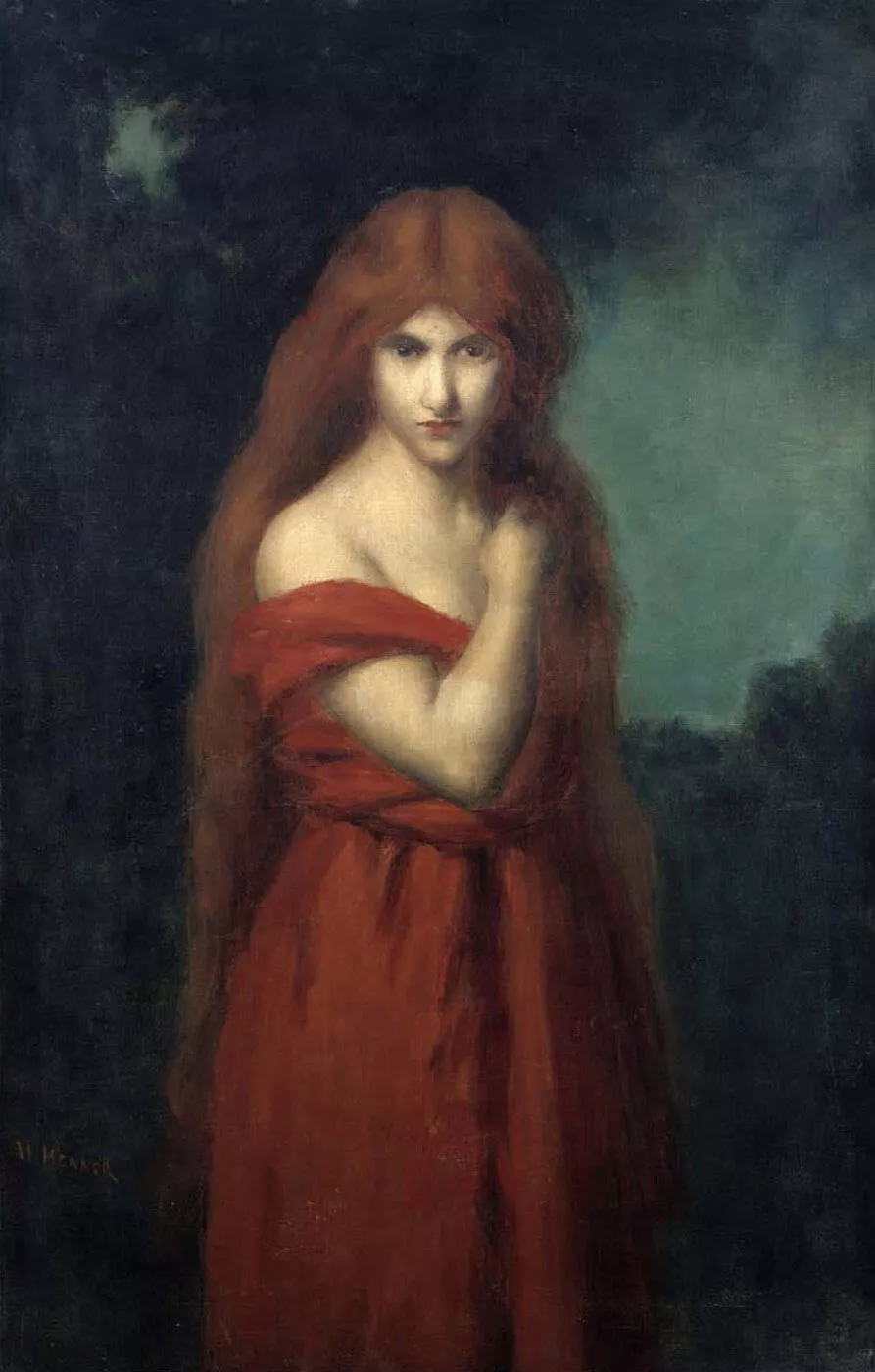
Henner’s love of portraying nudes in historical or mythological settings was not his only love. He had a passion for the colour red and of portraying women with red hair !

Woman in Red by Jean-Jacques Henner

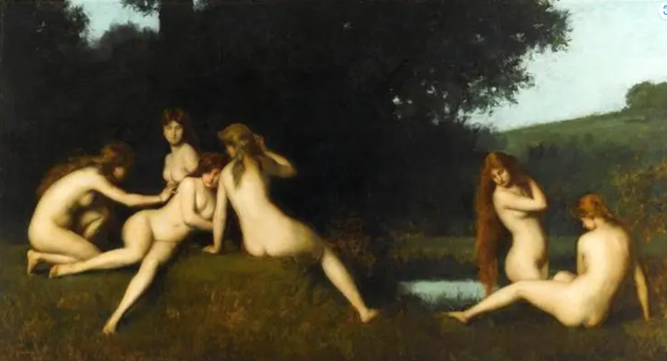
Les Naïades by Jean-Jacques Henner (1861). Painted for the Soyers’ dining room, 43 rue de Fauborg Saint-Honoré. Paris.

Alsatian Girl by Jean-Jacques Henner

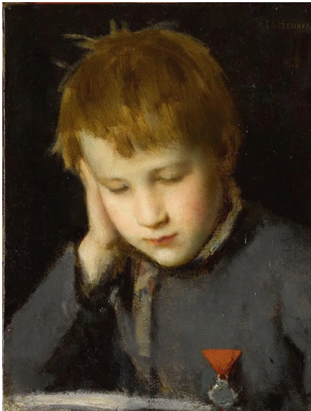
L’Ecoliere by Jean-Jacques Henner

Over the years Henner tutored many aspiring painters. Between 1874 and 1889 he taught at what was termed “the studio of the ladies”, which he organized with Carolus-Duran, during the time when women were not allowed entry to the École des Beaux-Arts. Some of these students also served as his models such as Dorothy Tennant, Suzanne Valadon and Laura Leroux-Revault, daughter of his close friend Hector Leroux; Henner’s full-length portrait of Laura Leroux (shown earlier) is now at the Musée d’Orsay having been shown at the Paris Salon of 1898 and purchased by the French State.

Jean-Jacques Henner (Photograph by Nadar c.1900)

Jean-Jacques Henner died in Paris on July 23rd 1905 aged 76.