
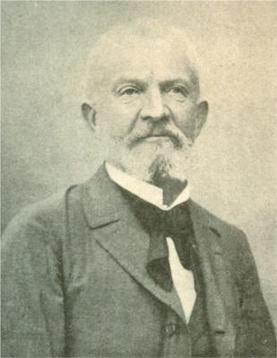
Jean-Baptiste Armand Guillaumin, the French impressionist painter and lithographer, was born on February 16th 1841 in Paris. He was brought up in a working-class family, the grandson of Jean Joseph Guillaumin who was a notary by trade. He was sent to school in Moulins, where his family came from, and this period in central France, made him take note of the beautiful surroundings and the mountainous landscape which stimulated his interest in art and it was also in Moulins that he first met Eugéne Murer, a pastry chef, author, self-taught painter and collector of impressionist paintings, who became his life-long friend.

Farms in Janville by Armand Guillaumin (1878)
By 1857, at the age of sixteen, Guillaumin returned to Paris and began working as a clerk in his uncle’s lingerie shop awhile also studying art under the sculptor Louis Caillouet. His interest in art and the time he spent studying it caused friction with his family and he left to hold a position in the French government railways. He then continued his art training at the Académie Suisse where he trained to draw from the models, in the mornings and evenings. It was here that he first met with Courbet, and began more lasting friendships with painters such as Cézanne, Pissarro and Francisco Oller, a Puerto Rican Impressionist painter.

Garden in Janville in June by Armand Guillaumin (1886)
Now friendly with the artists associated with the Anonymous Society of Painters, Sculptors, Engravers, (later dubbed The Impressionists) he was able to exhibit with them at the first Salon des Refusés in 1863 and their first joint Impressionist Exhibitions in 1874 at the former studio of the photographer Nadar (at 35 Boulevard des Capucines) in Paris, and in total he submitted work to six of their eight annual exhibitions. Still young, the art critics of the time judged him to be an accomplished draughtsman who completed amazing mature compositions. He developed connections with Emile Zola and his circle of friends and was greatly influenced by the artwork of Manet and Courbet.
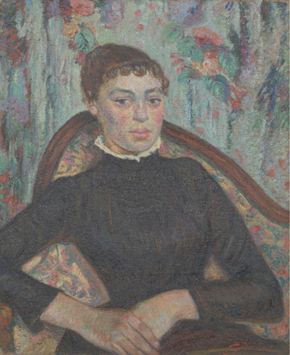
Portrait of a Young Woman by Armand Guillaumin (1876)
One of the problems Guillaumin soon encountered was financial as he had no private income to turn to and so he had to continue holding down a job to survive. This situation was further exacerbated with the advent of the Franco-Prussian War in 1870. Once the War and the Paris Commune fighting had ended there was some hope for Guillaumin who had managed to have himself included with the popular Impressionist movement. Guillaumin and fellow Impressionist, Cézanne had met up with Dr Paul-Ferdinand Gachet, a French physician most famous for treating the painter Vincent van Gogh during his last weeks in Auvers-sur-Oise, and he bought a number of their works. Guillaumin also sold a number of his works to his friend, Eugéne Murer who had recently established a successful café in Paris. Guillaumin and Cézanne began sharing a studio but both found themselves in precarious financial positions despite the sales of their work to Gachet and Murer who continued to be close friends of the pair.

Cottages in a Landscape by Armand Guillaumin (1896)
At the start of the 1880s the Impressionist group was beginning to break apart and it split into two camps. One headed by Pissarro and the other by Degas. Gaugin had vociferously supported Pissarro and he had allied himself with Guillaumin. Although not initially supportive of the Impressionist group having misgivings about what its intentions were, Renoir and Monet joined the Impressionist Exhibition of 1882 with Guillaumin, Gauguin and Pissarro as well as Sisley, Morisot, Vignon and Caillebotte. However, Degas was noticeably absent.

Moulins en Hollandee by Armand Guillaumin (1904)
It was somewhat surprising that Paul Gaugin, known for his irrational behaviour towards his fellow painters, continued to befriend Guillaumin and keep him in the Impressionist group despite its continued disintegration. It was through Gaugin, that Guillaumin met many new young artists who had arrived on the Paris art scene such as the Symbolist painter, Odile Redon, and the Pointillists, Georges Seurat and Paul Signac. In the mid 1880s Guillaumin’ s studio had become a meeting place for the young group of painters. By 1885, new styles of painting had come to the fore and this resulted in further rifts between the old guard of Impressionism resulting in the disintegration of the Impressionist Group. The other factor for the break-up of the Group was its leading man, Gaugin, became more and more temperamental and intolerant and was destroying the Movement from the inside. Guillaumin decided it was time for him to exit the movement which he had been part of from the very start. Guillaumin’s reputation had grown over the last decade and Paul Adam wrote in La Revue Contemporaine:
“…I was not aware of any other painter who has so correctly noted the corresponding values of the lights of the firmament and of the ground…. their unification in colour appears to be perfect…”
Again, Felix Feneon, the French art critic, gallery director, and writer reiterated this, writing about the same show Immense Skies and commented on Guillaumin’s work:
“… superheated skies where clouds jostle each other in a battle of greens and purples, of mauves and of yellows…”

Vue de Port by Armand Guillaumin (1880)
t was in 1886 that Guillaumin married. His wife was his cousin Marie-Joséphine Charreton, a schoolteacher, who was able to support him financially. They settled down at 13 quai d’Anjou in the Saint-Sulpice area of the 6th arrondissement of Paris. It had previously been the studio of the painter Charles-François Daubigny. Guillaumin’s relationship with Pissarro eventually ended with the latter beginning to concentrate on experimentation with pointillism while Guillaumin became progressively interested in romantic art. Guillaumin’s relationship with Gaugin also in due course ended as the latter being constantly away on his travels.

Agay Bay by Armand Guillaumin (1910)
From 1875 to 1880, Guillaumin was a frequent guest of Dr Gachet at Auvers, at a time when he was travelling in that area searching for views of the rural scenery of the Yonne valley to paint and, later, the Creuse valley and the countryside around the farming village of Crozant, where he spent most of his life. Around 1887 Guillaumin became a good friend and mentor to Vincent Van Gogh, who was twelve years his junior. Vincent’s letter to fellow painter Ermil Bernard in December 1887 shows how highly he thought of Guillaumin:
“… I believe that, as a man, Guillaumin has sounder ideas than the others [the Impressionists], and that if we were all like him we’d produce more good things and would have less time and inclination to be at each other’s throats.
Again in a letter to his brother Theo in June 1888, Van Gogh writes about a visit he made to Guillaumin’s house and how he was inspired by him:
“…Wasn’t it pleasant at Guillaumin’s last winter — finding the landing and even the stairs, not to mention the studio — chock-full of canvases? You understand since then that I have a certain ambition, not about the number of canvases, but that these canvases as a whole should, after all, represent a real labour on your part as well as mine…”

Neige by Armand Guillaumin (1876)
In the last decade of the nineteenth century Guillaumin’s circle of artist friends was dwindling. Vincent van Gogh died in July 1890 and his brother Theo, the art dealer, died in the January of the following year. Gaugin and Cézanne had left Paris and Guillaumin and Pissarro’s views on art had diverged so much that their friendship had gradually faded. Despite all this Guillaumin’s life was to change rapidly when won he won the sum of 100,000 francs (about 400,000 euros in today’s money) in a state lottery. This completely changed his life. He no longer had to rely on commissions. He no longer had to exude a subservience towards patrons. He was now able to paint what he liked and strive for his own artistic goals.
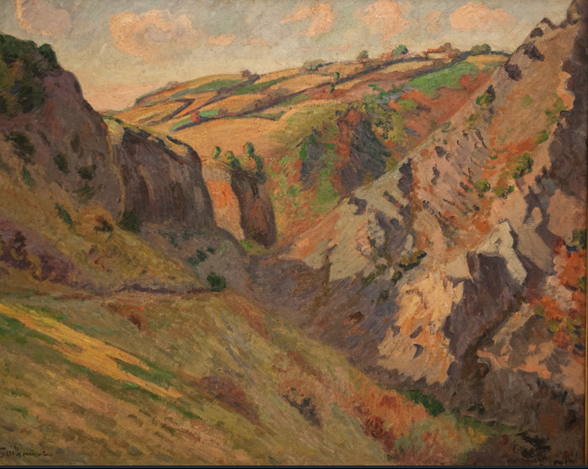
Caves Prunal near Pontgibaud by Armand Guillaumin
With this newly found wealth Guillaumin set off travelling around France capturing on his canvases the beautiful views of the countryside, mountains and the coast, often during sunrise and sunset. His continuous journeying around was brought to an end with the onset of The Great War of 1914. Once the war came to an end he once again set off on his travels but by then he was seventy-seven and he, like his artistic output, was declining. In 1926 a retrospective exhibition was held at the Salon d’Automne. He died at the Chateau de Grignon in Orly, Val-de-Marne, just south of Paris, on June 26th 1927 aged 86. He was the last survivor of the Impressionist Group.
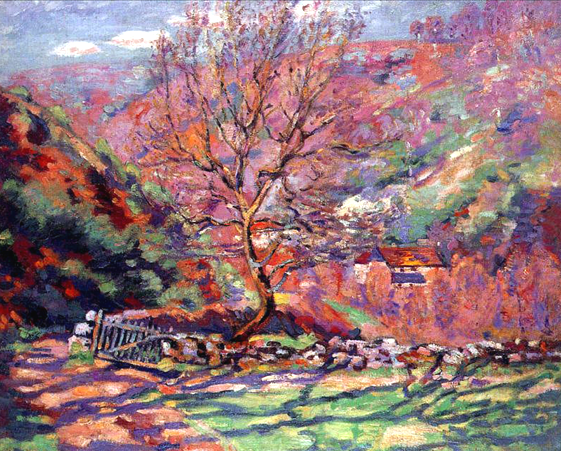
Crozant, Solitude by Armand Guillaumin (1915)
Guillaumin’s paintings are renowned for their intense colours and can be found in major museums around the world. Most of all he is best remembered for his landscapes of Paris, the Creuse département, and the area around Les Adrets-de-l’Estérel near the Mediterranean coast in the Provence-Alpes-Côte d’Azur region of France. Guillaumin became known as the leader of the École de Crozant, a disparate group of painters who came to portray the landscape in the region of the Creuse around the village of Crozant.

Paysage à Crozant (1917)
One such depiction is entitled Landscape in Crozant, is part of the Art Institute of Chicago collection.
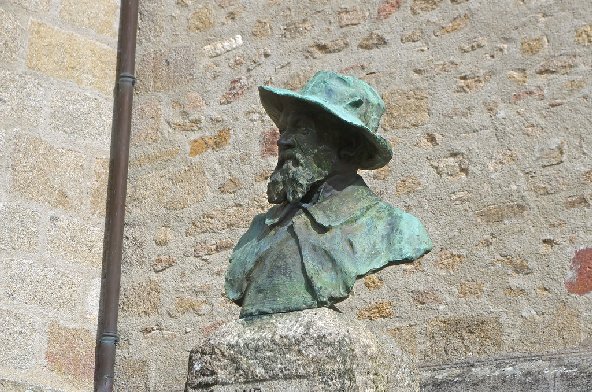
His bust is in the square near the village church in Crozant.

 my daily art display
Love reading your posts . Thank you so much for sharing your knowledge, enthusiasm and time with us.
These paintings are a riot of color. So talented and so little known. Guillaumin should be cruising up in the sky with other eagles of impressionism.
Never heard of him before. Love his work.
un gran maestro …seguidor de esa linda escuela pictotica del impresionismo frances …un genio.
perezcubas@hotmail.com