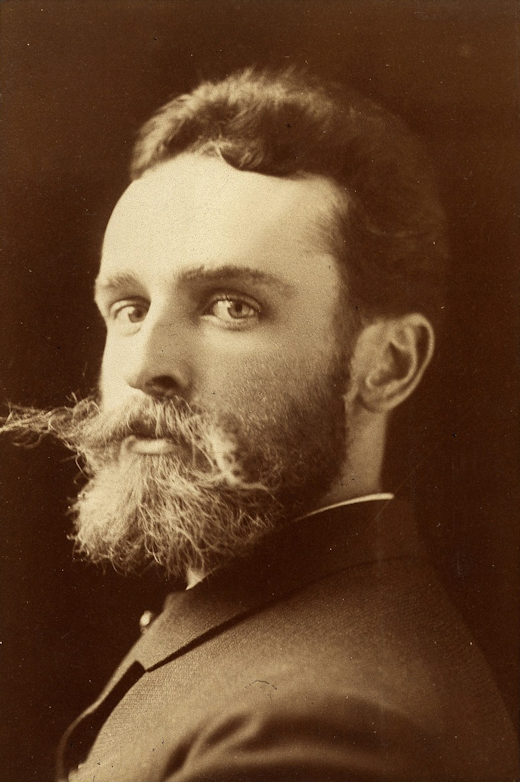
Wilhelmina Douglas Hawley

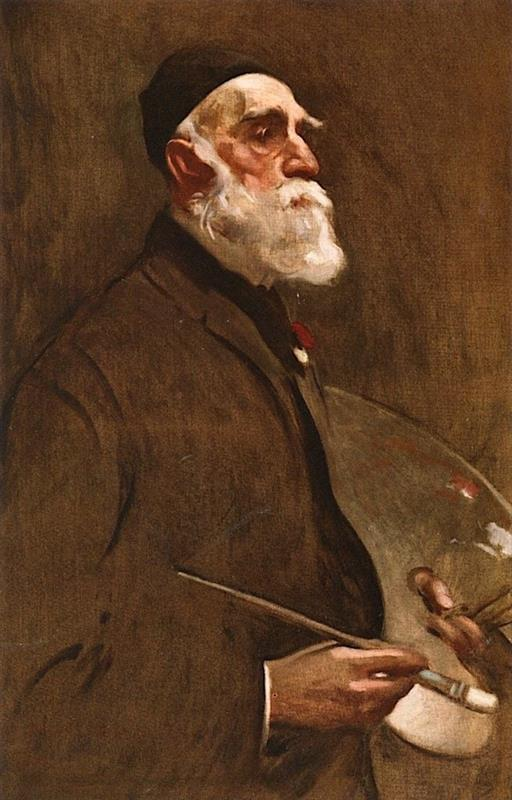
Wilhelmina Douglas Hawley, Self Portrait (1897)

The artist I am featuring today is the American painter and watercolourist Wilhelmina Douglas Hawley.  She was born on July 13th 1860 in the small coastal town of Perth Amboy, New Jersey. Her father, Peter Radcliffe Hawley was an officer in the coast guard and her mother, Isabella Hawley (née Merritt), a Canadian-born dancer. Wilhelmina’s ancestors were English and Scottish migrants, who moved to the east coast of the United States and Canada in the seventeenth and eighteenth century

Birthplace of Wilhelmina Douglas Hawley, Merritt Peck House, 213 High Street, Perth Amboy, New Jersey

Wilhelmina had three siblings: an older sister Jeanne and two younger brothers William and Alan Ramsey.  When Wilhelmina was four-years-old, the family moved to the New York suburb of St Albans, a residential neighbourhood in the southeastern portion of the New York City borough of Queens. Wilhelmina developed two loves during her pre-teen years.  One was a love of sketching and painting thanks to two of her unmarried aunts, Florence and Georgina Agnes Merritt and the other was the love of travel once her grandparents took her to Europe when she was just twelve years of age and it was the excitement of visiting so many new places that encouraged her to start writing a journal.

The Cooper Union

Wilhelmina soon developed a love of art and decided to follow the dream of becoming a professional painter.  In 1879, at the age of nineteen, she enrolled in the Cooper Union Women’s Art School, one of the New York art academies that is open to women.  The Cooper Union for the Advancement of Science and Art was established in 1859 and is among the nation’s oldest and most distinguished institutions of higher education. The college, founded by inventor, industrialist and philanthropist, Peter Cooper, offers a world-class education in art, architecture and engineering as well as an outstanding faculty of humanities and social sciences.  Cooper took the revolutionary step of opening the school to women as well as men. There was no colour bar at Cooper Union. Cooper demanded only a willingness to learn and a commitment to excellence, and in this he manifestly succeeded.
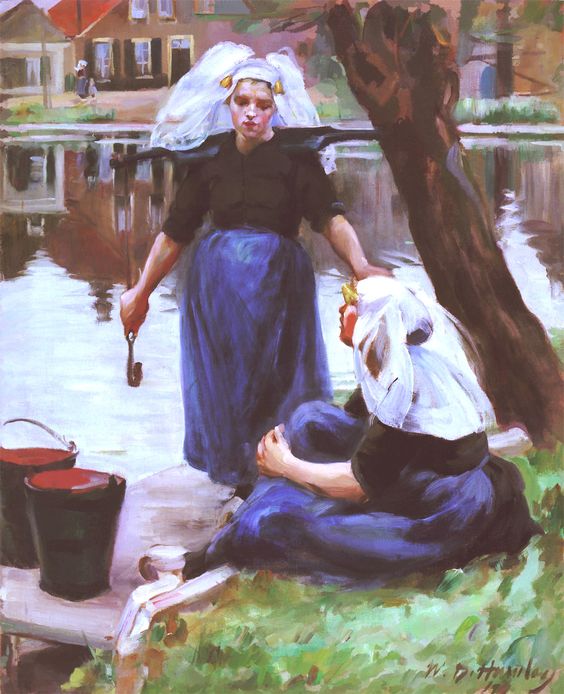
Two Women near the River Waal by Wilhelmina Douglas Hawley (1894)

Wilhelmina remained at the Cooper Union for a year and then enrolled at the Art Students League where she honed her artistic skills eventually becoming the first woman vice-president of this progressive institution. Her tutors included William Merritt Chase, Julian Alden Weir, Charles Yardley Turner and Kenyon Cox. The popularity of the Art Student League was that it was based in New York and the city attracted many European artists, many of whom Wilhelmina met while living and studying at the Arts League.

Young Woman in the Meadow by Wilhelmina Douglas Hawley

To escape the cold climate of New York, Wilhelmina spent the winter of 1891/2 on the island of Bermuda where she fell in and out of love with a mysterious Englishman whom she had agreed to marry.  Fortunately, she realised the error of her judgement and the two split up.  Once again, like so many American artists of the time, who succumbed to the magnetism of Paris, Wilhelmina was drawn towards the French capital to continue with her artistic tuition. On June 18th 1892, just a month before her thirty-second birthday, Wilhelmina once more, set sail for Europe on the Holland-America steamer Veendam.  During her Atlantic voyage, Wilhelmina was accompanied by the Dutch-American artist John Vanderpoel and his wife Jessie Elizabeth Humphreys. Vanderpoel. He was a well-known artist and taught at the Art Institute of Chicago where one of his tudents was Georgia O’Keeffe, and it was he who most likely suggested to Wilhelmina that she should spend the summer months at the charming village of Rijsoord near Dordrecht in the Netherlands, where he had founded an artists’ colony in 1886. 

Interior with Mother, two Children and Cat by Wilhelmina Douglas Hawley

On arriving in Paris Wilhelmina registered at the Académie Julian, one of only two art academies in the city to which women and foreign students were admitted.  Having arrived in the Summer, all the Academies were closed for the summer break and would not re-open until the September.  Wilhelmina used the time to travel throughout Belgium and the Netherlands and on 4 July 1892 she made her first visit to the Dutch flax village and artists’ colony at Rijsoord, where various foreign artists and art students had been living and working since 1888 especially during the summer months.  In 1893, Wilhelmina achieved her first artistic successes at the French Academy where she was awarded a prize for best composition.  Also for the first time, one of Wilhelmina’s paintings was selected for the Paris Salon that year, and success came from across the Atlantic when her painting, Holland Peasant Girl was shown in New York at an exhibition of the National Academy of Design
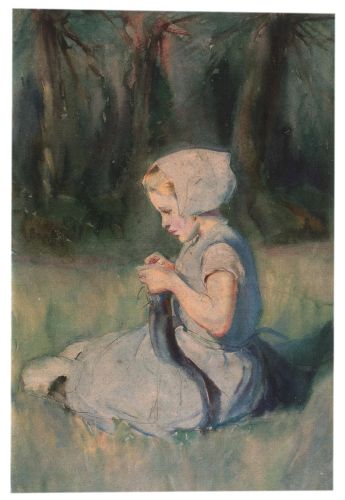
Girl Knitting in a Field by Wilhelmina Douglas Hawley

In 1893, Wilhelmina was appointed as an art teacher at Academy Colarossi and it was around this time that she met English-born Canadian art student, Laura Muntz  A friendship between the two women sprung up and Laura moved in with Wilhelmina at her studio at No. 111 Rue Notre-Dame-des -Champs. Close to the Palais de Luxembourg.  Directly across from their studio was the studio of American artist, James Abbott McNeill Whistler.  Both Laura and Wilhelmina were regular visitor to Whistler’s studio, and he to theirs.
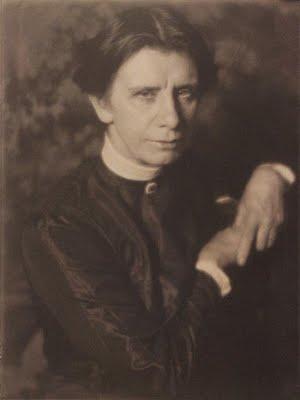
Laura Muntz Lyall

Laura Munz, who was born in 1860 in Radford, Warwickshire, England, was the same age as Wilhelmina and is recognised as one of the most talented painters of her time.  She was an impressionist painter, best known for her depiction of mothers and children. When she was a small child, she emigrated with her family to Canada, where grew up on a farm in the Muskoka District of Ontario. 
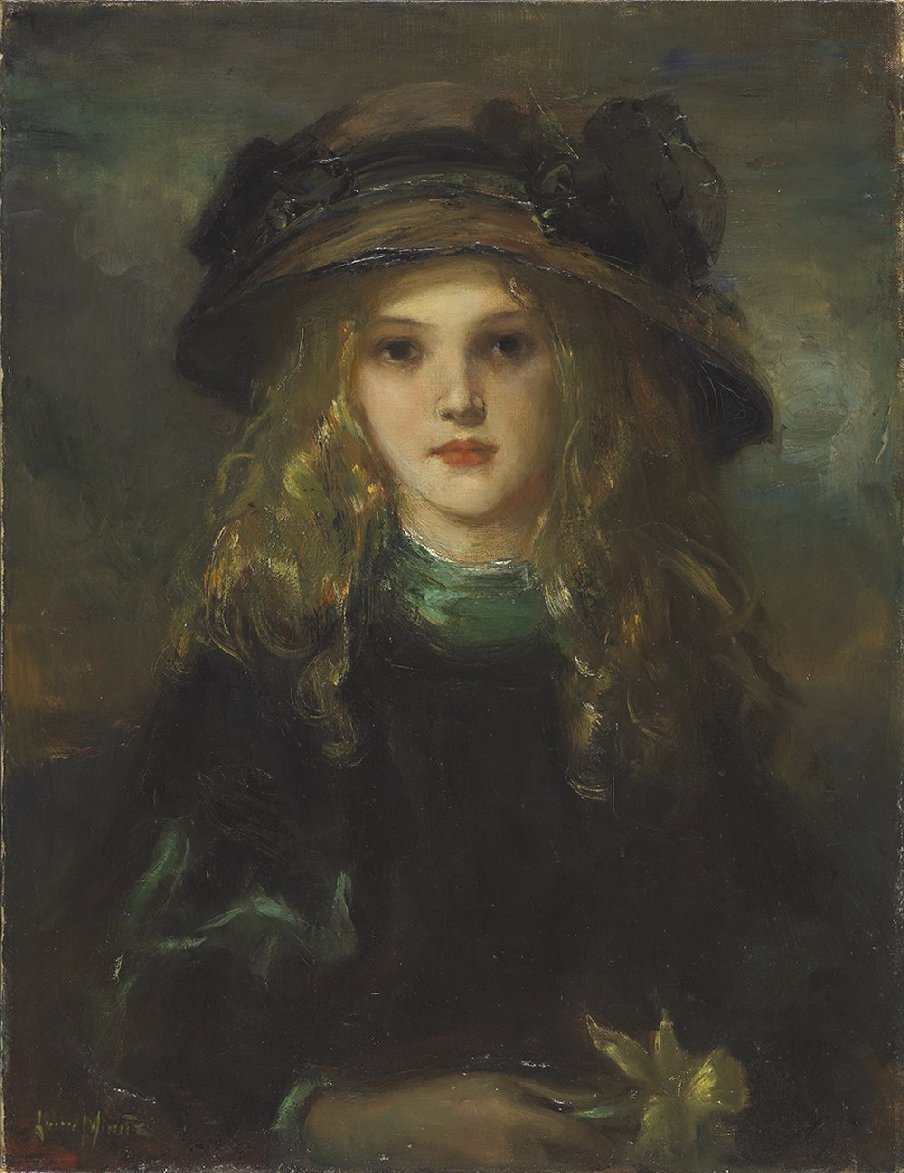
A Daffodil by Laura Munz Lyall (1910)

In 1882, Laura began to take classes at the Ontario School of Art in Toronto.   She also studied briefly at the South Kensington School of Art in 1887, then returned to Canada to continue her studies at the Ontario School. She came to Paris in 1891 and before she met Wilhelmina had been living alone and earning money by teaching and administrative work.  She was the first Canadian to receive the distinguished “Honourable Mention” at the Paris Salon exhibition in 1895.

Portrait of Wilhelmina Douglas Hawley by Laura Munz (1897)

In 1896 Laura returned to Canada for a short spell to help look after an ailing relative.  She returned to Paris and the Academy Colarossi and was promoted to the post of  massiere (Studio head) at the Académie Colarossi.  In 1898 she returned to Canada in 1898 and set up a studio in Toronto to teach and paint.  In 1906, she moved to Montreal to continue her career and built up a large clientele that regarded her as the premier Canadian portraitist of children.  Following the death of her sister in 1915, she returned to Toronto and married her brother-in-law Charles W.B. Lyall and cared for his children of her sister’s marriage, eleven in all, but many had left home by then.  She set up a studio in the attic of their home, and started signing her works with her married name. Laura Munz Lyall died in Toronto in 1930, aged 70.
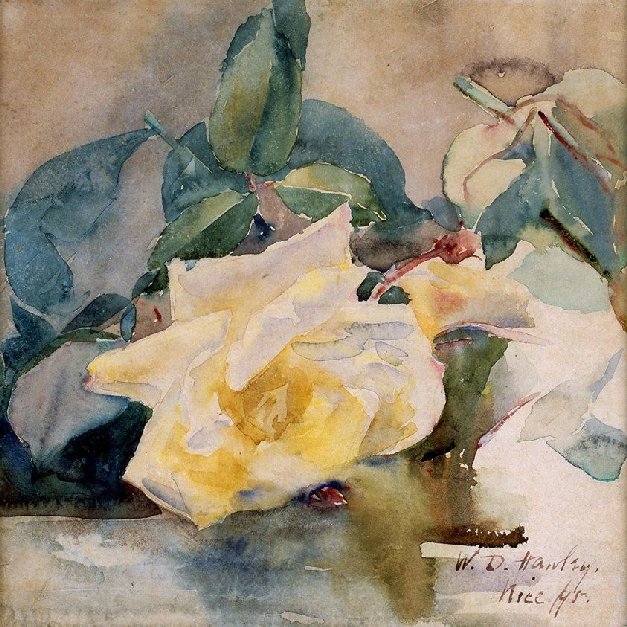
Rose by Wilhelmina Douglas Hawley (1895)

Wilhelmina and Laura spent part of the summers in the French countryside as well as the artists’ colony of Rijsoord in the southern Netherlands. She would often take her international students of the Académie Colarossi with her on these painting trips.   It was here that Wilhelmina captured the villagers in oils and watercolours. The village of Rijsoord was well situated for passing travellers on the Rijksstraatweg (State Highway), an important European road that connected Paris to The Hague.
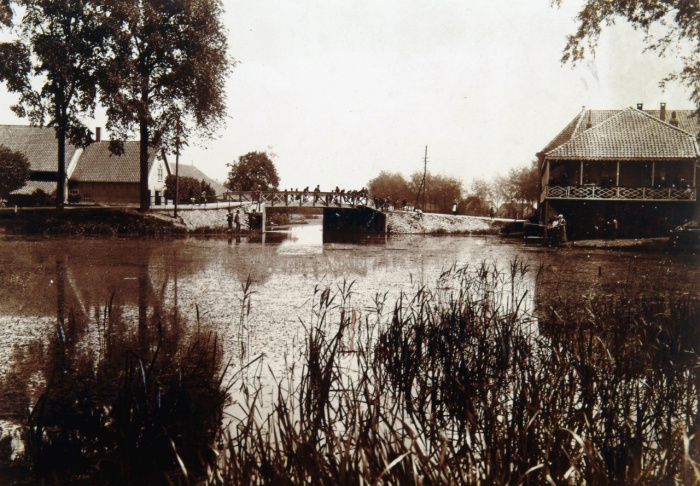
The bridge over the River Waal at Rijsoord, with Hotel Warendorp on the right

An inn was constructed on the spot near the river Waal where the eighteenth-century tollhouse had stood. The building is still standing and for several years had housed the restaurant Hermitage. When Wilhelmina first visited Rijsoord, the inn was called Hotel Warendorp. Hotel Warendorp functioned as the headquarters of the summer academy. The ground floor of the building comprised a livingroom, diningroom and a room for drinking coffee. Most of the guestrooms were also on the ground floor. On the floor above it, the large space under the roof was used as an artists studio, where the artists would hang their most recent paintings and watercolors for discussion. On rainy days, when it was impossible to work en plein air, the artists would actually work in the studio. Wilhelmina’s great granddaughter, Alexandra van Dongen, wrote about how her great grandmother met her husband in her blog: For Two Years, or Perhaps Forever”; Wilhelmina Douglas Hawley and the Artists’ Colony in Rijsoord.  The tale is an instalment in a monthly series of blogs telling stories about the rich history shared by the American and the Dutch peoples.  She wrote:

“…In 1899, Wilhelmina apparently first encountered the 31-year-old Rijsoord farmer Bastiaan de Koning (1868-1954). They most likely met during a boat trip on the river Waal, as the story goes, as local villagers including De Koning, regularly rowed the artists to their outdoor painting locations. In the summer of 1900 Wilhelmina returned to Rijsoord again and announced her engagement to Bastiaan. They married a year later on December 5, 1901. Another three years later, when Wilhelmina was 44 years old, she gave birth to a daughter, my grandmother, Georgina Florence de Koning (1904-1973), named after Wilhelmina’s aunts. By that time, Wilhelmina had been active in the art world for twenty-five years. Family life did not prevent her from traveling abroad, visit exhibitions or meet her friends in Paris and New York. In 1915, her family in Rijsoord engaged a young housekeeper, Geertrui van Nielen (1895-1981), who became an important supporter in her life. Trui, or Troy, as she was called by Wilhelmina, took care of household matters and looked after Georgy, as Wilhelmina’s daughter was called, when her mother was traveling abroad …”
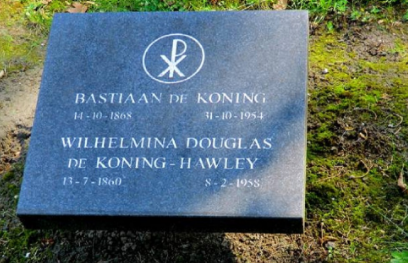
Wilhelmina continued to live with her husband and daughter in Rijsoord.  Years later she enjoyed the summer holiday visits from her daughter, Georgy, her husband, Hans van Dongen and their six children.  On February 18th, 1958, Wilhelmina Douglas Hawley passed away at home at the age of 97.


The information I used for this blog came from a number of excellent websites, all of which are worth visiting. They are:

The Society of the Hawley Family

For Two Years, or Perhaps Forever”; Wilhelmina Douglas Hawley and the Artists’ Colony in Rijsoord

Wilhelmina Douglas Hawley

Schildersdorp Rijsoord 1886-1914

New York Almanack


John White Alexander

During the nineteenth century, Paris was considered the art capital of the world.  Once the American Civil War had ended, aspiring American artists, who had the necessary funds, made their way across the Atlantic to the French capital and enrolled in one of the many ateliers there, to learn from the foremost painters of the time.  Many enrolled in the prestigious government-sponsored École des Beaux-Arts and in thriving private academies and studios.  They also had the chance to visit the Louvre and study the works of the Masters of byegone days and be impressed by the modern works on display at the Paris Salons, World’s Fairs, and other exhibitions, including the eight shows staged by the Impressionists.  These young Americans also submitted their own works to the various exhibitions.  Today I am looking at the life of one such American, John White Alexander.

The American photographer and art critic, John Nilson Laurvik, wrote about my featured artist in the December 1909 edition of the Metropolitan Magazine:

“…In the whole history of art one looks in vain for anything approaching his inimitable skill in the arrangement and play of his figures. . . .[He is] pre-eminent as a delineator of feminine beauty and charm…”

John White Alexander

John White Alexander was an illustrator, landscape and still life painter, printmaker, muralist, society portraitist,  and production designer of posters, costumes, scenes, lighting, and tableaux vivants.  Alexander was born on October 7th, 1856, in Allegheny, Pennsylvania, which is now a part of the city of Pittsburgh.  He was orphaned at the age of five and was subsequently raised by his grandparents. When Alexander was 12 years old, he quit school and became a telegraph boy. One of his employers, Colonel Edward Jay Allen, the secretary/treasurer of the Pacific & Atlantic Telegraph Co., noticed Alexander’s aptitude for drawing and began working with him to help him develop that talent. So impressed with Alexander that he assumed guardianship of the young boy and persuaded him to return to the local High School for eighteen months.

Six years later, in December 1874, Alexander and a friend took a trip down the Ohio River,  earning money for food by sketching farmhouses and selling them to the locals.  It is said that Mark Twain read about their trip and a number of incidents on their voyage of exploration were used in his 1884 novel,  Huckleberry Finn.  Soon after his adventure, Alexander relocated to New York and spent three months seeking a job in New York City, visiting a number of publishers, showing his sketchbook.  He was finally employed as an office boy at Harper’s Weekly magazine where he was later promoted to illustrator and political cartoonist in 1875. He remained working for the magazine for three years. 

Alexander then travelled to Paris but found it very expensive and moved on to Germany and the city of Munich where he received his first formal artistic training at the Royal Academy, winning a bronze medal for drawing.    It was in Munich that Alexander first met Kentucky-born German painter, Frank Duveneck.  In 1878, Duveneck had opened a painting school in Munich.

Portrait of John White Alexander by Frank Davenek (1879)

However, like Paris, the cost of living in the city of Munich proved too onerous for Alexander and so he and Duveneck moved to the Bavarian town of Polling, a small town fifty miles east of Munich, where Duvenek set up another painting school and Alexander taught a private watercolour class in Duveneck’s school.  His students were known as the Duveneck Boys and included such aspiring painters as John Twachtman, Otto Henry Bacher, and Julius Rolshoven.  In 1879 Duvenek completed a portrait of John White Alexander.

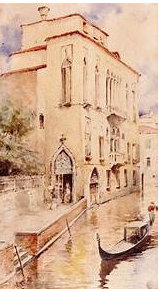
Venice Canal Scene by John White Alexander (1880)

From 1879 to 1881, Alexander travelled and studied with Frank Duveneck in Italy. The pair spent the summer of 1880 in Venice.    One day, Alexander met Whistler by chance as he was painting next to a canal. Alexander returned to America in 1881 and was able to pick up illustrative commissions from various magazines.  One such commission saw him travelling 2,100 miles along the Ohio River in the Spring of 1881 resulting in sixteen sketches of the local coal industry.

Oliver Wendell Holmes by John White Alexander

On his return to America besides returning to his work as an illustrator, he became a very successful portrait artist. Many well-known individuals sat for Alexander such as Oliver Wendell Holmes, an American physician, poet, and humourist notable for his medical research and teaching, and as the author of the “Breakfast-Table” series of essays.

…..also Thomas Worthington Whittredge, an American artist of the Hudson River School.

Walt Whitman by John White Alexander (1889)

….and Walter Whitman Jr. who was an American poet, essayist, and journalist. He is considered one of the most influential poets in American history.

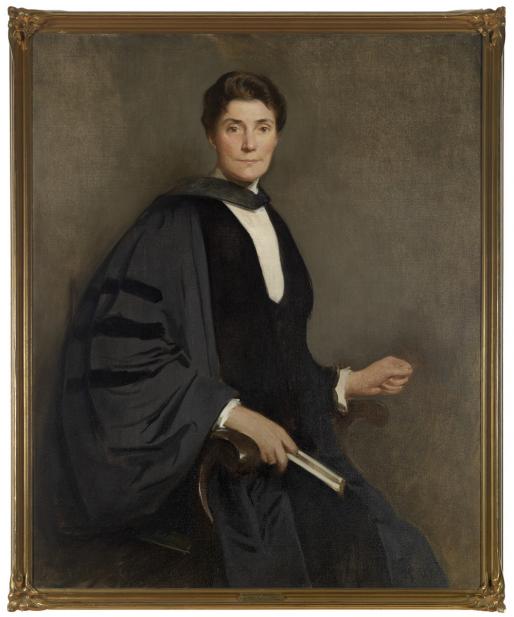
Mary Emma Woolley by John White Alexander

In 1909, Alexander completed the portrait of Mary Emma Woolley, an American educator, peace activist and women’s suffrage supporter. She was the first female student to attend Brown University and served as the 10th President of Mount Holyoke College from 1900 to 1937.  It is a beautiful portrait of the woman, exuding elegance and his brushstrokes along with the delicate shadows depict her as a dignified woman of great importance.  The sitter lightly thumbs a book with one hand while the other is clenched into a fist which was possibly referencing her knowledge and passion.  It is said that the way Alexander portrays Woolley validates a tendency among male artists of this era, who often painted women as domestic, inwardly emotional beings with exquisite exterior refinement.

Owing to the fact that they both had the same surname, John White Alexander was introduced to and later married, Elizabeth Alexander.  She was the daughter of James Waddell Alexander, president of the Equitable Life Assurance Society.   John and Elizabeth had one child, the mathematician James Waddell Alexander II.  In 1881 John White Alexander completed a black and white sketch of Elizabeth.

Portrait of Mrs John White Alexander (1902) by John White Alexander

……….and in 1902 he completed a full-length portrait of his wife.

Azalea (Portrait of Helen Abbe Howson) by John White Alexander (1885)

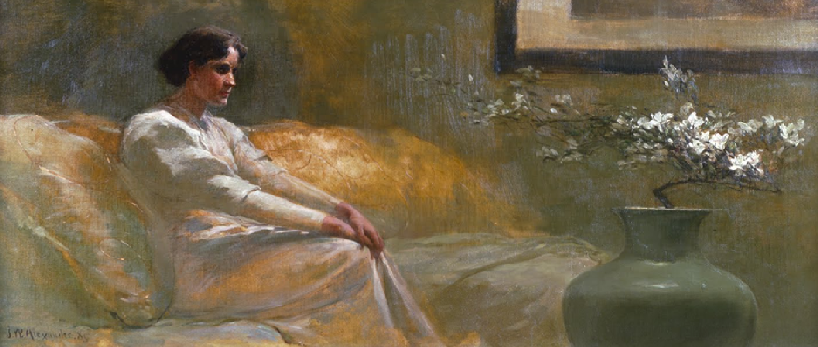
A turning point in Alexander’s artistic career came when, during a summer European holiday in 1884, he wrote to his early mentor, Colonel Allen, telling him of his desire to complete a “subject picture”. The result was his 1885 painting entitled Azalea (Portrait of Helen Abbe Howson). In Alexander’s painting, we see Howson adorned in a white dress seated on a sofa on the left of the horizontally elongated painting.  To counteract that, on the right is a white-flowering azalea branch in a large celadon vase and on the back wall one can see the bottom of a framed image.  The main title of the painting refers to the flowers Helen Howson stares pensively across the room at.  This pose of Howson is one of contemplation and in many of his figurative works Alexander depicts women who avoid the gaze of the viewer.  Some believe that Alexander’s depiction of self-conscious subdued women may be his way of counteracting the growing activism of women in their battle for suffrage and other forms of equality that was manifesting around this time.

Whistler’s Mother by James Mcneil Whistler

Historians believe the depiction was influenced by Whistler’s portrait of his mother which had been exhibited in New York in 1882.  The poses are similar. The “cut-off” picture frame is depicted in both paintings.

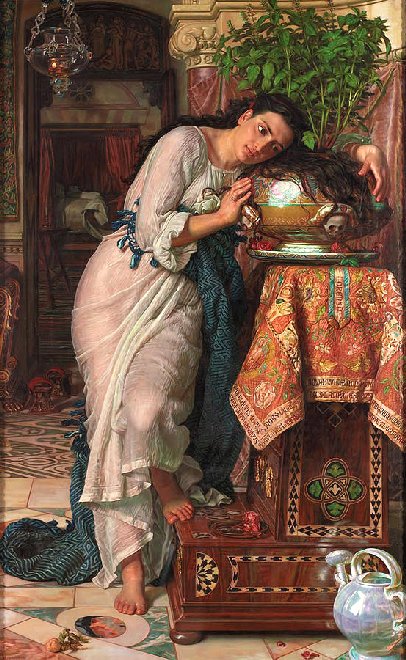
Six years later in 1897 Alexander completed another memorable work featuring a single woman.  It was entitled Isabella and the Pot of Basil and is based on a poem written by the English poet John Keats entitled Isabella, or the Pot of Basil. Keats had actually “borrowed” his tale from the Italian Renaissance poet Giovanni Boccaccio.  The story goes that Isabella was a Florentine merchant’s beautiful daughter whose ambitious brothers disapproved of her romance with the handsome but humbly born Lorenzo, their father’s business manager. The brothers murdered Lorenzo and told their sister that he had travelled abroad. The distraught Isabella began to decline, wasting away from grief and sadness. She saw the crime in a dream and then went to find her lover’s body in the forest. Taking Lorenzo’s head, she bathed it with her tears and finally hid it in a pot in which she planted sweet basil, a plant which is now associated with lovers. 

This scene was made famous by William Holman Hunt’s 1868 version…

 …….and the 1907 one by John Waterhouse,

However Alexander’s pictorial rendition of the scene is so different to the other two.  His depiction has used theatrical effects to depict this gruesome scene.  He has isolated Isabella in a shallow recess and illuminated her from below, almost as if she were an actor on a stage who has been illuminated solely by the footlights.

There is an eeriness about the way Alexander has utilised a cold monochromatic palette, and if we allow are eyes to follow the sensuous curves of Isabella’s gown, they are finally drawn to the loving attention Isabella gives the pot, as she gently caresses it. Isabella seems to be in a world of her own totally oblivious to us, the viewers.  It is a tragic depiction of lost love.

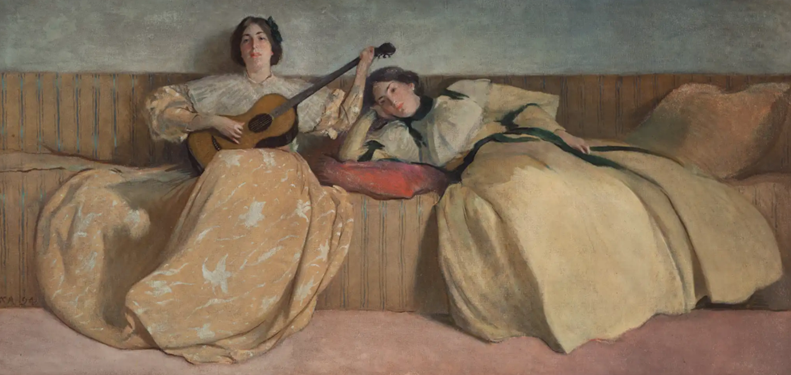
Panel for Music Room, by John White Alexander (1894)

There has always been a connection between fine art paintings and music.  So many famous works of art have depicted people playing musical instruments.  It is the conjoining of two great arts.  Many such paintings depict young ladies playing a musical instrument or intently listening to a musical recital.  Take a look at this beautiful work by John White Alexander as he depicts two young women laying back languorously on a long and plush sofa. 

Look carefully at their facial expressions.  The woman on the left who is playing the guitar is lost in concentration and in some ways seems mesmerised by the sounds coming from her instrument.  The woman on the right lies towards her resting on an ornate cushion.  She seems to be in a dream-like state lost in thought.  It is a frieze-like horizontally elongated depiction which measures 94 x 198cms (33 x 78 inches) portraying a dream-like atmosphere.

Memories by John White Alexander (1903)

Another of Alexander’s paintings featuring the interaction between two women is his 1903 work entitled Memories.

Repose by John White Alexander (1895)

One of Alexander’s most famous works is his 1895 painting entitled Repose. Once again it is a depiction of a woman lying languourously across a large cushion on a long sofa. The curves of her body can be seen despite the voluminous white dress she wears. Her head rests on her hand and she looks out at the viewer. 

The facial expression of the woman, whose lips are slightly parted, gives an added touch of sensuousness to the depiction. This provocative facial expression along with the sinuous curves are a reflection of the then current French taste for sensual images of women as well as the undulant linear rhythms of Art Nouveau.

Murals by John White Alexander on the Grand Staircase of the Art Museum of the Carnegie

Alexander held his first exhibition in the Paris Salon in 1893 and it was held to be a brilliant success.  Immediately following the exhibition, he was elected to the Société Nationale des Beaux Arts.  In 1901 he was named Chevalier of the Legion of Honor, and in 1902 he became a member of the National Academy of Design. He was elected a member of the American Academy of Arts and Letters and in 1900 at the Paris Exhibition he was awarded a gold medal.  Another gold medal was awarded to him in 1904 at the World’s Fair at St. Louis. His works are in museums in both America and Europe.

Grand staircase, Art Museum of the Carnegie Institute in Pittsburgh

In addition, in the entrance hall to the Art Museum of the Carnegie Institute in Pittsburgh, a series of Alexander’s murals entitled Apotheosis of Pittsburgh covers the walls of the three-storey atrium area.

View overlooking Grand Staircase of the murals by John White Alexander

At the top of the Grand Staircase of the Carnegie Art Museum in Pittsburgh, a cultural haven sponsored by industrialist Andrew Carnegie, there is a sweeping mural completed by John White Alexander in 1907.  This total number of murals cover almost 4,000 square feet of wall space of the interior.  The Apotheosis of Pittsburgh is a series of forty-eight murals, all painted by Alexander between 1905 and 1915.  The murals reflect turn of the century Western ideals of progress across three floors of the Grand Staircase. Alexander was given creative freedom for the project, and the resulting murals tell a story of Pittsburgh through the lens of Andrew Carnegie’s vision of the steel industry and the wealth gained through Industrial Capitalism that fuelled his philanthropy. Alexander completed the first elements of the mural in 1907 and the remainder in 1908.

Jonathan Scorch’s blog has a full description of the murals.

John White Alexander died May 31st 1915, aged 58, before finishing the mural panels for the third floor.

Laura Wheeler Waring. Part 2.

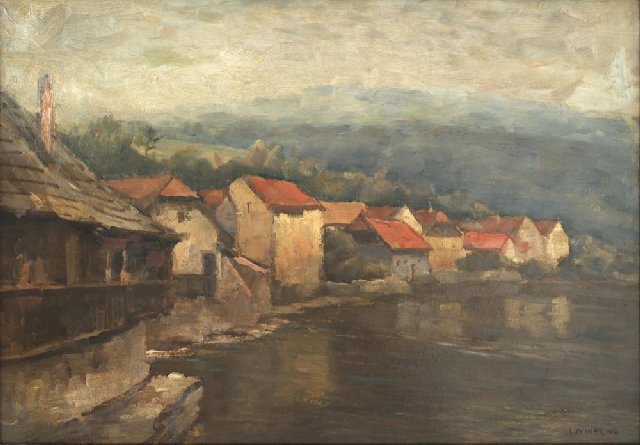
Houses at Semur by Laura Wheeler Waring (1925)

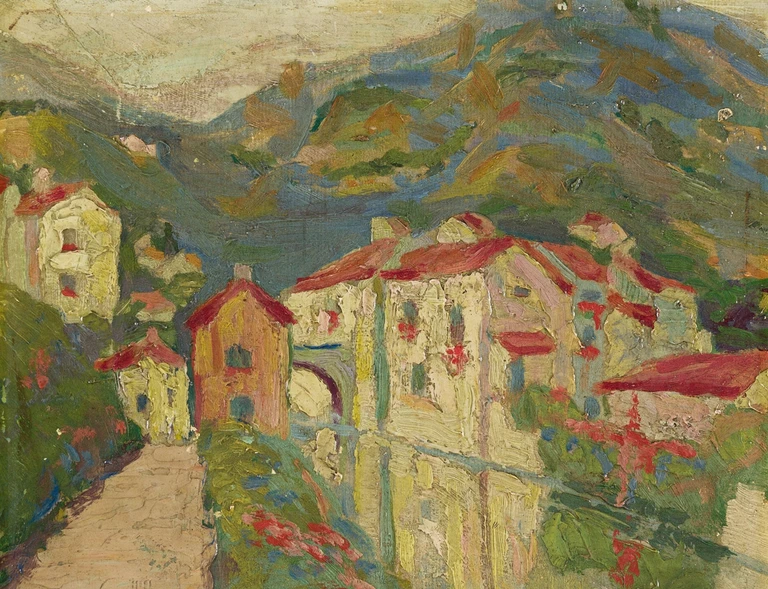
Saint-Jean-Pied-de-Port by Laura Wheeler Waring (1925)

After her short stay in the south of France, Waring returned to Paris in the Spring of 1925 and continued her studies at the Académie de la Grande Chaumiére whilst staying in the Villa de Villiers in Neuilly-sur-Seine.  That year Laura completed her paintings, Houses at Semur, France and Saint-Jean-Pied-de-Port. Critics believed this was a turning point in her artistic style as we see her use of vivid colours in order to express vivid, brilliant atmospheric conditions. Both works enhanced her growing reputation.  The following year, she had works shown at the Corcoran Gallery in Washington, D.C., the Brooklyn Museum, and the Philadelphia Museum of Art. And her standing in the art world was such that she was asked to curate the Negro Art section at the Sesquicentennial Exposition in Philadelphia.  

On June 23rd, 1927, Laura Wheeler was married to the Philadelphian, Walter Waring, a public-school teacher, who was ten years her junior and who was then working as a professor at the all-Black Lincoln University. The couple had no children. That same year, Laura won a gold medal in the annual Harmon Foundation Salon in New York. Laura Waring was actively painting during the Harlem Renaissance.  The Harlem Renaissance was an influential movement in African American literary, artistic, and cultural history from 1918 to the mid-to-late 1930s. The movement was originally referred to as the New Negro Movement, which referred to Alain LeRoy Locke’s 1925 book, The New Negro, which was an anthology that sought to motivate an African-American culture based in pride and self-dependence.

She was also involved with the Harmon Foundation.  It was established in 1921 by wealthy real-estate developer and philanthropist William E. Harmon who was a native of the Midwest, and whose father was an officer in the 10th Cavalry Regiment.  The Foundation originally supported a number of good causes but is best known for having served as a large-scale patron of African-American art and by so doing, helped gain recognition for African-American artists who otherwise would have remained largely unknown.

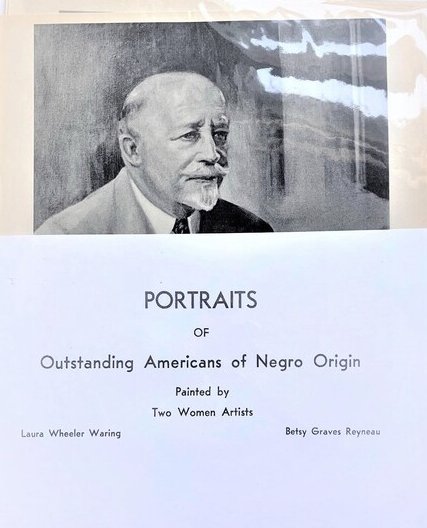
In 1944 the Harmon Foundation, which was under the direction of Mary Beattie Brady, organized an exhibition Portraits of Outstanding Americans of Negro Origin.  The idea behind the exhibition was to try and counteract racial intolerance, ignorance and bigotry by illustrating the accomplishments of contemporary African Americans. The exhibition featured forty-two oil paintings of leaders in the fields of civil rights, law, education, medicine, the arts, and the military. Betsy Graves Reyneau, Laura Wheeler Waring, and Robert Savon Pious painted the portraits that became known as the Harmon Collection. US Vice President Henry A. Wallace presented the first portrait, which featured scientist George Washington Carver, to the Smithsonian in 1944. The Harmon Foundation donated most of this collection to the Smithsonian’s National Portrait Gallery in 1967.

Anna Washington Derry by Laura Wheeler Waring (1927)

Laura Wheeler Waring will always be remembered for her portraiture and her most acclaimed work was not of the prosperous and famous African Americans which I have highlighted below but of a poor laundress, Anna Washington Derry.  She was one of five children who had moved with her family from Maryland to the eastern Pennsylvanian town of Strodsburgh, a borough in Monroe County.  Monroe was home to a small free Black community who had arrived via the Underground Railroad, a network of secret routes and safe houses used by enslaved African Americans to escape into free states.

The beautiful realistic depiction of the old lady beautifully conveys the lady’s dignity and inner determination through her use of simple, brown-beige tones of her dress, her expressive face, her folded arms and hands.  In the town where she lived Derry was looked upon as that of a community matriarch who was fondly addressed locally as “Annie”. The portrait was unveiled in 1926 at an elite exhibition for Black Philadelphian professionals some of whom may not have identified with Waring’s “ordinary” subject. The art historian Amanda Lampel commented:

“…Although Derry’s portrait did not sell that day, the Philadelphia Tribune, the oldest continuously published African American newspaper in the United States, called it remarkable……… Compared to fellow contemporaries like Aaron Douglas, Waring was much more conservative in her painting style and subject matter. This was in keeping with the types of artists who won the prestigious Harmon Foundation award, which sought to spotlight the up-and-coming Black artists of the Harlem Renaissance. Most of the award winners painted more like Waring and less like Douglas…”

In 1927 Laura exhibited the portrait of Anna Washington Derry at New York’s Harmon Foundation where it received the First Award in Fine Art – Harmon Awards for Distinguished Achievement Among Negroes. From there it was exhibited at Les Galeries du Luxembourg in Paris and across America.  The depiction was often reproduced in magazines and journals. The exhibition had its premiere at the Smithsonian Institution on May 2nd, 1944.  For the next ten years, Portraits of Outstanding Americans of Negro Origin, exhibition, travelled to museums, historical societies, municipal auditoriums, and community centres around the United States.  The public response was overwhelmingly positive in every venue.

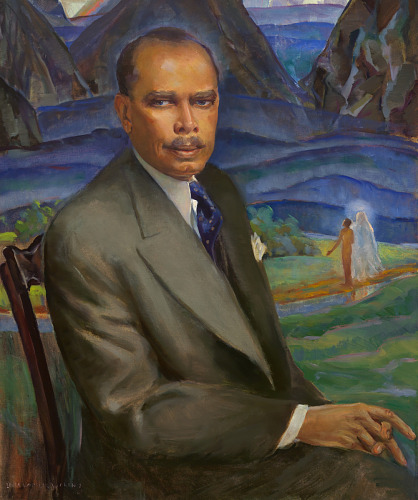
James Weldon Johnson by Laura Wheeler Waring

Laura Wheeler Waring will be most remembered for her portraits of successful, upper class Negroes and whites including James Weldon Johnson, the successful Broadway lyricist, poet, novelist, diplomat, and a key figure in the NAACP, National Association for the Advancement of Coloured People.  In 1900, he collaborated with his brother to produce “Lift Every Voice and Sing,” a song that later acquired the subtitle of “The Negro National Anthem.”

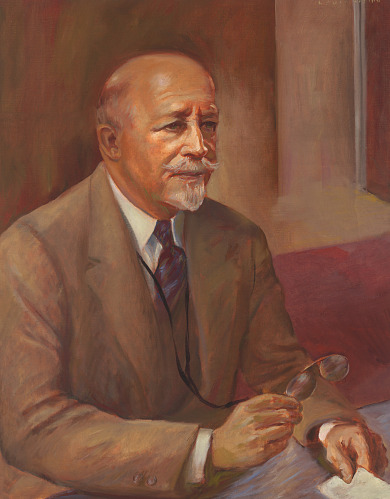
William Edward Burghardt Du Bois by Laura Wheeler Waring

Another sitter for Laura was William Edward Burghardt Du Bois (W.E.B. DuBois), who was the first African-American to earn a doctorate from Harvard University  He then became a professor of history, sociology, and economics at Atlanta University, and  co-founder of the National Association for the Advancement of Coloured People (NAACP), and founder and editor of the NAACP’s magazine The Crisis. Laura Waring had worked for Du Bois, creating several illustrations for The Crisis. Laura depicts Du Bois seated at a wooden desk or table, looking to the right. The spectacles he holds in his right hand, and the small paper he holds in his left, confirm his status as an intellectual and academic.

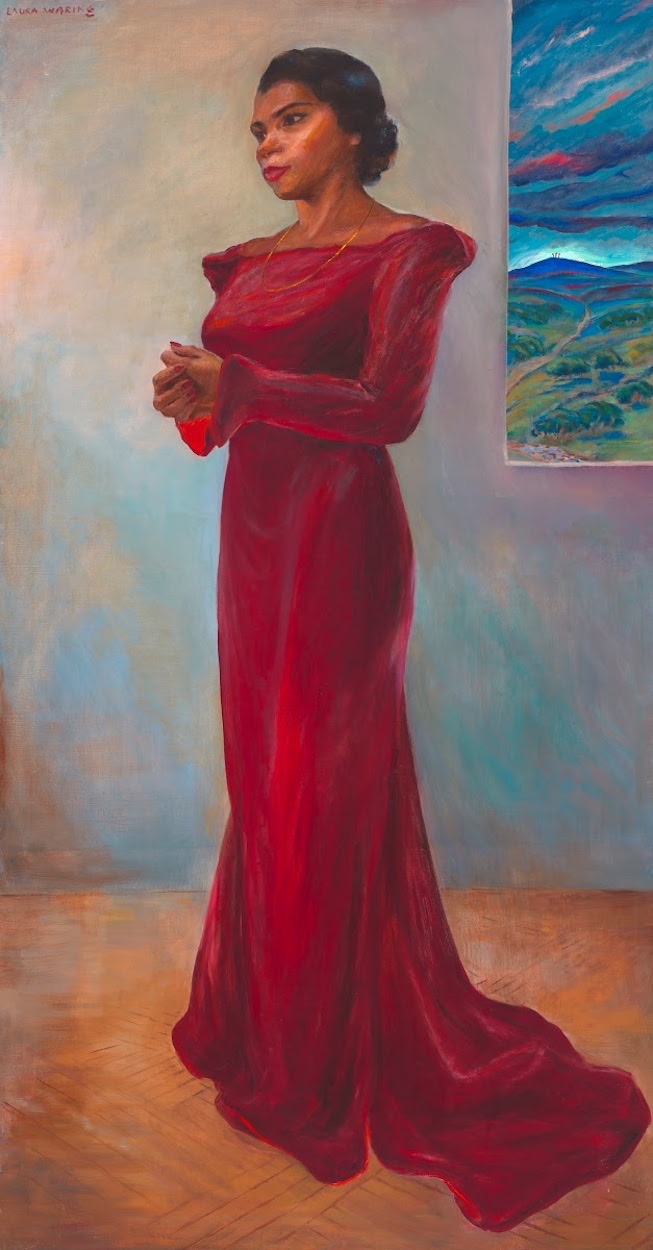
Marian Anderson by Laura Wheeler Waing (1947)

Many women were sitters for Laura’s portraits including Mary White Ovington, an American suffragist, journalist, and co-founder of the National Association for the Advancement of Coloured People (NAACP).  Another of her most famous female portraits was of  the opera singer, Marian Anderson.  This contralto singer, like many African American artists of the time, first achieved success in Europe. She was persuaded to return to America in 1935 and that year had a triumphant concert which secured her standing in the opera world.  In 1939 she became embroiled in a historic event when the Daughters of the American Revolution banned her appearance at its Constitution Hall because she was black. President Roosevelt’s wife, Eleanor, stepped into this controversial banning and arranged for her to take top billing at the Easter Sunday outdoor concert at the Lincoln Memorial, an event which drew in 75,000 opera fans as well as having the event broadcast to a radio audience of millions.

Jessie Redmon Fauset by Laura Wheeler Waring (1945)

Another female to have her portrait painted by Laura Wheeler Waring was Jessie Redmon Fauset, the first African American woman to be accepted into the chapter of Phi Beta Kappa at Cornell University, where she graduated with honours in 1905. Fauset then taught high school at M Street High School (now Dunbar High School) in Washington, D.C., until 1919  She then moved to New York City to serve as the literary editor of the NAACP’s official magazine, The Crisis. In that role, she worked alongside W. E. B. Du Bois to help usher in the Harlem Renaissance of the 1920s.

Alice Dunbar-Nelson by Laura Wheeler Waring (1927)

In the 1890s women formed national women’s club federations, most of which were dominated by upper-middle-class, educated, northern women. Few of these organizations were bi-racial, a legacy of the sometimes uneasy mid-nineteenth-century relationship between socially active African Americans and white women. Rising American prejudice led many white female activists to ban inclusion of their African American sisters. The black women’s club movement rose in answer in the late nineteenth century. The segregation of black women into distinct clubs produced vibrant organizations that promised racial uplift and civil rights for all blacks, as well as equal rights for women. Soon there followed another, more powerful group known as the National Association of Coloured Women in 1896. Women, including Laura Wheeler Waring and Alice Dunbar-Nelson, came together from a variety of backgrounds to combat negative stereotypes and fight for basic rights. Alice Dunbar-Nelson became the subject of Laura Wheeler Waring’s 1927 portrait. By the time the portrait was completed, Dunbar-Nelson was a prominent political activist and journalist and was much in demand as a public speaker. The depiction of her radiates her self-confidence and both artist and sitter were talented, intellectual women whose friendship helped advance the rights of both women and African Americans.

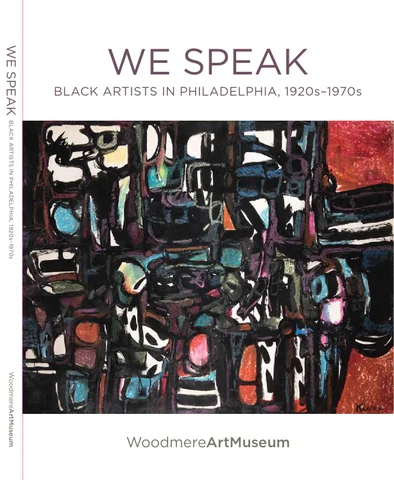
Waring died on February 3rd, 1948, aged 60, in her Philadelphia home after a long illness.  She was buried at Eden Cemetery in Collingdale, Pennsylvania. In 1949, Howard University Gallery of Art in Washington, D.C. held an exhibition of art in her honour.  Her paintings were also included in the 2015 exhibition We Speak: Black Artists in Philadelphia, 1920s-1970s at Philadelphia’s Woodmere Art Museum.

Laura Wheeler Waring (1887-1948)

There is no doubt that although Laura spent most of her life in America she always treasured her three stays in France which played an important role in her artistic progress. During those three periods on French soil she was able to engage in its culture, and associated with famous French, African, and African American intellectuals. Her scholarship, her study at the Academie de la Grande Chaumiere, and her solo exhibition in Paris gave her recognition in the United States in the form of awards, supervisory and teaching positions, and additional exhibitions.  Like many of her colleagues, Waring cherished the freedom she found abroad, declaring in her diary:

“…In my very busy seasons here to come I shall want to relive some of these moments of atmosphere. I record them so that I can never say “I wish I had enjoyed that more” or “I didn’t apprecate all that then but now—[.]” I can never say the above truthfully because am grateful every minute and even the least of things gives me a thrill. . . . The very feeling of freedom is a pleasure and the ride on the bus down will be a joy…”
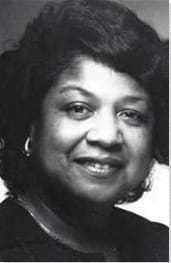

Much of the information for this blog and many of my other blogs in the past has come from an excellent website entitled The Art Story.

Other sources were:

A CONSTANT STIMULUS AND INSPIRATION”: LAURA WHEELER WARING IN PARIS IN THE 1910s and 1920s by Theresa Lieninger-Miller

BLACKPAST

SPEEDWELL

Laura Wheeler Waring. Part 1.

The art critic Patricia Tilton commented on the artist I am featuring today, Laura Wheeler Waring, writing:

Waring is the perfect role model for little girls who have big dreams. Determined and committed to pursuing her passion, young Laura began to manifest her dreams. She was self-confident, believed in her gift, and welcomed each opportunity that came her way.

Laura Wheeler, later Laura Wheeler Waring, was born in Hartford Connecticut on My 26th 1887.  She was the fourth of six children. 

Her father was Reverend Robert Foster Wheeler, who was the pastor of the first all-Black church in Connecticut, the Talcott Street Faith Congregational Church. It had been built in 1819 as a place for African Americans to worship on their own since they were previously only able to worship in the backs of churches and in church galleries in that city.  Her mother was Mary Wheeler (née Freeman), who was a teacher and amateur artist. Laura’s maternal grandparents were Amos Noë Freeman, who was a Presbyterian minister, and her maternal grandmother, Christiana Williams Freeman, was an anti-slavery activist who worked as part of the Underground Railroad which was the given name to a secret network of escape routes and safe houses run by abolitionists in Portland, Maine, and Brooklyn, New York. Laura’s family were well educated.  Her father studied Theology and graduated from Howard University in 1877 and her mother graduated from Oberlin College.

Still life with Heather by Laura Wheeler Waring (1927)

Laura’s parents were determined that their children should learn about African history and were attendees at the local bible classes.  The family would also make regular visits to Hartford’s Wadsworth Atheneum Museum of Art as well as other local art events. The children soon developed a love of art and would frequently sit around their dining room table to sketch and paint together. The American art critic Patricia Campbell Carlson wrote about young Laura:

“…[Waring] would even bribe her brothers and sisters with peppermints to get them to pose for her. And although she knew there were no portraits of African Americans in museums yet, she hung her paintings in her room as a ten-year-old so that her sisters and brothers could see pictures of people with all different shades of brown staring back at them,,,”.

After Sunday Services by Laura Wheeler Waring

Laura Wheeler Waring attended Arsenal Grade School and Hartford High School and was a model student who graduated from Hartford with honours. Whilst at the High School she showed an interest in art and the school fostered this love of hers, encouraging her enthusiasm for drawing and painting with watercolours.  She graduated from Hartford High School in 1906 with honours.

Institute for Colored Youth Building Historical Marker

In the Autumn of 1907, Laura, now a twenty-year-old, through the auspices of her father was offered and accepted a position at the Institute for Coloured Youth, an African Institute, a trade school that taught young Black people necessary skills to retain employment and later became a training institution for teachers. In 1902, the Institute moved to George Cheyney’s farm, 25 miles west of Philadelphia, and afterward the name “Cheyney” became associated with the school and became known as the Cheyney Training School for Teachers. Nowadays and since 1983 it has become the Cheyney University of Pennsylvania.

Girl in Green Cap by Laura Wheeler Waring

Times were difficult financially for Laura who was paid just seven dollars a month although room and board were provided. She needed money to pay the train fare to Philadelphia where she attended drawing classes, still life painting, portraiture, and illustration at the Pennsylvania Academy of the Fine Arts.   She remained there for the next six years.  The person who influenced Laura the most at the Academy was Henry Bainbridge McCarter, an American illustrator and painter known for his influence on the modernistic art movements. McCarter had worked as an illustrator in New York before becoming an instructor at the Pennsylvania Academy of the Fine Arts for forty years.  He managed to encourage Waring to take on board and appreciate Impressionism and Post-Impressionism.

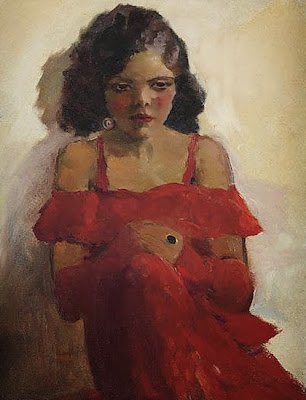
Girl in Red Dress by Laura Wheeler Waring

In 1914, Laura graduated from the Academy, and she was awarded the William Emlen Cresson Memorial Travel Scholarship. The Pennsylvania Academy of the Fine Arts prize was a two-year scholarship for foreign travel awarded annually to their art students.   This award for artistic excellence, which began in 1902, was funded by Emlen and Priscilla Cresson in memory of their son William Emlen Cresson, an Academy alumnus, who died in 1868 at the age of 23. He had been a child prodigy painter who began exhibiting at the Academy at a very young age. The award allowed recipients to study art at the Louvre.  Laura was the first Black woman to receive the award,

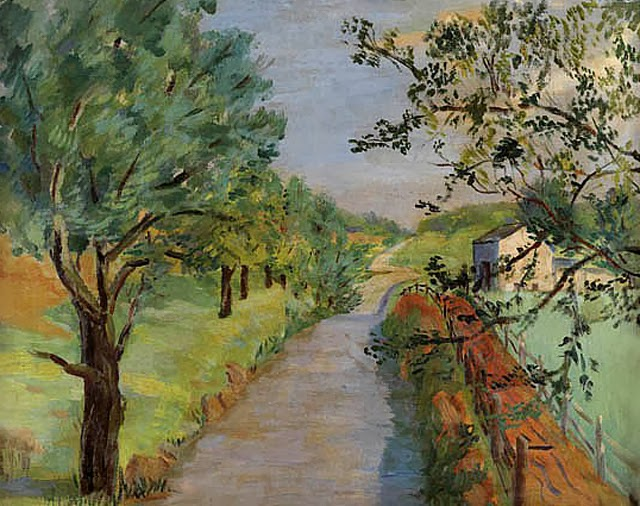
A Rural Landscape by Laura Wheeler Waring

Whilst in Paris Laura studied at the Académie de la Grande Chaumière and travelled throughout Great Britain. During her stay in the French capital, she spent much time in the Louvre Museum studying the works of Monet, Manet, Corot, and Cézanne. In Theresa Leninger-Millerher article:  A constant stimulus and inspiration”: Laura Wheeler Waring in Paris in the 1910s and 1920s, she quotes Laura as saying:

“…I thought again and again how little of the beauty of really great pictures is revealed in the reproductions which we see and how freely and with what ease the great masters paint…”

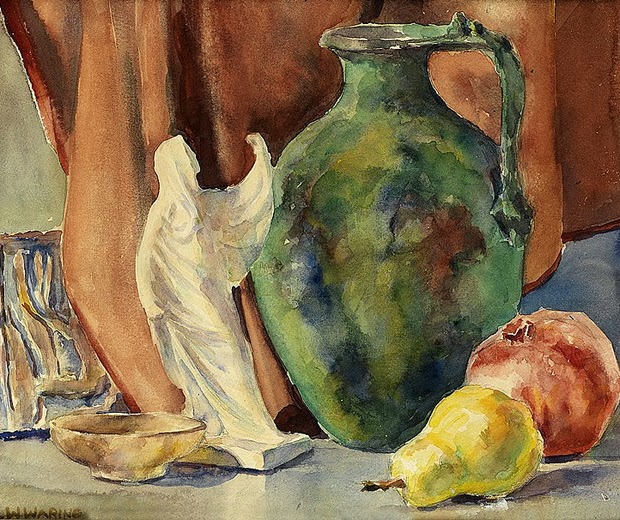
Still Life with Fruits by Laura Wheeler Waring

Laura Wheeler Waring had originally planned to travel more around Europe visiting Switzerland, Italy, Germany, and the Netherlands, but her trip was cut short when war was declared in Europe and she had to return to America.

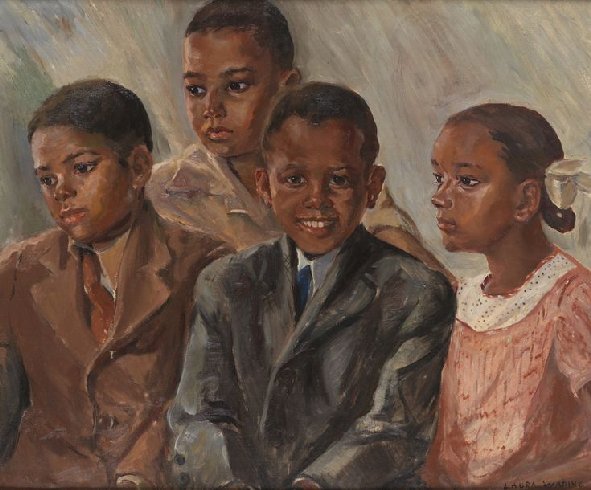
Four Friends by Laura Wheeler Waring

Back in America, Waring returned to teaching at Cheyney, and she played an important role in setting up the school’s new art and music departments. For thirty years she acted as the department’s art director and Chair, and between 1921 and 1934 she conducted the Cheyney Choir, training her students in high-toned spirituals and classical music. The Cheyney College like the local church, the Thornbury African Methodist Episcopal Church, slowly became the community centre for the black residents of Cheyney. Laura took her choir to sing at the church.  It was through her involvement with the church that she first met Annie Washington Derry, who would later become the subject of her most famous portrait which she completed in 1927 and which is owned by the Smithsonian is American Art Collection in Washington DC.

Landscape with River by Laura Wheeler Waring

Laura took a year out from teaching between 1924 and 1925 and returned to Paris.  This time she was accompanied by African-American novelist and poet, Jessie Redmond Fauset. On her arrival at the French capital she enrolled for classes in Expressionism and the Romanticism which were run by French artist and designer Bernard Boutet de Monvel, and the American painter Robert Henri. In October 1924 she enrolled to study at the Académie de la Grande Chaumiére, where she studied painting and it was here that she began her life-long love of portraiture.

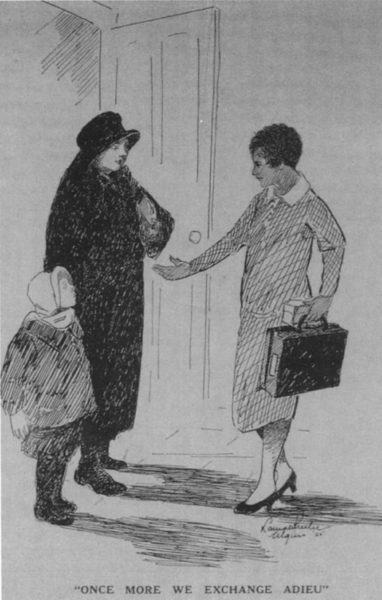
Once More we Exchange Adieu by Laura Waring (1925)

In January 1925, Laura Waring travelled to the South of France where she spent four days in the coastal town of Villefranche-sur-Mer. While living there she began to create illustrations for short travel stories and completed a number of figurative pen and ink drawings for The Crisis magazine. One of these was her pen and ink drawing entitled Once More We Exchange Adieu.  It depicts an African American woman dressed in a modern collared long sleeve dress, with black pumps holding a briefcase and waving goodbye to a white woman and child dressed in winter attire.

Houses at Semur by Laura Waring (1925)

Saint-Jean-Pied-de-Port by Laura Waring (1925)

In the next blog I will be looking at Laura Wheeler Waring’s portraiture, a genre which she is most famous for.

……………………………………………………to be continued.