After my very long last blog, here is a shorter one !
Ben Uri Gallery (Boundary Road, off Abbey Road, St John’s Wood, London)
When I was visiting London the other day, I visited the Ben Uri gallery in St John’s Wood, just off the famous Abbey Road. I had been sent regular emails from the gallery about events and followed them on Facebook and was interested to visit the premises.
The Girl in the Green Sariby Clara Klinghoffer
A few weeks ago I wrote about Clara Klinghoffer and I knew one of her paintings was at this gallery so I was interested to look at it up close. I eventually found the gallery after going round in circles because I struggled to follow the GPS on my phone. The gallery was much smaller than I had imagined but there on display was the Klinghoffer painting entitled The Girl in the Green Sari.
Girl in a Red Shirt by Ottilie Tolansky (c.1950)
The full-length painting was displayed in the small gallery and was quite impressive. However, for me, more impressive was the full length painting next to it. It was entitled Girl in a Red Shirt and the artist was given as Ottilie Tolansky and I knew I had to find out more about this unknown (to me) artist.
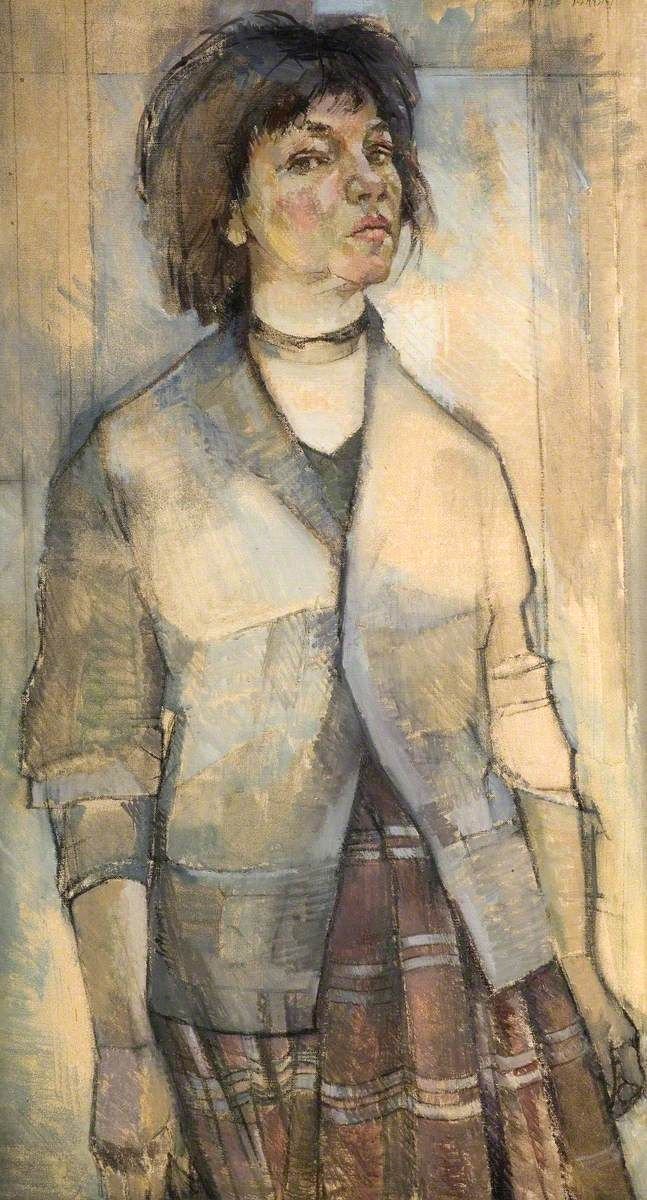
Self portrait by Ottilie Tolansky
Ottalie Pinkasovitch was born in Czernowitz, which was, at the time of her birth, in the northern Bukovian sector of the Austro-Hungary. The town is now known as Chernivsti and is in western Ukraine. She was born on May 30th 1912 into an Orthodox Jewish household. Shortly after Ottalie was born, the town witnessed numerous riots directed against the Jewish community and so the family moved to live in Vienna. For Ottalie, Vienna was home and she always looked upon herself as being Austrian.
Reimann Art School in Berlin
In 1928, at the age of sixteen, the family were on the move again. This time they set up home in Berlin where Ottalie’s father, an internationally recognised singer, took up the post of Obercantor at the city’s eighteenth century Alte Synagougue. Meanwhile, the family having recognised that their daughter had a great talent for art decided to enter her into the Reimann School of Art in Berlin. It was a private art school which had been founded in 1902 by Albert and Klara Reimann, and later in January 1937 was re-established in Regency Street, Pimlico, London following the persecution of the Jews by the Nazis. After leaving the Reimann School, she continued her studies at the Berlin Academy of Fine Arts.
Meadow Scene by Ottilie Tolansky
Hitler came to power in 1933 when he became the German Chancellor and with growing antisemitic views which swept the country the Pinkasovitch family moved to the safety of England. Ottilie’s father accepted a job at a synagogue in Cheetham Hill, which was the predominantly Jewish area of Manchester. Ottilie, who was enrolled at the Manchester Municipal School of Art, once again came into contact with her friend, the physicist Samuel Tolansky who was working at the University of Manchester.
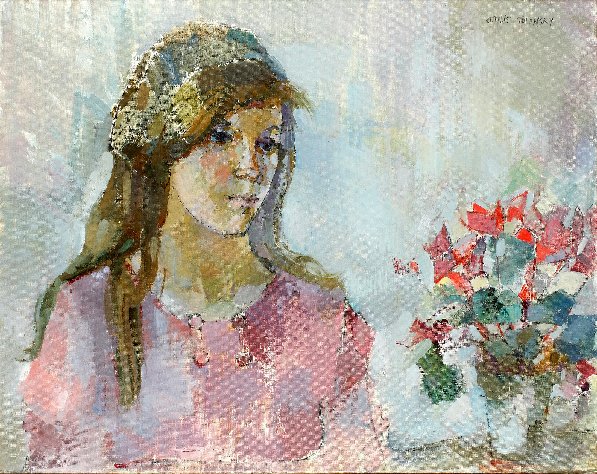
Mary Louise by Ottalie Tolansky
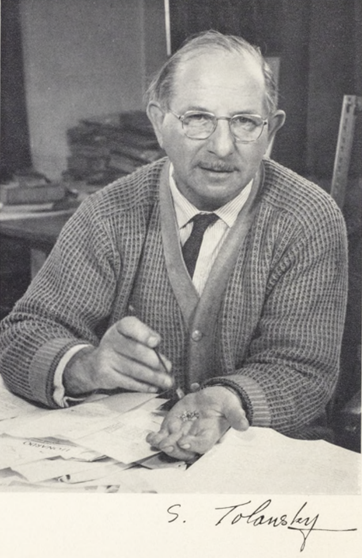
Samuel Tolansky had been born on November 17th 1907 in Newcastle upon Tyne. His parents had migrated to Great Britain around the turn of the century. His ancestors had come from Odessa but were of Lithuanian Jewish origin. Samuel was the second child in a family of two boys and two girls. His father was a tailor and, like most immigrants from Eastern Europe at the time, he had to start near the bottom of the ladder both financially and socially. For the first ten years of life in England Samuel’s father lived in conditions of considerable poverty and that his son’s progress up the educational ladder was, at every critical stage, dependent on his ability to win scholarships and other awards. However, Samuel worked hard and succeeded.
Samuel Tolansky
Ottilie had first met Samuel in Berlin in 1931 when he had been working at the Physikalisch-Technische Reicsansalt, a German government scientific institute. In 1932, after a year working at the Berlin Institute he went to England and attended Imperial College London as a researcher into interferometry. He remained in London until 1934. From Imperial College London he relocated to Manchester and from 1934 to 1947 worked at the University of Manchester, as an Assistant Lecturer, later Senior Lecturer and Reader. Ottilie and Samuel’s friendship blossomed and the couple found themselves in love. The couple married in 1935. Ottilie gave birth to their first child, Ann, who is now married and having graduated in history from Oxford University, became a solicitor. A second child, Jonathan, was born in London. He became a musician, a percussionist who has played in several of the leading orchestras.
Abstract by Ottilie Tolansky
Samuel and Ottilie Tolansky left Manchester and moved to London, where, after the war had ended, she attended the Hammersmith School of Art and regularly submitted her work at various exhibitions. Ottilie’s portraiture, still lifes and figure drawings, which she completes mainly in oils and gouache are characterised by her main use of blues and violets.
Rabbi Joseph Trostmann by Ottilie Tolansky (c.1962)
One of her most famous portraits, in fact two paintings, is of her grandfather Rabbi Joseph Trostmann. She based the depiction of the elderly man on her childhood recollections and family photographs. One can be found at Stoke-on-Trent Art Gallery whilst the other was kept in the family. After Ottilie died, her son Jonathan Tolansky, donated it to the Ben Uri Gallery.
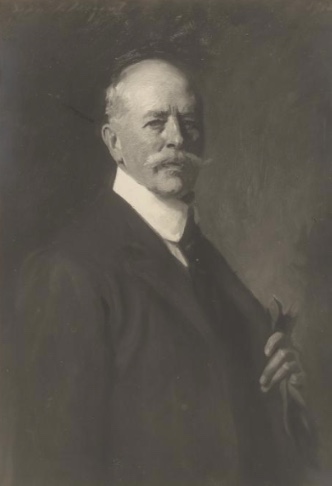
Portrait of a Gentleman by Ottilie Tolansky
Ottilie Tolansky died in London on February 13th 1977 aged 64. Her husband who had been nominated for a Nobel Prize, and was a principal investigator to the NASA lunar project known as the Apollo program, died four years earlier.
For this blog I am reverting to my early modus operandi when I concentrated the blog on one painting, rather than, as I do nowadays, focus on the artist(s). Having said that, the blog revolves around two American artists, one who is rightly categorised as one of the great nineteenth century painters and the other, who is less well-known, is now almost forgotten. One is the artist who painted the work and the other is the father of the four girls who are depicted in the painting. The artist was John Singer Sargent, the American expatriate painter, considered the leading portraitist of his generation and the father of the girls depicted in the work is Edward Darley Boit, a watercolour painter from Boston. The work of art I am featuring is entitled The Daughters of Edward Darley Boit, which was originally titled Portraits d’enfants.
John Singer Sargent – Self-Portrait (1906)
Edward Darley Boit Jnr., known as Ned, was born in 1840. His father, also Edward Darley Boit, was a Harvard-educated lawyer and his wife was Jane Parkinson Hubbard whom he married in 1839. Jane’s family, the Hubbards, were an old New England family who owned sugar plantations in British Guyana. The couple had three sons, Edward (Ned), Robert (Bob) and John and two daughters, Jane and Elizabeth. His son, Edwards Darley Boit Jnr. studied at the Boston Latin school and then Harvard where he graduated in 1863. From there he went on to study at Harvard Law School.
Mrs Edward Darley Boit(Mary Louisa Cushing) by John Singer Sargent (1887)
Edward’s love of legal matters soon waned despite his aptitude in his legal studies. However it was his love of art which came to the fore in his life but it was not just art that was to enter his life. There was a woman who would take a leading role in the life of Edward (Ned) Darley Boit junior. She was Mary Louisa Cushing, known simply as Isa, who was part of the upper-class Bostonian Society. Her great uncle was Thomas Handasyd Perkins hailed from a wealthy Boston Brahmin family and was an American merchant, slave trader, smuggler, philanthropist and early patron of the Arts. Isa’s father, John Hubbard, worked for his uncle’s merchant’s businesses in China. He returned to America in 1831, a very wealthy man and a very eligible bachelor. Isa’s father met and fell in love with her mother, Jane Parkinson, and the couple married in 1839. In 1840, they moved to their Bellmont estate in Watertown, Massachusetts. They had five children, four sons and one daughter, Mary Louisa (Isa). Isa was brought up in a wealthy household and wanted for nothing.
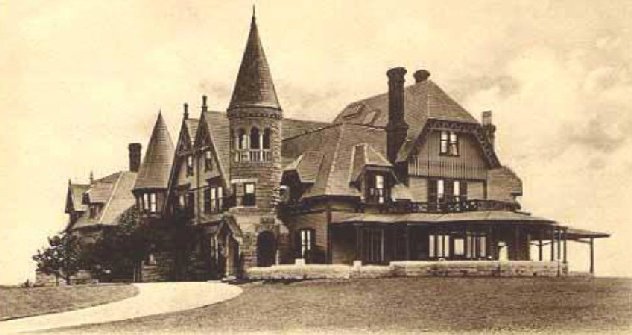
Edward and Isa’s summer home, The Rocks
Despite her wealthy upbringing, tragedy was to strike Isa in 1862 when she was still only sixteen years old. In April of that year her father died, aged 75 and less than two months later, in early July her mother Mary Louisa Cushing died. She was 63. Isa went live with her elder brother Ned who acted as her legal guardian. On June 16th 1864, with the American Civil War still raging, twenty-four-year-old Edward Darley Boit, who was still studying law and was exempt military service, and seventeen-year-old Isabel Louisa Cushing married in an Episcopal ceremony at Christ Church in Harvard Square, Boston. It was a sumptuous, no-expense spared affair. The young couple split their time between Boston and Newport, Rhode Island where they had their summer house built. It was known as The Rocks, and was situated above Bailey Beach and just along from Isa’s brother, Robert’s home.
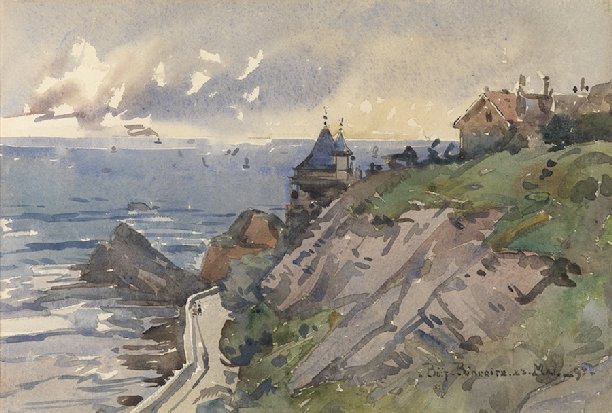
Biarritz by Edward Darley Boit
In April 1865 Isa Boit gave birth to their first child, named Edward after his father but was known as Neddie. The following year Edward Darley Boit was admitted to the Massachusetts Bar and once again Isa was pregnant. That summer Edward Boit, his pregnant wife and their son travelled to Europe visiting Dublin, Paris, Rome before returning to the French capital. Throughout the European journeys Edward was continually visiting the major city art galleries and absorbing as much as the European art as he could. In the Autumn of 1886 they returned to London where Isa gave birth to their second child, a son called John. Neither Isa nor John were well following a problematic birth but their travels continued and they returned to Paris, their favourite city, in mid-December 1866. However Edward wanted to once again visit Italy to study the works of the Italian Renaissance Masters and so Edward, Isa, Neddie and baby John went to Rome visiting Genoa and Florence en-route. Five month old baby John was became very ill and never recovered his health. He died in March 1867 and was buried in the Protestant Cemetery in Rome. Edward, Isa and Neddie returned to Boston where Edward resumed his legal career.
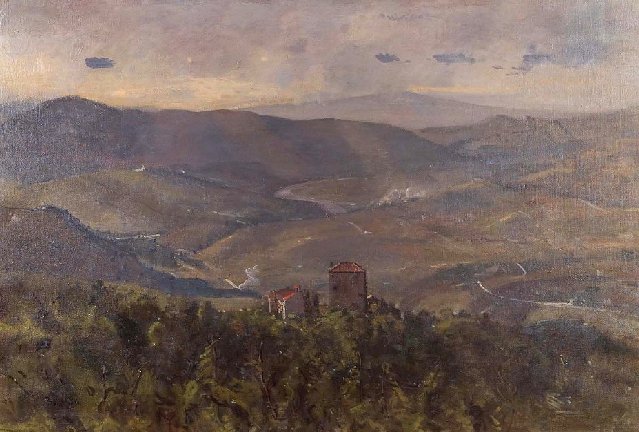
Italian Landscape by Edward Darley Boit
Edward Boit visited an art exhibition at Boston’s Soule and Ward gallery and for him it was a magical visit and he was overwhelmed by the landscape work of Jean-Baptiste-Camille Corot and how the French painter had managed to capture the light, air and atmosphere in his works. It was an epiphany for Boit who there and then decided that he would give up law and become a painter and furthermore he and the family would leave America and live in Paris. Edward’s wife Isa supported him both passionately and financially having received a sizeable inheritance from her late parents. Isa preferred life in Paris to that of life in Boston.
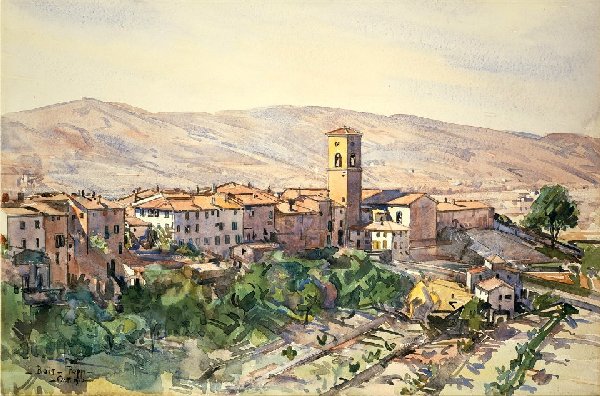
Poppi in the Casentino, Tuscany by Edward Darley Boit
Whilst in Newport Rhode Island, the size of the Boit family had increased. A daughter, Florence, was born on May 6th 1868 and a second daughter, Jane, was born on January 17th 1870. There was one major problem to the Paris relocation plans. Their eldest son, now five-years-old, suffered from severe mental retardation and was now living in a “home”. Edward and Isa had a heartbreaking decision to make as to whether to stay in Boston to be near him, albeit he didnt recognise them and could not communicate or leave their son behind when they emigrated to Paris. After a lot of soul searching they decided to relocate the family and leave Neddie behind in the specialist home. In the Autumn of 1871, Boit gave up his conventional legal life, and the couple sold their Newport home and moved to Europe with the family, visiting Italy first then travelling around the French countryside before arriving at their ultimate destination, Paris. One of the first things Boit picked up about French art was the way they cared less for detail and concentrated on overall effect liberation. Edward Boit and his family split their time between Paris and Rome and enjoyed all that French and Italian society had to offer. Among the close friends they met were the author, Henry James and the young artist Frederic Crowninshield both of whom had connections with Boston. In 1876 Boit decided to make Paris his base and had rented a studio at 139 boulevard Montparnasse in the city’s Left Bank artist quarters. At the start of his Parisian residency he began to be tutored by the French landscape artist François-Louis Français, who himself had been a pupil of Corot, one of Boit’s favourite painters.
Avenue de Friedland, Paris.
In 1874 the Boit family increased with the birth of a third daughter, Mary Louisa on June 5th in Paris and eighteen months later on November 15th 1878 a fourth daughter, Julia, was born in the northern Paris suburb of Soissy. Edward and Isa decided that it was now time to return to America for a long stay so as to introduce their daughters to their uncles and grandparents and in mid-June 1879 they, along with European governesses and nurses, boarded SS Bothnia for the Atlantic sea passage. Great celebrations followed their arrival and Edward’s parents looked forward to Edward and his family remaining over the winter months in Boston, but their hopes were dashed when Edward outlined his plans to return to Paris. The voyage back to France took place in early October 1879. On arriving back in Paris they took a large apartment on the avenue de Friedland, a large boulevard that radiated out from the Place d’Etoile,
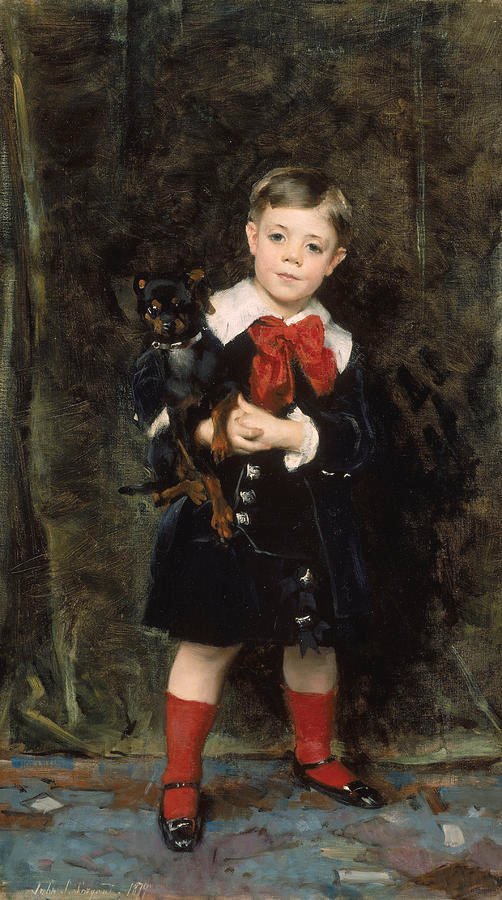
Portrait of Robert de Cévrieux with his Pet Dog by John Singer Sargent
There is some doubt as to when Edward and Isa Boit met the artist, John Singer Sargent but it is thought most likely it was in Paris in the late 1870s during one of the many artistic soirees that the Boits and Sargent frequented. Another possible reason was the meeting came about through the auspices of Edward Boit’s teacher, François-Louis Français, whose close friend was Carolas-Duran, one of Singer Sargent’s tutor. Sargent was an expert portraitist and a third of them were commissions to paint children. An example of one such painting is Sargent’s 1879 Portrait of Robert de Cévrieux with his Pet Dog. We see him standing on an oriental rug in front of a curtained backdrop.
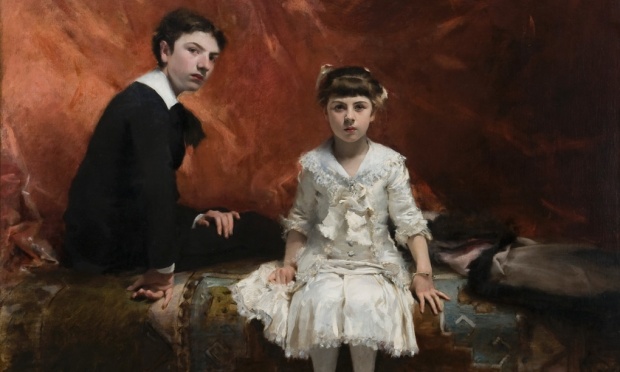
Portrait of Edouard and Marie-Loise Pailleron by John Singer Sargent (1881)
Another child portrait by Sargent was a commission from one of Sargent’s earliest patrons, Edouard Pailleron, the French poet and dramatist. Sargent had completed a portrait of Edouard and his wife in 1879 and two years later, a portrait of Edouard’s two children, sixteen-years-old Edouard and his younger sister, Marie-Louise, which was exhibited at the 1881 Salon. The children’s portrait was time consuming and Marie-Louise, later recorded that there were eighty-three sitting for this painting which might explain why the subjects seem strangely remote from the artist.
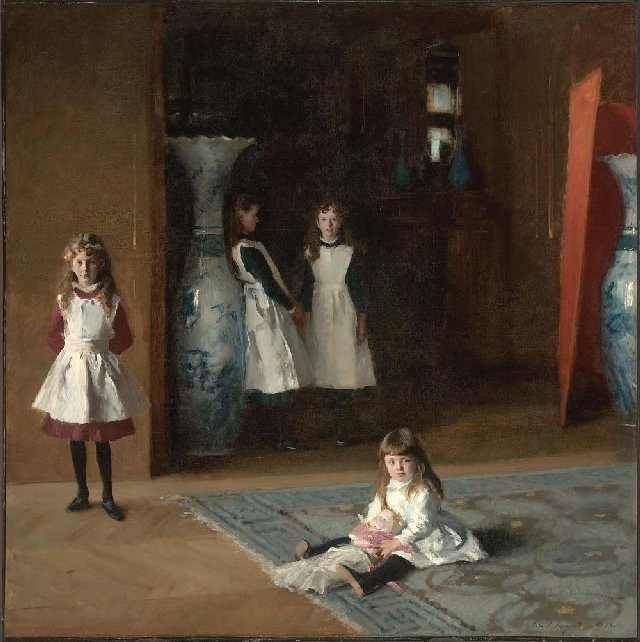
The Daughters of Edward Darley Boit by John Singer Sargent (1882)
The painting I am concentrating on in this blog, The Daughters of Edward Darley Boit, is one that Sargent started on in October 1882 after he returned to Paris from Italy. He completed the work in December, a mere two months later. This was a great achievement as the painting was so large (225 x 255 cms) 87.6 inches square. Sargent titled the painting Portraits of Children and it was then shown at Georges Petit’s Exposition de la Société Internationale and the following year at the Salon. It is an unusual depiction in as far as, that besides the four girls and two large vases, the location seems empty, even stark. This would be completely different to the real Boit household which was known to be full of furnishings which they had collected on their travels over the years. The stylistic interior tastes of the Boits is not reflected in this portrait with the exception of the vases. Maybe Edward and Isa first approached Sargent tasking him to paint a traditional portrait of their four daughters but subsequently they may have acceded to Sargent’s decision to make the depiction part portraiture and part an interior genre painting.
Mary Louisa (Isa) Boit
The setting for this portrait is one of the rooms in the family’s spacious apartment, possibly the foyer. Edward and Isa had moved into the apartment on the avenue de Friedland, a large boulevard that radiated out from the Place d’Etoile, Their elegant residence was situated in the eighth arrondissement, a luxurious neighbourhood much preferred by wealthy Americans. They had lived there since 1879 when they had arrived back from a summer in Newport, Rhode Island. It was to be home to the Boits until 1886.
Julia Overing Boit
In the painting, the light comes from the left. The two older daughters are shielded from it by the recessed enclave they stand in, a position which they have found for their uneasy refuge. All the girls wear white pinafores, which gives Sargent the opportunity to show off his absolute mastery of a full range of tones created by the folds and creases in the pinafores. It was a dark shadowy space in which Sargent then positioned the Boits’ four daughters. The youngest daughter, four-year-old Julia sits on the floor, eight-year-old Mary Louisa stands at the left midground of the painting whilst the two older daughters, Jane, aged twelve, and Florence, fourteen, stand in the background, partially obscured by shadow.
Painting with the vases at the Museum of Fine Arts, Boston.
Besides the four girls the other striking feature of the painting is the inclusion of the two tall vases. These were not Sargent’s props but two Japanese vases owned by the Boits, which Sargent faithfully depicted, although he subdued the colour allowing the girls to be the more important. The vases, like their owners, criss-crossed the Atlantic more than a dozen times and only suffered minor damage to their rims. They were six feet tall giants, the tops of which flared into scalloped ripples of porcelain. The size of them dwarfed the girls. They were made in Arita, Japan an area famous for its porcelain, which in the late nineteenth century was specifically made for export to the West. The two oversize Japanese porcelain vases depicted in the work were, along with the painting, also donated by the Boit family to the Boston Museum of Fine Arts and are exhibited beside Sargent’s painting.
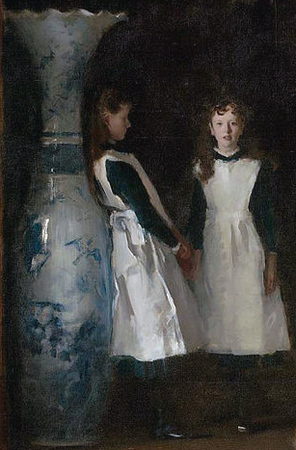
Florence Dumaresq and Jane Hubbard Boit
The painting by Sargent is not a conventional group portrait as Sargent has positioned the four girls individually. There is no connection between the siblings. The two older sisters are placed in the semi-shade in the background while the youngest is centre stage in the foreground holding her doll and the other girl is standing alone off to the left. Each of the girls is presented individually, but the features of the two older girls are obscured, by the darkness of the background. The presence of empty space, and the isolation of the figures all add to the sense of quiet anxiousness. Florence with her back to the vase comes over as being independent and refuses to participate at all and Jane, facing us, is left unsure whether to side with her big sister or to emerge from the shadows and face the artist.
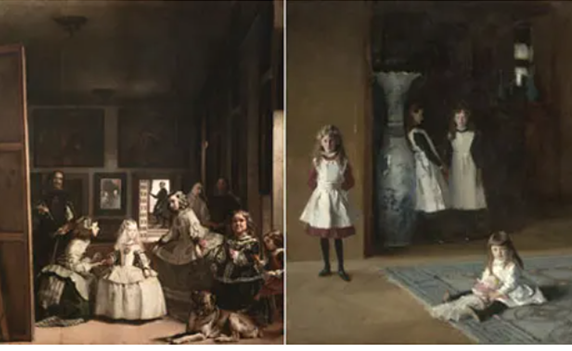
Las Meninas by Velazquez (1656)
Many art historians have likened the position of the girls with way Velazquez set up the figures in his painting, Las Meninas, the famous portrait of the young Spanish infanta with her maids in a great shadowed room. Sargent had studied and copied this work during his 1879 visit to the Prado in Madrid.
A composite image of Las Meninas by Diego Rodriguez de Silva y Velazquez and The Daughters of Edward Darley Boit by John Singer Sargent.
The relationship between these two works was considered so noteworthy that the Museum of Fine Arts in Boston who owned the Boit family portrait loaned it to the Museo del Prado in 2010, so that the paintings could be exhibited together for the first time.
Malcolm Rogers, the director of Boston’s Museum of Fine Arts at the time of the loan, when asked about the similarity of the two works of art stated;
“…These two great paintings have never been together in one room before……It is Sargent’s greatest painting, one of the great paintings of childhood and for it to hang side by side with arguably the world’s greatest portrait of childhood has to be a historic and iconic moment. I think people will be very moved…”
When the Daughters of Edward Darley Boit was first exhibited in 1883, the depiction of the children was the subject of much discussion. Many art critics were confounded as to why the children were so isolated from each other and also why is one in profile and almost indistinct? Again Malcolm Rogers postulated:
“…The Boit daughters is just one of those paintings that moves people because of its beauty, but also its mystery. You don’t quite know what these four girls are thinking; it opens up your own imagination. It’s got a little bit of sadness, a little bit of happiness, a little bit of childishness, great beauty. It is a very intriguing work…”
I will end this blog with a brief summary of what happened to the family. Isa, Edwards wife, was taken ill in the summer of 1894 and by the Autumn she had suffered from increasing paralysis of her limbs and both her heart and lungs began to fail. She died in Dinard, France on September 29th 1894 aged forty-eight and was buried in Paris, the city she loved so much. Edward refused to return to Boston in deference to Isa who had hated living in the American city.
In Biarritz, in the summer of 1895, Edward became re-aquainted with a young girl, Florence McCarty Little, who he had first met in Boston and was a firend of his twenty-one year-old daughter Isa. To everybody’s shock and his daughters’ horror Edward and Florence became very close and and they announced their impending marriage. Florence was thirty-six years younger than Edward.
Edward Darley Boit and F lorence set June 1896 for the marriage ceremony but it was postponed until October. His four daughters were sent back to Boston to stay with their aunt, Jane Boit Hunnewell in Wellesley. Edward’s brother Bob tried to dissuade his brother from marrying such a young girl saying that he was acting like a selfish, infatuated, silly school-boy and that he was appalled by his brother’s “abandonment” of his children. His daughters’ cousin Mary Boit returned to Paris with the four girls in October and wrote about the atmosphere at her cousins’ home:
“…I think he seems quite pre-occupied and now we are over hereUncle Ned says he is going to marry Florence Little next month. Well it is a very strange thing and I am more sorry for the girls than anything. poor dears, it seems so queer to look at Uncle Ned then think he is in love with somebody my age…”
Edward Darley with his sons, Julian and Edward.
The marriage finally took place in Biarritz on January 5th 1897 and on June 21st 1900 Florence gave birth to their first child, a son, Julian. Two years later, on April 12th 1902 she gave birth to their second son, Edward. Sadly, two weeks after the birth of Edward, Florence contracted a fever and died on April 24th, aged 25. Edward Darley Boit died of arteriosclerosis in Rome on April 21st 1915, three weeks before his 75th birthday.
None of the four daughters, depicted in the painting, married. The eldest, Florence Dumaresq died in 1919, aged 51. The second born daughter, Jane Hubbard Boit had suffered a nervous breakdown and never completely recovered. Her father was concerned that she would end up in a mental asylum like his first-born, Neddie. She improved and in fact, went to live on her own in a Paris apartment. She died in New York State in November 1955, aged 85. Mary Louisa Boit, the girl who stood alone on the left of Sargent’s painting, and who was looked upon as the prettiest of the four girls, died in New York in June 1945, aged 71.
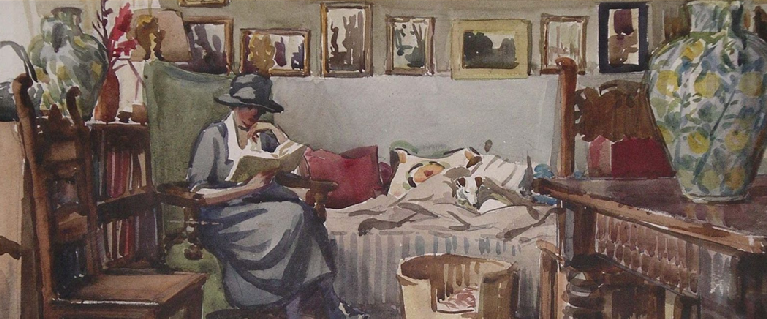
Woman in Blue, Apartment in Paris by Julia Overing Boit (1921)
The youngest aughter, Julia Overing Boit, became a talented watercolour painter and often her letters contained small watercolour sketches. Her work was exhibited in many exhibitions and in March 1929 at the Copley Gallery in Boston, sixty-six of her watercolours were exhibited. She died in February 1969, aged 91.
Most of the information for this blog came from an excellent book which I bought from Amazon. It is entitled Sargent’s Daughters, The biography of a portrait, by Erica E Hirshler. If you would like a greater in-depth read about the Boit family and the painting, this is a must-have book.
My blog today is about a family of artists, the Walton family, a veritable artistic dynasty. The head of the family was Edward Arthur Walton, best known as, simply, E.A.Walton. Walton was born on April 15th, 1860 in Barrhead, a small town in East Renfrewshire, Scotland, thirteen kilometres (8 miles) southwest of Glasgow city centre.
The Artist’s Mother, Elizabeth Balfour Nicolson, Mrs Jackson Walton by Edward Walton (1885)
Edward Walton was one of twelve children of Jackson Walton and his wife Elizabeth Balfour née Nicholson. Jackson was a Manchester commission agent and a skilled amateur painter and photographer. His brother was George Henry Walton, a noted architect, furniture designer and stained glass designer, who worked with Charles Rennie Mackintosh, a renowned Scottish architect, designer, watercolourist and artist.
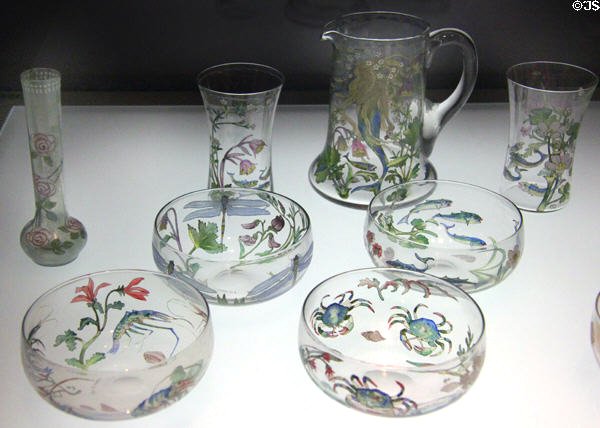
Glassware painted by Helen Walton (1910)
Edward’s sisters, Helen and Constance were also talented artists. Helen Walton was best known for her decorative work in ceramics and glass and as one of the eldest children, Helen became an artistic mentor to her siblings including her brother, Edward Arthur, who was ten years her junior.
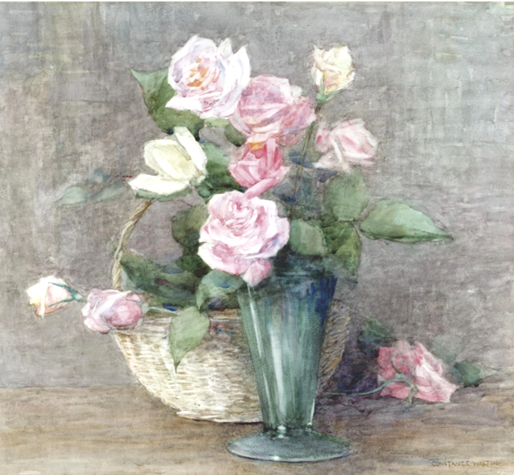
Still Life with Roses by Constance Walton
Constance Walton was a much-admired botanical painter. She trained at Glasgow School of Art and became a member of the group known as the Glasgow Girls. This group of women artists and designers pursued different styles and worked in a range of art forms. Many of the women created their own discreet groups while others chose to work alone and although the name of the group was coined by William Buchanan in an essay, he contributed to the catalogue for a Glasgow Boys exhibition held in 1968, many of the women lived and worked outside Glasgow. These female artists became prominent in the late nineteenth century, thanks to the enlightened attitude of Francis Newbery, a painter and art educationist, best known when he was director of the Glasgow School of Art between 1885 and 1917. who set out to enrol men and women equally.
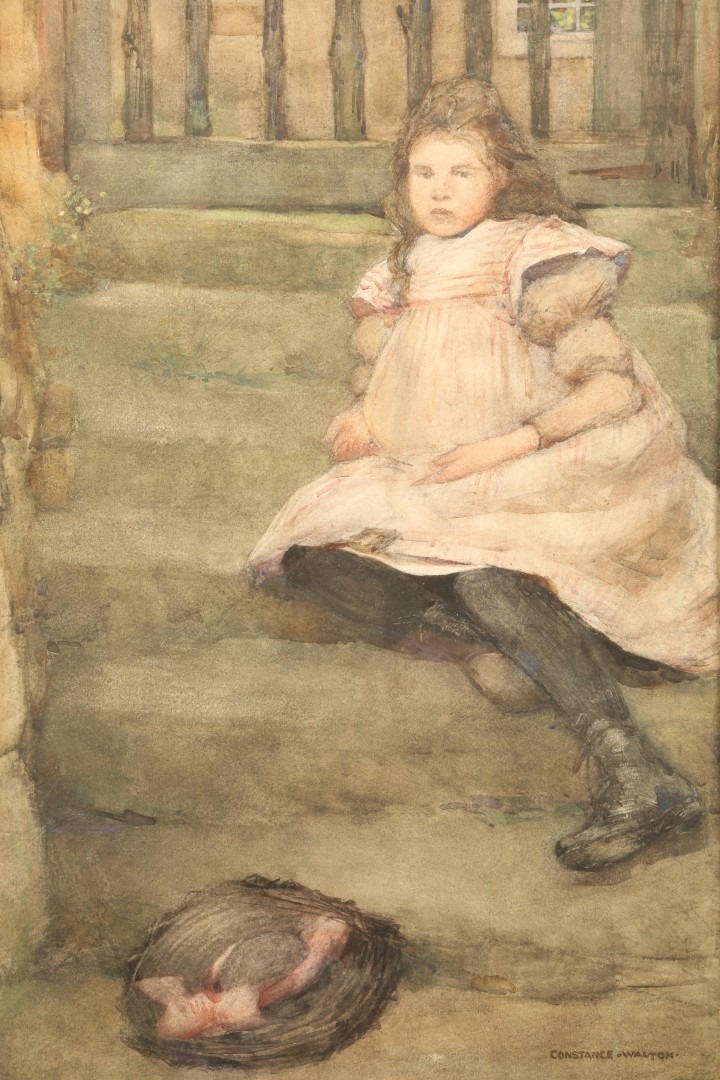
Daydreams by Constance Walton(c.1895)
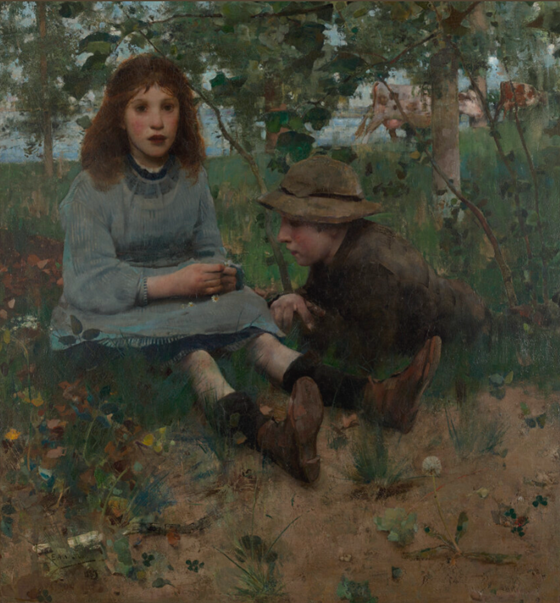
Day Dreams by Constance Walton is a large watercolour depicting a young girl sitting on steps looking distractedly into the distance. Constance Walton’s figurative paintings are quite rare as after her marriage in 1886 she concentrated on her flower and botanical paintings. This depiction could have been influenced by her brother, Edward’s work of the same name which he completed in 1885.
A Daydream by Edward Walton (1885)
Helen and Constance’s brother Edward Arthur Walton was probably the best-known artist of all the siblings
Self portrait by Edward Walton
After completing school and wanting to concentrate on his art he travelled to Germany where he spent two winters at the Dusseldorf Academy of Art before returning to Scotland and enrolling at the Glasgow School of Art in 1878.
Joseph Crawhall by Edward Walton (1884)
At the Glasgow School of Art he became good friends with fellow aspiring painters, James Guthrie and Joseph Crawhall whose sister married Edward’s brother. As we have often seen in various blogs, young artists training at State Academies often became disillusioned and disheartened by the academic training which concentrated on historical painting and high levels of finish. It was for this reason that in many countries the young artists rebelled and set about working to their own agenda. In the case of Edmund Walton and his friends they formed a loose group which became known as the Glasgow Boys who decided that their focus should be on realistic depictions, often of rural subjects, depictions that would illustrate real life, the hard-bitten and candid view of living.
The Harbour Scene, St Ives by Edward Walton
The Glasgow Boys group gained inspiration from the progress in landscape painting in France and sought to take greater notice on the natural effects of light in the open air when setting about painting Scottish rural scenes. The group also took to the French style of en plein air painting when, whilst outdoors, they would paint directly onto the canvas. The painter who had the greatest influence on this group of artists was the French realist painter, Jules Bastien-Lepage whose down-to-earth depictions focused on the real, often, impoverished life that surrounded his village. For all Edmund Walton learnt about art in Dusseldorf and the Glasgow School of Art, nothing compared to the knowledge he gained working alongside his fellow “boys”.
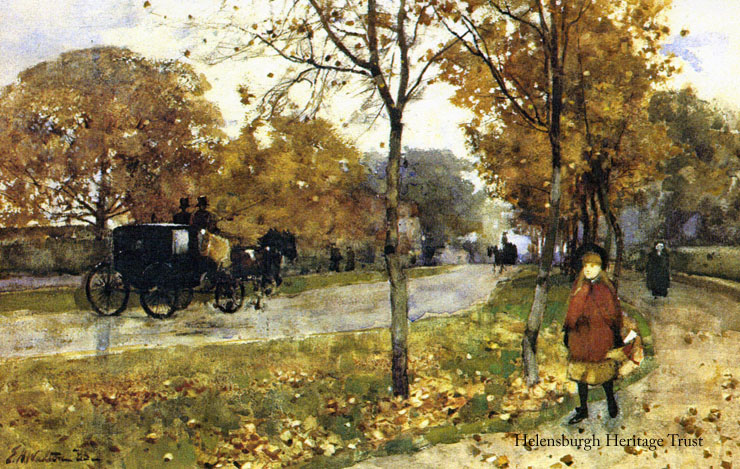
Victoria Road Helensburg by Edward Walton
In 1883, Edward Walton joined James Guthrie, at Cockburnspath, Berwickshire where he honed his talent as a painter in both oil and watercolour in the open air. He also spent time in Helensburgh, an affluent coastal town on the north side of the Firth of Clyde where he completed a series of watercolours depicting the well-dressed affluent residents of this prosperous suburb.
Helensburgh by Edward Walton
His skill as a watercolourist resulted in him being accepted as a member of the Royal Scottish Society of Painters in Water Colours in 1885 and shortly after he became a member of the New English Art Club. In 1894, when he was thirty-four, he moved to London living in Kensington and later Chelsea, where his neighbour and good friend James Whistler lived. Other artistic neighbours were the Irish-born painter John Lavery and Philip Wilson Steer, a British painter of landscapes, seascapes plus portraits and figure studies. Steer was also an influential art teacher and a leading figure in the Impressionist movement in Britain.
Edward Arthur Walton Artist, with his Fiancée Helen Law or Henderson as Hokusai and the Butterflyby Sir John Lavery (1889)
Around 1889 Edward Walton met Helen Law. Love followed and the pair got engaged. To celebrate their engagement the couple attended the Grand Costume Ball, organised by the Glasgow Art Club November 29th 1889. Edward dressed as the Japanese printmaker Hokusai, (an exhibition of his work was on show in Glasgow at the time) while his fiancée’s costume represents the painter Whistler’s signature in the shape of a butterfly. Photographer James Craig Annan took a photograph of the couple. Artist and the couple’s friend, the artist, John Lavery, sketched this portrait of Edward and Helen on the night and presented it to them as a gift for their engagement, which they had announced earlier that evening.
Eric Robertson
Edward and Helen married and went on to have four children, the eldest of whom was their daughter Cecile who was born on March 29th 1891. In 1894, Edward Walton, his wife and two-year-old Cecile moved from Scotland to London. In the summer the Walton family travelled to Suffolk where they rented the Old Vicarage at Wenhaston, which was a few miles from Walberswick, a village on the Suffolk coast, where Frank and Jessie Newbery lived and the two families painted together in the summer. Cecile Walton and Newbery’s daughter Mary became close friends and later both developed strong links with Galloway area of Scotland. The Walton family returned to Scotland in 1904 and took up residence in Edinburgh where Cecile enrolled at the Edinburgh College of Art.
Cecile Walton by Eric Robertson (1922)
She also had private tuition from the Symbolist painter, John Duncan who taught her to appreciate Florentine art of the Renaissance and it was whilst at John Duncan’s house that she met another painter, Eric Robertson. Cecile’s parents were not enamoured with her friendship with Robertson as he had a reputation of being a heavy drinker and a philanderer but despite her parents’ views Cecile and Eric Robertson married in 1914 and their first child, Gavril, was born in February 1915.
Romance by Cecile Walton (1920)
Cecile and Eric’s second child, another son, Edward, was born in December 1919 and it was shortly after his birth that Cecile started what was to be one of her most famous paintings, Romance. Cecile Walton depicts herself holding up her new-born son, Edward, for intense scrutiny, whilst her elder boy, Gavril, clutches his gollywog doll. Although nowadays the toy is recognised as a racist caricature, they were commonplace in British childhoods until the 1960s. The depiction of mother and baby is usually associated with the Madonna and Child but in Cecile’s painting, the depiction knowingly echoes a well-known impressionist image of a sex worker; Olympia as portrayed by Edouard Manet, and this implies a more troubled attitude to motherhood. The inclusion of carefully placed details such as petals on the floor, and the apple, add to the sense of unease. In the painting we see Cecile, depicted lying half naked in bed holding her new baby son. At the foot of the bed, we see her first-born child Gavril looking on. In an article in the Woman’s Art Journal, Frances Fowle, art historian and curator comments on the painting:
“…The title Romance seems inappropriate and the picture itself has a disconnected feel: the figures seem strangely dislocated, the scene has an almost surreal clarity, and the eye is arrested by the disagreeable greenish hue of the wall. The picture poses questions; even the objects on the table and the discarded rose on the floor invite interpretation. The artist lies stretched out on the bed, naked except for a curious yellow hat and towel wrapped around her hips…”
The thorns on the stem of the rose symbolise the suffering of the virgin and this may, in this case, allude to the suffering of the woman during childbirth. The crushed rose seen on the floor next to the bed is thought to symbolise Cecile’s failing marriage brought on by her husband’s unacceptable habits and his surrender to the demon alcohol. Cecile was not in a good place at this time having to endure her husband’s drunkenness and infidelity. Marriage and subsequent children had also deprived Cecile of her personal freedom and curbed her artistic output, similar to what happened to her mother once she married Edward Walton. The painting was exhibited at the second Edinburgh Group Exhibition in 1920.
The Favourite Dress by Cecile Walton
Cecile’s marriage to Eric Robertson ended in 1923 due to his unacceptable behaviour and Cecile, along with her two sons, moved out of the family home and went to live with her friend Dorothy Johnstone. Her divorce was finalised in 1927. In 1924 Dorothy and Cecile staged a joint exhibition of their work. However since the ending of her marriage and subsequent divorce Cecile’s artistic output decreased and her artistic career began to fail.
Deserted Ferry by Cecile Walton (1949)
Eric Robertson’s artistic career also broke down after his separation from Cecile, and he eventually capitulated to alcohol. In 1923, following the failure of his marriage he moved to Liverpool and by the early 1930s, he was largely forgotten as a painter. Cecile Walton remarried in November 1936. Her second husband was to Gordon Gildard, a BBC producer, and she moved to Glasgow to be with him. Unfortunately, their marriage was short-lived and the couple divorced in 1945. Cecile went to live the rest of her life in the vibrant fishing port and artists’ town of Kirkcudbright, within Dumfries and Galloway, Scotland.
Cecile Walton died in Edinburgh on April 23rd 1956, aged 65.






















 my daily art display