
Early childhood and teenage years
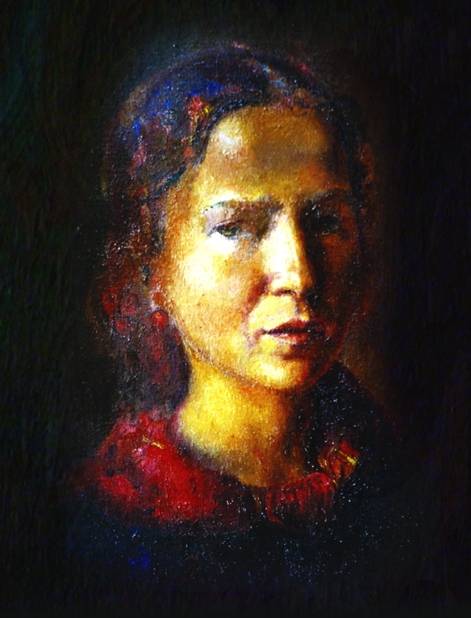
Self portrait by Clara Klinghoffer (1937)
“…Now universally recognized as one of the greatest English woman painters, she was a poor and utterly unknown young girl from the East End when her first exhibition took the artistic world by storm in 1919. Hailed everywhere as the girl who could draw like Raphael, her superb technique has always been compared with the Old Masters, but at the time of her first show she had never seen any of the great Old Masters pictures…”
–Women of Today, 1932
My blog today looks at the rise of one of the great female artists. For Clara Klinghoffer’s life story, I want to go back to her paternal grandparents, Abel and Witie Stark who lived in in Szerzezec, a village some forty minutes by train away from the large town of Lemberg, known to us now as the Ukranian city of Lviv, but at the time of Clara’s birth in 1900 it was part of the contested region that was once Polish Galicia, but was then part of the Austro-Hungarian Empire. Since Galicia had split from Poland and came under Austrian control, life had been good. The majority of the population of the small town of Szerzezec were Jewish but they had a good working and social relationship with their fellow Christian citizens. It was an easy-going and liberal place to live where both Jews and Christians realised they needed each other. Abel Stark ran a grain business and had achieved lucrative contracts with the Austrian military.
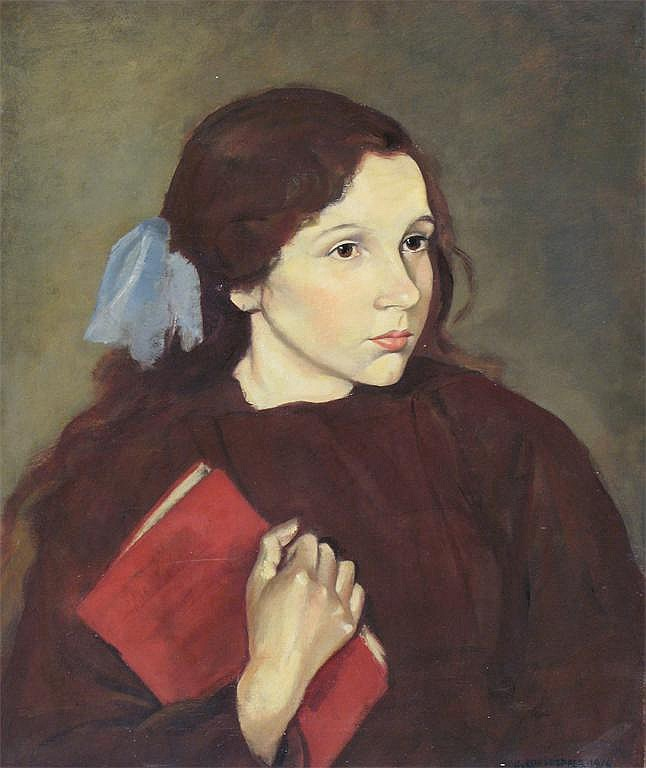
Portrait of Annie Salomans with her book by Clara Klinghoffer (1918)
In 1898 Abel and Witie had one major problem to solve. Their eldest daughter, Chana Riza (Hannah), was twenty four years old and despite her father and mother’s attempts to find her a husband and that of the local shadchan (matchmaker), she remained unwed ! If it was a problem for them, it was also a problem for her two younger sisters, Sarah and Leah, as according to ancient custom, they were not allowed to marry until the eldest sister married first. Eventually a “marriage candidate” arrived who was acceptable to both parents and Chana Riza. He was Salman Klinghoffer. To Chana’s father, Salman was ideal and would be able to work in the family business whilst to Chana herself he had all the physical attributes she found pleasing.
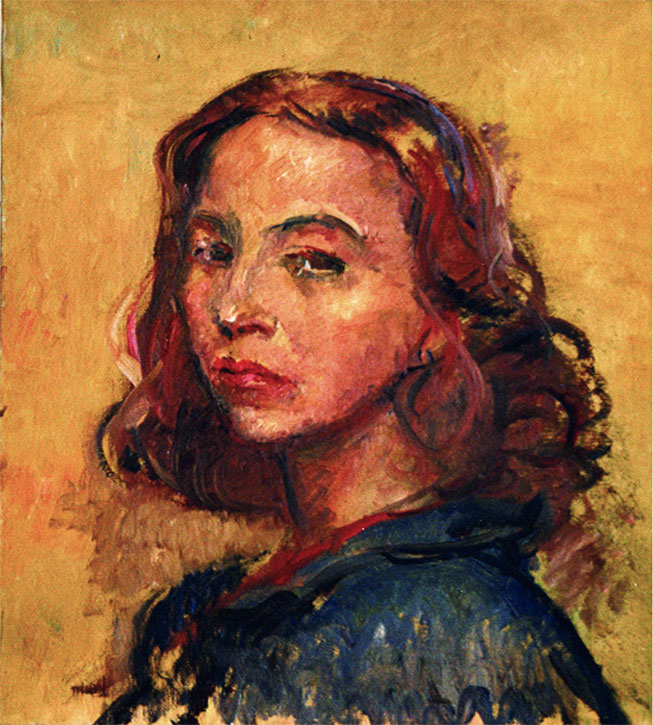
Self portrait by Clara Klinghoffer (1955)
Chana Riza and Salman Klinghoffer were married on March 1st 1898 at a large ceremony attended by most of the townsfolk and the merriment lasted for many days. The newly-weds moved into her parents home and Salaman began working for his father in law but Salman and his father-in-law did not get on well. They were two totally different characters. Abel Stark was shrewd, dynamic and very determined which was the reason for his success in business. On the other hand, Salaman was a quiet and contemplative man and somebody who shied away from confrontations. Chalk and cheese ! Abel soon became aware that Salman would not eventually be able to take over the family grain business in a partnership with Abel’s son Ephraim and Salman riled at being treated like a lackey by his father in law..
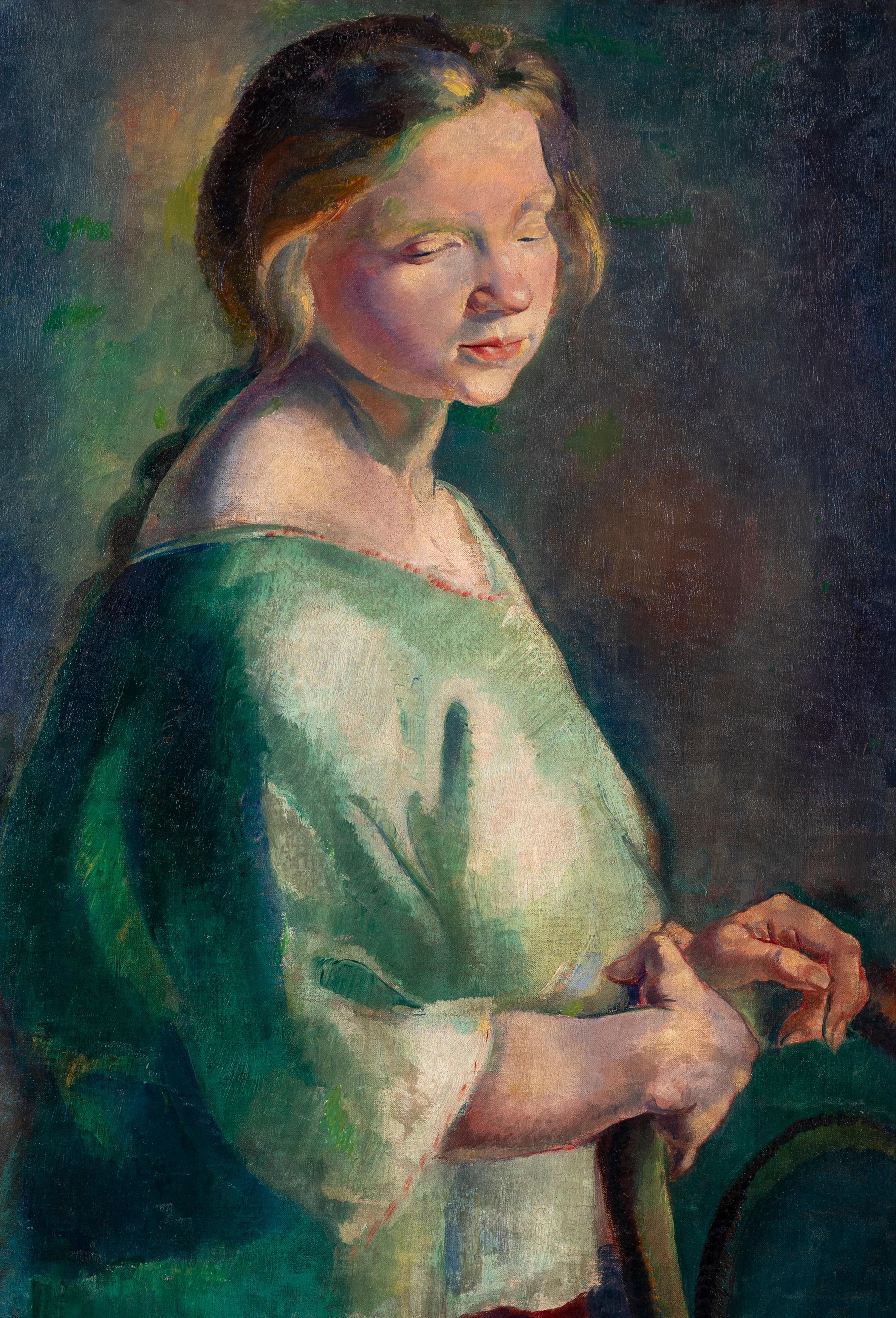
Untitled (Young Woman) by Clara Klinghoffer
Salman and Chana Rizi had their first child, Fegele, in early 1899 and later that year Chana became pregnant once more. Her second child was born on May 18th 1900. This second daughter was named Chaje Esther after her late maternal grandmother. A third child, another daughter, Reisel, was born on April 4th 1902. Although the grandparents were happy with the grandchildren, their happiness, at least in the eyes of Axel, was tempered by the fact that Chana Rizi had not given birth to any male offsprings.
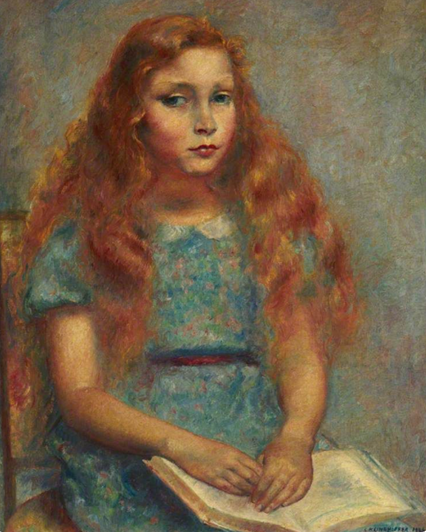
Portrait of a Girl Reading by Clara Klinghoffer (1946)
Salman was fed up with life and working for Abel and soon on hearing many stories about the golden land of America decided that his future lay there and he would head there alone, get a job and then send for his wife and children. Sadly Salman was a dreamer. He broached the subject with Abel and Witie who did not oppose his dream and seemed to be pleased to be rid of him. His wife viewed it differently but because she knew her husband was very unhappy, she believed he should grasp the chance to better his life and any way, soon she would join him.

Giuseppina by Clara Klinghoffer (1934)
Salman left Szerzezec but instead of going to America arrived in England in the city of Manchester and took a job as a presser in a tailor’s shop. Nobody knows why he changed his plans of fulfilling his American Dream but maybe he had contacts in the northern English city. At first he corresponded with his wife back home telling her what he was doing but there was never an invite for her and his three children to join him. The arrival of letters from her husband soon became infrequent and eventually stopped altogether. What had happened to him? Had he taken up with another woman? Had he become seriously ill? Had he decided to journey on to America? All were questions that Chana Rizi contemplated. So in 1903, she took the momentous decision to go to Manchester with their two children Fegele and Chaje and look for her husband. Her youngest daughter, Reisel, was left with her grandparents. Chana Rizi was just thirty years old and solo travel was hazardous and she would be arriving in a country whose language she could neither speak nor understand. However, she did arrive in Manchester after a long boat trip during which time she was violently seasick and she eventually located her husband, much to his surprise.

Pastel portrait of Lucien Pissarro by Clara Klinghoffer (1928)
Salman was paid a pittance as a presser but Chana Rizi was determined to stay by his side so they could build a life together even if they all had to endure poverty. It was also at this time that they changed the children’s first names. Fegele became Fanny and Chaje Esther became Clara – Clara Klinghoffer. The family could not make ends meet and so they moved to the Staffordshire town of Hanley. Salman’s wages were better and Clara enjoyed the peace of the small rural town which compared favourably with the noisy and polluted city of Manchester but all was not well with the family dynamics and there was a rumour that Salman was having an affair with a local woman. Chana Rizi, who was pregnant with her fourth child, packed their bags and demanded they returned to Manchester.

Harriet Cohen (pianist) by Clara Klinghoffer (1925)
The family arrived back in the city and rented a property at 18 Irwell Street in the Cheetham Hill district of the city and it was here in late June 1904 that Chana Rizi’s fourth child, another daughter, Rachel, was born. Many years later, Chana went to visit a friend in London and when she returned to Manchester she announced to her family that they were going to move to the English capital and there would be a job waiting for her husband as manager of a drapery shop in Poplar in the East End of London, which would suit him better as the physical strain on him as a presser was proving too much for him and was affecting his health. Salman went first to London to secure somewhere for the family to live. He managed to rent a small East End flat in Puma Court, a tenement block off Whitechapel Road, close to Spitalfields fruit market. Very little good could be said about their accommodation in their Puma Court flat or the neighbourhood and the smell of rotting fruit and veg coming from the market.
Clara’s early schooldays were ones she would rather forget. Ferocious teachers who often meted out corporal punishment with a birch and unfriendly fellow pupils were things she had to put up with. Added to that, her mother fell down the steps of their flat and broke her leg in a number of places which meant she had to rest up in bed with her leg in a heavy cast.

Pen & Ink fashion sketch from Clara’s childhood sketchbook (1913)
Salman was not happy working as manager at his cousin’s drapery shop. He wanted to be answerable just to himself and so he looked to become self-employed. He wanted to be his own boss. He travelled back to Manchester where he set himself up as a “mill end” trader and arranged for bags of “end of roll” materials to be sent to his London home where they were stored in one of their rooms. He and Clara’s mother then sorted them and Salman took them around various tailors selling the cloth. The tailors in those days partly made their livelihood from repairing clothes and so needed various pieces of material. Salman’s business prospered and he was soon able to lease his own shop in Grove Street, off Mile End Road in London’s East End, from where he would run his business and there would be accommodation above for the family. Throughout the day, tailors would call at the shop looking for material. Thanks to the support and ambition of his wife Chana, Salman had become a merchant – a profit-making businessman. Around the early part of 1910 the family moved to another East End property, a roomier three-storey house at 148 Cannon Street Road where Clara’s mother had a dress shop and in April 1914 Salman Klinghoffer applied for naturalisation, probably due to the prospect of war in his homeland .
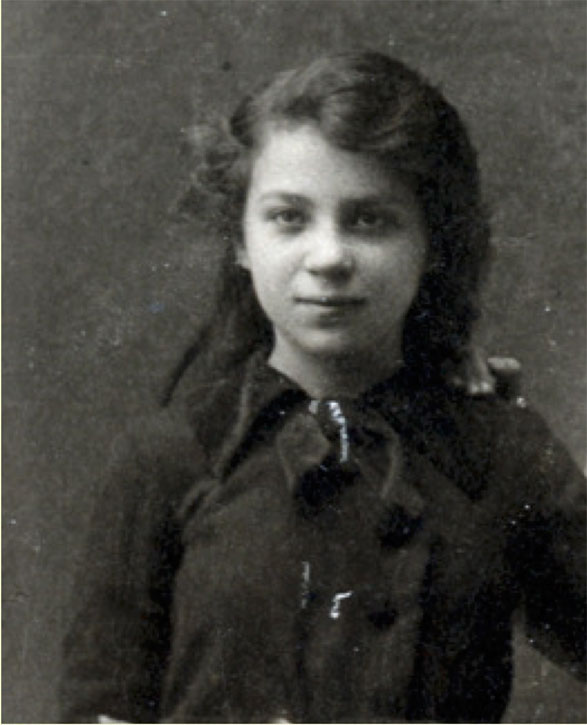
Photograph of Clara (c.1913)
Clara enrolled at St Mark’s School, a parish school serving poor and largely immigrant children, in nearby Cable Street and despite her sense of foreboding, she found she enjoyed school life and her favourite subjects were history drawing. After school, Clara would return home and spend time in her mother’s dress shop and began to sketch some of the clients. She would also spend time in the large attic which ran the whole width of their house and was used as a room to store her father’s mill ends. However there was a table in the attic at which she sat and sketched. This was her first “studio”.
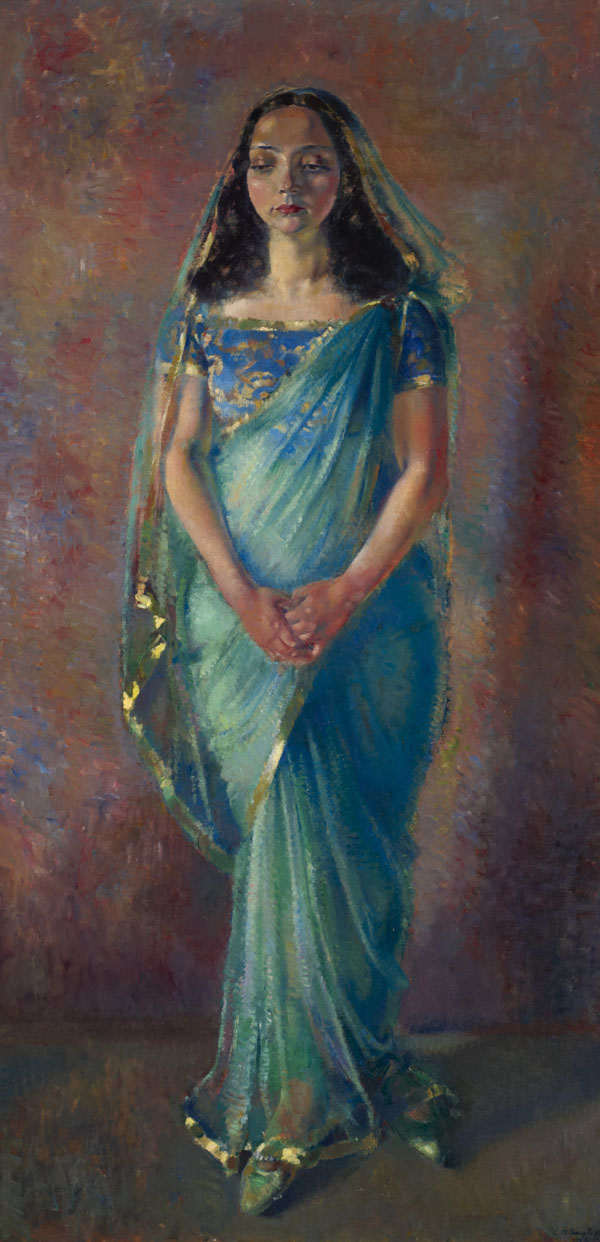
Girl in Green Sari by Clara Klinghoffer
One of her mother’s clients, a young man, who saw Clara’s sketches told Clara’s mother that her daughter was very talented and she should take art lessons. Clara’s mother was intrigued by the suggestion and she and her husband decided to do something to help their daughter. Studying art at an art school was very expensive but her father and mother managed to raise enough for her to enrol at the John Cass Institute, in Jewry Street, Aldgate.
………….to be continued
Information for this blog was found in many sources but the most important ones were:
Clara Klinghoffer – 20th century English Artist
Clara Klinghoffer: the girl who drew like Raphael and Leonardo

 my daily art display
If I wanted to write to you about sofanisba anguissola can I do it on this blog? I am 91 and not particularly good at the internet. How might I “ write” to you more privately?
Thank you for this story- I am intrigued
Clara Klinghoffer, an amazing superstar artist!!