My apologies for a lack of a post yesterday but I was touring the Italian Lakes and ended up in a non-WiFi hotel. This is the last day of my short break and I am at Milan airport awaiting a flight home.
I will start today’s blog with a question. What do you like best about an art gallery visit? Maybe that is a kind of obvious question but to many people galleries mean different things. I will go to a gallery sort of prepared as to what I want to see, especially if it is a large gallery and I have no hope of seeing everything. I am a great believer in the premise that if you try to see too much, you end up seeing very little. It is like going on holiday and trying to visit too many places. You do visit them all but you miss the soul of the places. You miss the hidden gems of a town and so if you rush around a gallery, you miss their hidden gems and you miss the opportunity of carefully studying great works of art. So back to my original question, what do you like best about art galleries?
For me a visit to an art gallery is not complete without visiting the gallery shop. My bookcase shelves groan at the weight of art books and gallery catalogues I have placed on them over the years. However to take away a piece of the gallery to read and study at your own convenience is an absolute must. Unfortunately when I have taken home gallery catalogues and read them I often kick myself for not reading the details of a painting before I actually stood in front of the paintings itself and thus would avoid the realization that I have missed something.
However most of all when I go to a gallery I like to discover a new artist, whom I have never heard of. To see a beautiful painting by an artist unknown to me is like finding a gold nugget during a walk in the countryside. You admire the landscape on your walk but then this little extra find makes your day. At the art gallery it is the same. You enjoy the paintings of well-known Masters but all of a sudden you come across a new name. For from that discovery you can then learn about the artist and search for his or her other paintings. It simply opens up a new window in your world. When I was looking around the Biblioteca Ambrosiana in Milan a few days ago, I came across a painting by Paul Bril and artist I had not heard of before. Yes, I can just imagine some of you groaning at my lack of knowledge, but that is how it is and I, like everybody, has to build up an artistic knowledge!
Paul Bril was a Flemish landscape painter and was born in Antwerp in 1550. His brother Matthijs was also a landscape artist. Paul, who received Papal Favour, a form of Papal patronage, lived and worked mostly in Rome. His brother died when he was quite young and Paul continued with his fresco work. Paul was also a painter of small cabinet paintings. These were small paintings, characteristically no larger than about two feet in either dimension, but often much smaller. The expression is especially used of paintings that show full-length figures at a small scale, as opposed to a head painted nearly life-size, and these cabinet pictures are painted very precisely, with a great amount of “finish”. From the fifteenth century onwards wealthy collectors of art would keep this type of painting in a cabinet, hence the name, in a relatively small and private room to which only those with whom they were on especially intimate terms would be admitted.
The painting on display for My Daily Art Display is one I saw at the Biblioteca Ambrosiana in Milan and is entitled Landscape with a Marsh which he completed in 1590. It is quite small in size, measuring 26cms x 35cms but its size does not detract from its beauty. It is a haunting landscape with just a few wading birds or ducks present at the pool. The water is still but appears crystal clear. The silvery-green colours add a picturesque tranquility to the scene. Wouldn’t you like just to sit on the bank of the pool and let the world pass you by? I know I would.
Feast in the House of Simon by Bernardo Strozzi (c.1630)
Whilst I was wandering around the narrow streets of Venice, crossing over the many quaint little bridges I had a sort of plan of what I wanted to see. I had to have a look St Mark’s square and cross the Rialto Bridge but I also had two artistic destinations I wanted to visit. First was the Basilica of Santa Maria della Salute which was the church at the heart of yesterday’s blog but most of all I wanted to visit the Accademia Galleries which houses a collection of the best works of art by Venetian painters. I finally found the building and I was luck as apparently it was “Cultural Week” and the entrance fee had been waived. The first room I entered was full of what they termed “The Primatives” and was a large collection of late 14th century and early 15th century altarpieces.
It was when I went into the other rooms that I was taken aback by the paintings. It was simply breathtaking. It was the sheer size of them which was overwhelming. In all the galleries around the world which I have visited, I have never seen such a large collection of gigantic paintings. Some, including the painting I am featuring today, were in excess of 7 meters in width and there was the Veronese painting Feast in the House of Levi which was in excess of 13 meters in width and almost 6 meters high. These large paintings simply overpowered you and you sat before them in total shock. You could only imagine how long the artists had taken to paint them. One room just had the complete nine painting cycle of the Legend of St Ursula, the fourth I featured in My Daily Art Display on March 22nd. As each of the nine was so big I spent almost an hour following the tale of St Ursula and studying all the marvelous detail laid out on each canvas. It was a remarkable experience. The final room I went through on my way to the exit had amongst its collection the famous and very beautiful Tempest by Giorgione which I featured on March 4th. This is a lovely painting much smaller than the mammoths I had been admiring earlier but still a gem. I was completely spellbound by this gallery visit and I suggest you add this gallery to your “must visit” list. You will not be disappointed.
Back to today’s offering in My Daily Art Display. It was one I saw during my visit. I could have picked so many from the wonderful collection but for today I have chosen a painting by Bernard Strozzi entitled Feast in the House of Simon which he completed around 1630.
The painting was acquired by the gallery in 1911 and comes from the chapel of Palazzo Gorleri in Genoa. It is thought that it was painted for the parlour of the Santa Maria in Passione monastery at Diano, Genoa. The story behind the painting is from the New Testament:
“…When Jesus was on his travels to preach, a Pharisee called Simon invited him to a meal.
When Jesus arrived at the Pharisee’s house and took his place at table, suddenly a woman came in, who had a bad name in the town. She had heard he was dining with the Pharisee and had brought with her an alabaster jar of ointment. She waited behind him at his feet, weeping, and her tears fell on his feet, and she wiped them away with her hair; then she covered his feet with kisses and anointed them with the ointment.
After this scene, Simon the Pharisee wondered whether Jesus was really the prophet everyone told he was, because surely Jesus would have seen that this woman had a bad name and would not have let her touch him. But Jesus retorted with a parable and he showed the difference of welcoming he had received from Simon as compared to the welcome of the woman. Simon had poured no water over Jesus’ feet and Simon had not anointed Jesus’ head.
Jesus said: “For this reason I tell you, Simon, that her sins, many as they are, have been forgiven her, because she has shown such great love. It is someone who is forgiven little who shows little love”. Then he said to the woman: “Your sins are forgiven…..”
The artist has distributed the various characters around the painting, not randomly but with care so as to tell various parts of the story behind the painting. There is so much going on within the painting which as you know is what fascinates me. We see Mary Magdalene kneeling at the feet of Christ with her porcelain urn of water in preparation to her washing the feet of Christ. There is also humour in the painting. Look how the man behind Christ’s right shoulder is remonstrating with the dog which is about to attack the cat. It appears the cat has managed to escape the clutches of the dog by jumping upon the table much to the displeasure of a young servant, who has raised a stick and is just about to whack the cat away. The banquet table lies diagonally across the painting. Our eyes fix on Jesus who is vociferously defending Mary Magdalene whilst Simon is seen half getting out of his chair as he stares on incredulously at the sight of Mary at the feet of Jesus. There is a splendor of colour which brings the painting alive. Look at the servant carrying the tray of fruit – see how he is lit up by the bright background of the sky.
This is an awesome painting and I can only hope that like me, one day you will be able to stand before it and absorb its beauty.
The Entrance to the Grand Canal, looking East with Santa Maria della Salute by Marieschi (c.1735)
I went to Venice today. It was my first visit to this beautiful place. I decided that once again My Daily Art Display should be a painting by a Venetian artist depicting this stunning city. The painter is Michele Marieschi and his work is entitled The Entrance to the Grand Canal, looking East, with Santa Maria della Salute. Although Venice is associated with the likes of Canaletto and Guardi I decided to select a painting of Venice by a less well-known artist. Michele Marieschi, the son of an engraver, was born in 1710 and was a contemporary of the two great Venetian artists, Canaletto and Francesco Guardi and in some ways probably suffered from their presence.
Santa Maria della Salute
What we are looking at in this painting is the entrance to the Grand Canal which is dominated by the magnificent Basilica of St Mary of Health known locally as Basilica di Santa Maria della Salute. This Roman Catholic church or basilica is situated on a small tongue of land between the Grand Canal to the left as we look at the picture and the Bacino di San Marco to the right. The dome of the basilica was an important addition to the Venetian skyline and was an inspiration to such artists as Guardi, Canaletto, Turner and Singer Sargent. The basilica was built in the late seventeenth century by the Venetian architect, Baldassare Longhena in thankfulness for the ending of the bubonic plague which killed more than 80,000 Venetians in 1630. This view has probably been taken from the monastery of San Gregorio which stands on the corner meeting point of the Grand Canal and the Rio della Salute and is on the opposite side of the Rio della Salute to the basilica. If you follow the way past the steps of the basilica you can just make out the tower of Dogana da Mar the original Customs house which once controlled all movement of boats and their goods in and out of Venice. On the opposite side of the Grand Canal are the Palazzo Manolesso and Contarini Fasan and if you look closely you can just make out the top of the famous Campanile of San Marco. As with all Venetian scenes the water is full of boats of various shapes and sizes, some gondolas, others cargo boats. If you look closely at the cargo boat in the left foreground it is loaded with cases marked “Roma” “Vienna” and “M:S:” the latter thought to be the artists signature. It is interesting to see how the artist has divided the scene vertically by the long mast of the boat which is tied alongside the quay. In some ways it balances the composition. This composition has a two point perspective. When you look at the basilica and the surrounding quay you get a strange sensation maybe caused by the “V” shape of the quay, that the bottom of the basilica appears to be coming towards you whilst the dome of the basilica seems to be moving away. Art historians believe that this illusion may be because Marieschi used a camera obscura to paint this picture.
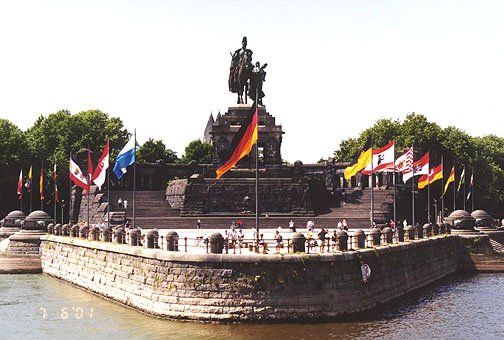
Deutsches Eck, Koblenz Germany
When I first saw this painting I was immediately reminded of Deutsches Eck at Koblenz, the triangular shaped headland, which is at the confluence of the rivers Rhine and Mosel and on which is the giant equestrian statue in honour of Emperor William I. It is strange the impression a painting gives you of a place. You take it that it is almost a photograph and I was very suprised when I arrived at the place shown in the painting. It was so different. The distance from the bottom step of the basilica to the quay edge is no more than 10 paces. I was expecting it to be like the Deutches Eck and the corner would be at least 50 metres away from the quay edgea nd that was based on the number of “small” people in the painting between the steps and the corner point of the quay. So although the camera doesn’t lie, the painting does!!!
Notwithstanding that the painting like Venice itself is truly magnificent.
Today I spent a pleasant day lin Milan looking around a couple of art galleries. I went to the Pinacoteca Ambrosiana which had some marvellous sketches and notes by Leonardo da Vinci and some superb paintings by Jan Bruegel as well as a plethora of Italian Renaissance works of art. I then went to the Pinacoteca di Brera which has an unbelievable collection of paintings, many of which, like The Kiss by Francesco Hayez and the Dead Christ by Andrea Mantegna, I have featured in My Daily Art Display.
However for My Daily Art Display today I am going to feature a painting by an artist whose works were on show at an exhibition in the Palazzo Reale which is almost next door to the awesome Milan Cathedral. You either love or hate this artist’s work but you can never ignore it. He is Guiseppe Arcimboldo, born in Milan in 1527. He is famous for his imaginative portrait heads which are made entirely out of fruits, vegetables, flowers and fish. His father was also a painter and he and his son were commissioned to do some stained glass windows for the cathedral. At the age of thirty-five Arcimboldo became court painter for Ferdinand I at the Habsburg court in Vienna. Later he was to work in Prague for Emperor Maximilian II and his son Rudolf II as both a costume designer and decorator. Although Archimboldo completed many conventional and traditional religious works he will always be remembered for his human heads made up of such unusual thgings, like vegetables. The jury is out on their merit. Art historians disagree on whether these painting were just fanciful and quirky or the result of the artist’s disturbed mind. However it should be remembered that during the Renaissance period, people were mesmerised by the weird and outlandish and maybe all the artist did was to offer up something which was in great demand.
I had seen many of his paintings before in books but I had never been up close to them. They really are quite amazing. The painting I am featuring today (above) is not one of his well known “four season” paintings but is one of his “reversible head” paintings. I came across it at the exhibition and found it hung in an alcove in front of which, lying horizontally, was a mirror. The painting which was entitled Vegetables in a Bowl appeared to be just what it stated – a bowl of mixed vegetables which I took on face value.
The Vegetable Gardener by Arcimboldo
However when I peered into the mirror it showed me an upside-down image of the painting and above is what I saw…… amazing isn’t it ?
The alternative title of the painting is The Vegetable Gardener. I love the chubby cheeks and the long swollen nose which some believe allude to the testicles and an erect penis but maybe that is taking imagination too far!
Like all painting, one can never fully appreciate the artist’s work until one is standing up close to them and taking in their true beauty. We all know that books try and give us faithful reproductions but there is nothing quite like the genuine article.
I leave Milan today and head east to Verona and Padua and then will go to Venice on Saturday.
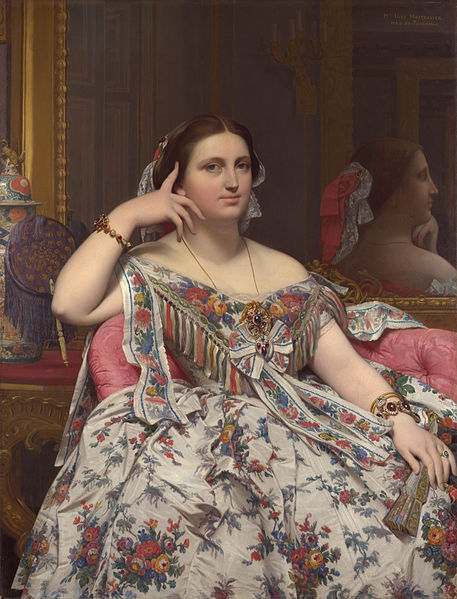
By now you will have realised that the paintings I like the most are ones that have a story behind them. My Daily Art Display today has an intriguing tale attached to it which I will now share with you. The painting is entitled Madame Moitessier and the artist who created this work of art was Jean-Auguste- Dominique Ingres. This painting which was completed in 1856 is housed at the National Gallery in London. It is the date which is interesting as Ingres initially started the painting in 1844!
Marie-Clothilde-Inès Moitessier, née de Foucauld, was the daughter of a civil servant. Born in 1821 she married the wealthy banker, and one time importer of Cuban cigars, Sigisbert Moitessier. He was in his forties whilst she was just twenty-one years of age. Two years later, her husband spoke to a friend of Ingres and asked him to speak to the artist about painting a portrait of his new wife, Madame Montessiere. Ingres refused the commission, as to him, portraiture was a “low” form of art and he preferred to concentrate on “history paintings”. However his friend Marcotte persevered with the Monsieur Moitessier’s request and finally Ingres agreed to meet the new wife.
Ingres was immediately struck and captivated by her beauty and agreed to paint her portrait. Ingres then made his first mistake by suggesting that Moitessier should include her young daughter “la charmante Catherine” in the portrait. If you look at preliminary sketches of this work, which can be seen at the Ingres Museum in Montauban, you can see the head of Catherine under her mother’s arm. However by 1847 the young child had become so restless, couldn’t sit still for any lengthy period and finally rebelled against any artistic instructions and so, was banished.
Ingres was a perfectionist. Everything had to be just right with the work and over a period of time the clothes which Madame Montessier wore were changed to suit the artist and be of the latest fashion. In the finished painting she wears the latest woven floral fabric with a crinoline, the stiffened petticoat, which had just come into fashion in 1855. The lady also had little choice on what jewellery she should wear. Ingres was the Master and told her what to wear and couched his suggestions in terms of flattery. He was reported to have told her one day when discussing how she should adorn herself:
“……Since you are clearly beautiful all by yourself, I am abandoning, after mature consideration, the projected grand headdress for a gala. The portrait will be in even better taste and I fear that it would have distracted the eye too much at the expense of the head. Same thing for the brooch at your breast; the style is too old-fashioned and I beg you to replace it with a gold cameo. However I am not against a long and simple chatelaine, which I could terminate with the pendant of the first one. Please….bring on Monday your jewel chest, bracelets and the long pearl necklace……”
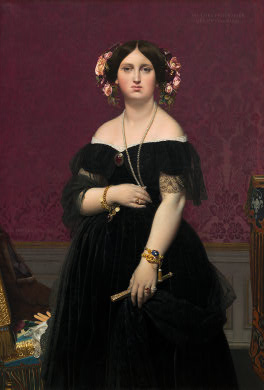
More bad luck for the commission was to follow as in 1849 Ingres’s wife died suddenly and the artist was devastated and didn’t paint for the next seven months. In 1851, seven years after he started the painting of the seated Madam Moitessier, little progress had been made and the husband became restless at this lack of progress. So that year, after constant cajoling and support from his friends and the demand of the sitter and her husband, he went back to the easel. Ingres started another painting of Moitessier’s wife, dressed in black, this time in a standing position. He completed this at the end of 1851 and this work can now be found in the National Gallery of Art in Washington.
After completing the standing portrait of Madame Moitessier he reverted back to the one he had begun in 1844. The lady is sitting in a rather strange pose. Art historians believe that the pose of the lady, hand touching cheek, captured in Ingres’s painting, was reminiscent of the fresco Hercules and Telephus from Herculaneum which Ingres probably saw when he was there in 1814. It is believed that Ingres had the sitter take up this pose but had to convince her husband that it was in keeping with Classical art and it made his wife look more learned and cultured. The husband liked this idea as he was of the nouveau riche and liked the idea that the painting may have people believe they were more akin to nobility. It is also quite amusing to read that Madame Moitessier had gained weight during her pregnancies and had demanded of Ingres that he should re-paint her arms and make them look thinner and thus more flattering! This painting took over twelve years to complete and there are many preliminary drawings of it in existence.
Why did it take him so long? I have told you of some problems he encountered during this epic and I suppose we should also remember that he was 76 years of age when he finally completed the work and age may have played a large part in the agonisingly slowness in his progress. Still, now we look at the finished article we must admire Ingres’s work.
By now you will have realised that the paintings I like the most are ones that have a story behind them. My Daily Art Display today has an intriguing tale attached to it which I will now share with you. The painting is entitled Madame Moitessier and the artist who created this work of art was Jean-Auguste- Dominique Ingres. This painting which was completed in 1856 is housed at the National Gallery in London. It is the date which is interesting as Ingres initially started the painting in 1844!
Marie-Clothilde-Inès Moitessier, née de Foucauld, was the daughter of a civil servant. Born in 1821 she married the wealthy banker, and one time importer of Cuban cigars Sigisbert Moitessier. He was in his forties whilst she was just twenty-one years of age. Two years later, her husband spoke to a friend of Ingres and asked him to speak to the artist about painting a portrait of his new wife, Madame Montessiere. Ingres refused the commission as to him portraiture was a “low” form of art and he preferred to concentrate on “history paintings”. However his friend Marcotte persevered with the Monsieur Moitessier’s request and finally Ingres agreed to meet the new wife.
Ingres was immediately struck by her beauty and agreed to paint her portrait. Ingres then made his first mistake by suggesting that Moitessier should include her young daughter “la charmante Catherine” in the portrait. If you look at preliminary sketches of this work, which can be seen at the Ingres Museum in Montauban, you can see the head of Catherine under her mother’s arm. However by 1847 the young child had become so restless, couldn’t sit still for any lengthy period and finally rebelled against any artistic instructions and was banished.
Ingres was a perfectionist. Everything had to be just right with the work and over a period of time the clothes which Madame Montessier wore were changed to suit the artist and be of the latest fashion. In the finished painting she wears the latest woven floral fabric with a crinoline, the stiffened petticoat, which had just come into fashion in 1855. The lady also had little choice on what jewellery she should wear. Ingres was the Master and told her what to wear and couched his suggestions in terms of flattery. He was reported to have told her one day when discussing how she should adorn herself:
“……Since you are clearly beautiful all by yourself, I am abandoning, after mature consideration, the projected grand headdress for a gala. The portrait will be in even better taste and I fear that it would have distracted the eye too much at the expense of the head. Same thing for the brooch at your breast; the style is too old-fashioned and I beg you to replace it with a gold cameo. However I am not against a long and simple chatelaine, which I could terminate with the pendant of the first one. Please….bring on Monday your jewel chest, bracelets and the long pearl necklace……”
Madame Moitessier by Ingres (1851)
More bad luck for the commission was to follow as in 1849 Ingres’s wife died suddenly and the artist was devastated and didn’t paint for the next seven months. In 1851, seven years after he started the painting of the seated Madam Moitessier little progress had been made and the husband became restless at this lack of progress. So that year after constant cajoling and support from his friends and the demand of the sitter that he produced something, Ingres started another painting of Moitessier’s wife, dressed in black, this time in a standing position. He completed this at the end of 1851 and this work can now be found in the National Gallery of Art in Washington.
After completing the standing portrait of Madame Moitessier he reverted back to the one he had begun in 1844. The lady is sitting in a rather strange pose. Art historians believe that the pose of the lady, hand touching cheek, captured in Ingres’s painting was reminiscent of the fresco Hercules and Telephus from Herculaneum and which Ingres probably saw when he was there in 1814. It is believed that Ingres had the sitter in this pose, and he had tgo convince her husband that it was in keeping with Classical art and it made his wife look more learned and cultured. The husband liked this idea as he was of the nouveau riche and liked the idea that the painting may have people believe they were more akin to nobility. It is also quite amusing to read that Madame Moitessier had gained weight during her pregnancies and had demanded of Ingres that he should re-paint her arms and make them look thinner and thus more flattering! This painting took over twelve years to complete and there are many preliminary drawings of it in existence.
Why did it take him so long? I have told you of some problems he encountered during this epic and I suppose we should also remember that he was 76 years of age when he finally completed the work and age may have played a large part in the agonisingly slowness in his work. Still, now we look at the finished article and must admire Ingres’s work.
Grand Canal: Looking North-East towards the Rialto Bridge by Canaletto (c.1725)
As today I am setting off for a short break in Milan and Venice, I thought it only right to feature a painting of the beautiful Adriatic city. I suppose the name one conjures up in one’s mind when one thinks of art and Venice is Giovanni Antonio Canal better known by his nickname Canaletto (meaning little canal). He was born in Venice in 1697 and was the son of Bernardo Canal, a painter, hence the use of the nickname to differentiate his works from those of his father. My Daily Art Display for today is Grand Canal: Looking North-East towards the Rialto Bridge which Canaletto completed around 1725 and now hangs in the Gemäldegalerie in Dresden.
This was one of the largest works ever completed by Canaletto, measuring 146cms x 234cms. We, the viewer, are looking on this scene from first floor of Palazzo Garzoni on the Grand Canal which is situated at the corner of Rio di Sant’Angelo. If we look across the water to the left we are just able to make out the start of the Rio di San Polo, on the left side of which, in the left corner of the painting is the building, Palazzo Barbarigo della Terazza. If you look over the top of the building you can just make out the top of the San Polo steeple. Let your eyes alight on the buildings across the other side of the water and move along to the right to the end of the buildings and you can just see the famous Rialto Bridge
We are looking in a north-easterly direction at a threatening sky and by the dampness on the parapet in the right foreground one must presume there has been rain earlier on in the day and maybe the storm has passed or perhaps the heavens are about topen once again.
Canaletto has added a number of gondolas to the scene and we see them move up and down and criss-cross the Grand Canal. I am not sure who has the right of way on the canal but if you look closely at the row-boat and the gondola in the left foreground they are about to collide with the men from the row-boat frantically trying to fend off the prow of the gondola. The passenger of the gondola can be seen standing up gesticulating at his gondolier. It is thought that Canaletto’s positioning of the various boats in the painting is not based on reality but more to add a picturesque quality to the work. This is not the only thing which is not true to life as what we see does not exist. Canaletto actually combined two views into one. The right side of the painting is a view one would see from the north-east corner of the Palazzo Garzoni but the left hand side of our painting could only be viewed from the north-west corner of the Palazzo so although the two sides look as if they are opposite each other we are in fact looking at a scene which encompasses a ninety degree angle. However let us not worry about that illusion, let us just take in the exquisite detail of life in 18th century Venice.
As I said at the begining I am about to go catch my flight to Milan and although I promised you a daily art display my output will be totally reliant on the WiFi availability at my hotels
The Anatomy Lesson of Doctor Tulp by Rembrandt (1632)
A few days ago I featured Rembrandt’s painting Bathsheba at her toilet and to me the interest in the painting was three-fold. The picture itself, the story of Bathsheba and her moral dilemma and the story behind Hendrickje Stoffels, who was the artist’s model for Bathsheba. Today’s featured painting is fascinating to me because of what is going on in the painting and of course I just love looking at Rembrandt’s stunning work of art.
The featured painting today in My Daily Art Display is Rembrandt’s The Anatomy Lesson of Doctor Tulp which he painted in 1632 and now hangs in the Mauritshuis in The Hague. Rembrandt who was born in 1606 began work as a professional portraitist when he was about twenty five years of age.
We see before us a group of eight men standing around a corpse which is lying on a table. All are well dressed , which would immediately signify to us that these are gentlemen of some standing. The man dressed in black, wearing the wide brimmed hat is Doctor Nicolaes Tulp, a Dutch surgeon and, at the time of the painting, was the official City Anatomist of Amsterdam. The seven men around him who look on and listen intently to what he is saying are members of the Amsterdam Guild of Surgeons and it is more than likely that Rembrandt was commissioned to paint this picture by the Guild so that it could be hung in their offices. Almost twenty-five years later Rembrandt was commissioned again by the Guild to do a similar painting featuring Tulp’s successor and it was entitled The Anatomy Lesson of Dr Jan Deijman.
The law at the time stipulated that the City Anatomist was only allowed to carry out one dissection of a body in a year and furthermore the body must be of a criminal who had been executed for his crimes. Such anatomy lectures would usually only be carried out in winter time when temperatures were lower as there was no electricity in those days to refrigerate corpses and sometimes this experimentation and these talks would go on for several days. It is interesting to note that sexual equality had not reached Amsterdam at this time as it would not be for another hundred years that a female body could be dissected !
There is hardly any visible background to this painting although I believe if you look at the painting itself you can just make out a stone archway. Everything retreats into shadows
The lifeless body shown in today’s painting is that of Aris Kindt, aka Adriaan Adriaanszoon. It is stiff and still in sharp contrast to the animated observers. He was a violent criminal and his crime had been one of armed robbery and was sentenced to death by hanging. His recent demise is seen in the way Rembrandt has partially shaded his face insinuating that umbra mortis, the shadow of death, had started to set in. In some way the dead body is what we focus upon, probably for its gruesome element, but also by the way the artist has given it a powerful brightness. The face has an evil look about it or is that just “in our mind” because we are aware that he was an executed criminal. Although this is an anatomical lecture there is one person missing, namely, the Preparator who was the person whose task was to prepare the body for the lesson. This was considered somewhat of a menial and bloody task, which the likes of Doctor Tulp would not be expected to carry out. Tulp was a lecturer and an educator and if you look to the right of the painting you can see an anatomical text book lying open on a lecturn.
Our eyes then move to Doctor Tulp and his onlookers. The thirty-nine year old Tulp leads the experiment. His hat remains on his head to signify his standing within the group of men. The onlookers included just two doctors, the rest being made up of leading citizens who would pay handsomely for the privilege of being included in this type of official group portrait. They are all dressed in their finest clothes as if it was a social event. In reality, that is exactly what it was – a social event of the Guild of Surgeons and at such events members of the Guild could invite guests or admit paying citizens. Look at their facial expressions, what do you see? Fascinated interest or an unease at what they are witnessing for remember the dissection of a human body was not fully accepted for another century. Note how Rembrandt has positioned them randomly on different levels. Some looking up, some looking down and some stare straight out at us. This is very different to the way artists used to paint Group Portraits in the 17th century when the people stood in rigid symmetry with similar postures to ensure that no one person looked more important than the others. For us the viewer, we experience a moral dilemma regarding the experimentation of an executed person for the medical reasons. However the seven people attending the anatomical experiment are in no doubt with regards its legality and watch avidly as Doctor Tulp, using forceps he is holding in his right hand, raises the muscle and tendons of the dead man’s arm so as to demonstrate the interaction and control they have on the movement of the hand and at the same time we see Tulp with his left hand manipulating his own fingers to demonstrate to his audience the amazing action they are witnessing. It is not known how Rembrandt gained the anatomical knowledge but maybe he copied it from textbooks. Rembrandt has cleverly caught Tulp’s dramatic gesture. It reminds me of a magician who looks out at his audience with a sense of pride after he has completed his trick and maybe, for some of his on-lookers, that is exactly what Tulp has done.
In the top left hand corner of the painting we can just make out the artist’s signature (unfortunately, not very clear in my attached picture). He has signed it :
Rembrandt f[ecit]
This was his usual signature, in fact it is the earliest painting of his that has been signed just using his christian name as normally he signed his works just with his initials:
RHL
which stood for Rembrandt Harmenszoon of Leiden. Maybe the artist believed he was now famous enough to just be known as “Rembrandt” which of course is how we know him today.
There is an interesting footnote to this piece. In 2006 a group of researchers re-enacted this scene with a male cadaver and in so doing revealed many anatomical discrepancies in the way the left arm had been depicted in the painting in comparison to how it was in reality. Notwithstanding this, I hope you will agree with me that this is an excellent work of art.
Young Man with a Skull (Vanitas) by Frans Hals (c.1628)
Frans Hals was born in Antwerp around 1582. His family were forced to leave their home and flee to Haarlem during the siege of Antwerp by Spanish troops. Hals studied under the Mannerist painter, Karel van Mander. In 1609 he became a member of the city’s painter’s union and society, the Haarlem Guild of St Luke and began to earn a living by working for the town council as an art restorer. Hals married twice. His first wife Annetje Hamensdochter Abeel died in 1616 during childbirth. A year later he married Lysbeth Reyniers, the young daughter of a fishmonger, who he had employed to look after his children from his first marriage. Hals and his second wife went on to have a further eight children. Unlike his fellow artists of the time he demanded that his patrons came to him rather than for him to leave his family and travel the country to seek out patronage and make his fortune. Frans Hals died in Haarlem in 1666, aged 84 with very little to show financially for his artistic career. He had been penniless on many occasions and had often been taken to court by his creditors. Left destitute, the municipality had little choice but to subsidise him for the last two years of his life.
My Daily Art Display today is the oil on canvas painting entitled Young Man Handling a Skull (Vanitas) painted by Frans Hals between 1626 and 1628. On first sight we immediately think of the scene from Shakespeare’s play Hamlet when Hamlet was seencontemplating the skull of Yorick in the graveyard of Elsinore. For many actors and playgoers this scene is a lasting favourite and remains one of the most memorable images of the melancholy Prince. The play was first performed in 1600 so maybe Hals based his painting on that very scene. However art historians would have us believe otherwise, and believe it is much more likely to be a Dutch Vanitas allegory. Vanitas paintings feature an object (or objects) which symbolises our own mortality and the fact that life is short and reminds us of the transient nature of all our earthly pleasures and achievements. The Vanitas paintings are meant as a warning and ask us, the viewers, notwithstanding our age, to think about death . The inclusion of a skull in a painting was a typical motif of a Vanitas painting.
However this is more than just a Vanitas painting. In front of us we have a boy holding a skull. His rosy cheeks, similar in colour to his lips, give him a youthful appearance. His right hand reaches towards us as he gestures. See how the artist has skilfully foreshortened his hand in such a way that it seems to be bursting out of the canvas towards us. In his left hand is the skull, glowing in comparison to the darkness of the boy’s palm and clothes. The light comes from the left hand side of the painting causing a dark shadow on one side of the boy’s face.
The painter was famous for his style. He worked quickly, often painting “wet on wet”. Wet-on-wet is a painting technique in which layers of wet paint are applied to previous layers of wet paint. This technique requires a fast way of working, because the art work has to be finished before the first layers have dried. This technique results in vibrant swirls of semi-blended colour. Van Gogh admired this technique and wrote:
….eyes, nose, mouth done with a single stroke of the brush without any retouching whatever,,,,, To paint in one rush, as much as possible in one rush…..I think a great lesson taught by the old Dutch masters is the following: to consider drawing and colour [as one]….”
This is an interesting portrait. There is a beautiful simplicity about it but let us not overlook the skill of the artist who has given us such a work of art.
El bufón don Sebastián de Morra by Velázquez (c.1646)
The oil on canvas painting featured in My Daily Art Display today is a somewhat unusual, and to me, disturbing portrait by Diego Rodriguez de Silva y Velázquez entitled El bufón don Sebastián de Morra. Sebastián de Morra was a dwarf and jester to the court of Philip IV of Spain. He was crippled from birth and sadly was the subject of ridicule and mistreatment from the nobleman at Philip’s court. He was the servant of the King’s eldest son and heir, the teenage Prince Baltasar Carlos. On the prince’s untimely death at the age of 16, due to contracting smallpox, Baltasar left in his will a small silver sword and other objects to Don Sebastian and from this gesture we must believe the two of them had a very close and amicable relationship. Velázquez painted the portrait of other dwarfs of the Spanish court. Look back at My Daily Art Display of December 27th when I featured Velázquez’s painting Las Meninas in which we saw the dwarf, Maribárbola. The German philosopher and art historian Carl Justi said of their life at court: “they were loved and treated as dogs”. These unfortunate people were often found at courts in the Middle Ages and were given shelter in return for their services as court jesters, a position which left them open to offensive remarks and practical jokes. It was their lot in life to accept such unkindness and had just to be thankful that they had a roof over their heads.
This painting by Velázquez around 1646 is, by far, one of the painter’s most impressive and unforgettable works. Against a dark background we see the figure of the dwarf, Don Sebastián. There is a lack of elegance in the way he sits on the ground. He is leaning slightly to one side. His foreshortened legs stick out and he reminds us somewhat of a puppet which has been abandoned and his strings released by his puppeteer master. His tightly clenched hands rest on his thighs. He looks intently out at us making us feel slightly guilty that we are staring in at him. Can you look at him for any length of time without wanting to turn away as if you know you shouldn’t be staring at him? He looks somewhat annoyed. There is sadness in his dark eyes, which is contrary to his role as a jester, when his sole aim was to exude happiness and make people laugh. Maybe his expression is to remind us, lest we forget or are swayed by his opulent attire, that his life is not full of fun. Although he displays a dignified air, he also looks tormented and gloomy.
He wears a plush red and gold cape with a flamenco lace collar over a buttoned green doublet. His clothing, although splendid, cannot conceal from us his menial position in the court and this is emphasised even more by the fact that this sad diminutive figure is seated on the bare ground and not within the opulence of a court setting. Was it in the mind of the artist, or from the instructions of his patron, that the dwarf, Don Sebastián, should be dressed lavishly so as to portray to us, the viewers, that the jester was well treated and that he enjoyed the best life could give? Are we taken in by that premise?
My Daily Art Display today features three main characters. Two are women and one a man – the artist. The artist and painter of today’s featured work of art is Rembrandt Harmenszoon van Rijn. I will not go too much into his life story except for when his path crosses one of my two featured women, namely, Hendrickje Stoffels.
Hendrickje Stoffels was born in Bredevoort, which is a small Dutch town close to the border of Germany. Her father Herman worked at the castle at Bredevoort as a sort of gamekeeper. He died in 1646, one of the many victims who perished in the devastating explosion of the town’s gunpowder tower when it was struck by lightening. Her mother re-married six months later to a neighbour who had three young children of his own and Hendrickje had no choice but to leave home and go to Amsterdam. It was here that she first met Rembrandt. At this time Rembrandt had been widowed for some two years. His late wife was Saskia van Uylenburg and she was the cousin of an art dealer Hendrick van Uylenburg at whose house Rembrandt had been lodging and who had carried out a number of commissions. Saskia had actually posed for many of these commissions. Saskia had come from a wealthy family, her father was a lawyer and at one time was the burgermeester of Leeuwarden.
Staue of Hendrickje Stoffels at Bredenvoort
Hendrickje became Rembrandt’s maid and soon after, although twenty years younger than the artist, became his lover. This was frowned upon by the local church and she was brought up before the town council for “living in sin”. So why didn’t they get married? Well the answer was all about money, to be precise, Rembrandt’s money, for on the death of his first wife Saskia he received a sizeable inheritance which he would have to give back to Saskia’s family if he remarried. Rembrandt, even with this inheritance, was suffering financially so the thought of losing his inheritance was unthinkable. The reason why I am mentioning Hendrickje is that she was the model for today’s featured painting.
Now to my second featured woman – Bathsheba who is the subject of today’s oil on canvas painting entitled Bathsheba at her Bath and was painted by Rembrandt in 1654 and which now hangs in The Louvre. The story behind the painting is the Old Testament tale of King David who lusted after Bathsheba after seeing her bathing. She was the wife of Uriah, one of his soldiers, whom he then sends off into battle and orders his generals to abandon him, thus leaving him to certain death. He then makes a play for Bathsheba. The painting depicts Bathsheba having received a letter from King David summoning her. The work of art is an insight into Bathsheba’s moral dilemma – her husband is away in battle and her Lord and Master, the King has summoned her, by letter, to his bedchamber.
The depiction of Bathsheba bathing was not a new idea but most other artists had painted her with her hand maidens as part of an outdoor scene and often incorporated the figure of David surreptitiously gazing at her the naked body. However Rembrandt ignored this standard treatment of the scene and instead we see Bathsheba alone except for her maid who is bathing her feet, in preparation for her encounter with David. David is no longer the voyeur of this painting – maybe in this case we, the viewers, are the voyeurs as we look at Bathsheba’s naked body. This is a life-sized painting (measures 142 cms x 142cms) and the figure of Bathsheba dominates the canvas. In the background we see her abandoned clothes.
Look at Bathsheba. Kenneth Clarke, the author and art historian, is in no doubt about the quality of the figure when he wrote that “it was one of Rembrandt’s greatest painting of a nude”. This figure of Bathsheba is not a figure of perfection. This is no naked beauty we see in magazines. This is simply a woman with a woman’s normal body shape but in my mind it does not lose its sense of eroticism and beauty. Look how the artist has drawn her belly. This is not the flat stomach of a supermodel. This is simple reality. If we talk about the reality of the painting look at her left leg, just below the knee and you can make out the mark made by a garter or stocking top as it clings to the flesh. This is an example of the detail the artist has put into the painting.
She sits their gazing vacantly as the maid bathes her feet. She is lost in her own thoughts. What has made her so pensive? The artist gives us the answer. In her left hand we see her grasping a letter. The letter is her invitation (or is it a royal summons?) to join King David whilst her husband is away in battle. There is her dilemma – remain faithful to her husband and risk the wrath of the king or submit to his sexual overtures and dupe her husband. Look at her facial expression and the sadness in her eyes. She knows she is going to betray her husband and we can perceive her guilty expression.
This is a moralistic painting and maybe we stand in judgement. Do we look at her with an air of condemnation as we know that she goes to King David or do we look at her and sympathize with her because of her dilemma?
That’s it – well not quite as there is a scientific/medical twist to this painting. A number of breast surgeons studied the figure of Hendrickje, the model for Bathsheba and said that the way Rembrandt had drawn her left breast showing a slight deformity was a classic symptom to early stages of breast cancer or it shows an abscess due to tuberculosis. Many medical articles have been written on this matter. However Hendrickje lived for another nine years after this painting and strangely enough, in other of Rembrandt paintings in which she modeled there was no sign of a deformity to her breast!







 my daily art display