
Maria Slavona was born Marie Dorette Caroline Schorer on March 14th 1865 in the north German town of Lübeck. She was the daughter of the pharmacist Theodor Schorer and his wife Ottilie, (née Steger). Her father owned the Löwenapotheke on the corner of Königstraße, and Johannisstraße in the town, which is now known as Dr.-Julius-Leber-Straße. She was the youngest of five children and had two brothers and two sisters. As a child, she was brought up in a happy household in the old patrician house in Johannisstraße. Her parents’ home was a great meeting place for writers, artists and intellectuals. For Maria life at home was a liberal and cultural experience and, at an early age, she soon developed an intense interest in drawing and painting. Her parents encouraged her love of all things artistic and they hopde that one day she would become a painter and her mother and father supported this future road for her.
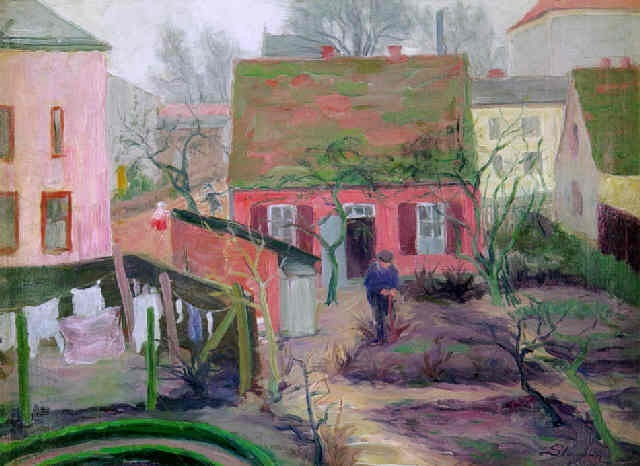
Red Gardener’s House with Gardener (Early Spring, Kahlhorst near Lübeck) by Maria Slavona
In 1882, when she was seventeen years of age, Maria went to Berlin to study art. This was an unorthodox move as accordance with the social conventions of the time, it was unseemly for a young, unmarried woman to leave her parents’ home and pursue an education, in her case. studying painting. Her move to Berlin caused a scandal in the Hanseatic city of Lübeck. However, since women in Germany were denied access to art academies, Maria Slavona attended the Eichler private painting school in Berlin and the Deutsches Gewerbe-Museum zu Berlin, (Royal Museum of Decorative Arts) which at the time had a teaching institute. In 1887, aged twenty-two, she moved to the painting school of the Verein der Berliner Künstlerinnen (Association of Women Artists and Friends of Art) in Berlin. It was an informal and free atmosphere, and the women here were allowed to conduct nude studies on living models. A year later she enrolled at the painting school of the Münchner Künstlerinnenverein (Munich Association of Women Artists).

Self portrait by Maria Slavona (1887)
Her self-portrait, created in Berlin in 1887, shows the face of a 22-year-old, extremely pretty young woman, framed by tangled curls. With her head turned to the left, she fixes her gaze firmly on the viewer. Settling in this Bavarian city was fortuitous as the city of Munich had been, since 1850 onwards, deemed the most important centre for artistic creation and painting. At this time, her most important patron and mentor was Ludwig Herterich, a German painter and art teacher, who in 1898 was a professor at the Academy of Fine Arts Munich, where he taught many young artists including Maria Slavona. He introduced Maria to French Impressionism. A painting style that would be influential for her later paintings.
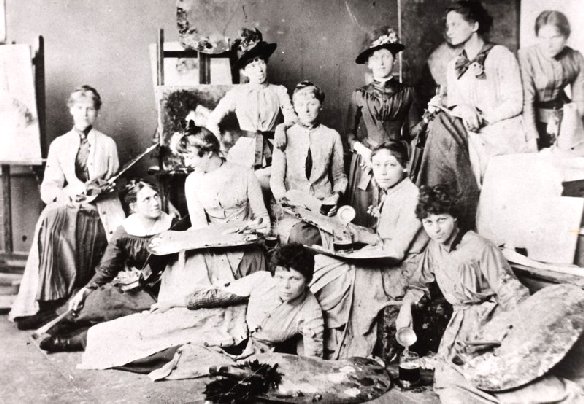
In the Munich Ladies’ Academy: Käthe Kollwitz seated between Maria Slavona (front right) and Rosa Pfäffinger (lying in front right)
Maria loved her time in Munich and made many friends including a fellow aspiring young painter, Käthe Kollwitz, who was also studying art in Munich. During a return home to Lübeck, she met some Scandinavian artists, one of whom was Vilhelm Petersen and, as they became closer friends, they both decided to take assumed names for their artworks. He chose Willy Gretor and she became Maria Slavona. Along with friends Maria and Vilhelm visited Paris in 1890. She recalled her arrival in the French capital:
“…In 1890, I came to Paris. This is where a new world opened up to me. The first visits to the Louvre almost numbed and overwhelmed me. But I was disappointed by the schools I saw, I didn’t like them. I decided to work alone and seek advice and judgment only in the circle of a few young like-minded friends, almost all Danes and Norwegians…”
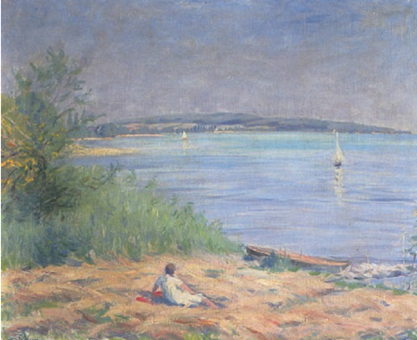
Sommermorgen am Starnberger See by Maria Slavona
That same year, Maria gave birth to an illegitimate daughter, Lilly, but her relationship with the father of the child, Petersen, was over. She had at first looked upon him as a charismatic and educated man but he turned out to be a dubious art dealer, womanizer and bon vivant. Worse still when their daughter Lilly was born Petersen had deserted Maria and she was left to bring up her daughter alone.
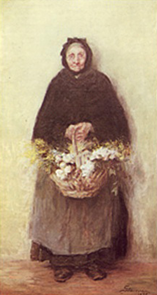
Alte Blumenfrau by Maria Slavona (1893)
In 1893, at her first exhibition at the Salon de Champ-de-Mars an annual event organized by the Société Nationale des Beaux-Arts. Maria Slavona submitted her work, Alte Blumenfrau (Old Flower Woman). At this exhibition, ironically she identified herself under the male pseudonym “Carl-Maria Plavona”. The painting depicts an old woman standing in frontal view, holding a large basket of white and yellow flowers in front of her body in her worn-out hands. Placed in front of a simple, ochre-coloured wall, the dark, poor clothing of the woman forms a strong contrast to the light background. The wrinkled face, framed by a headscarf, shows emotionless features. The tired eyes look firmly at the viewer.
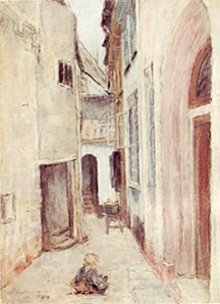
St Jurgen-Gang in Lubeck by Maria Slavona (1902)
Maria Slavona who, around 1898 had met the Swiss art connoisseur and collector Otto Ackermann. Their friendship grew over the next two years and in 1900 they married. Maria’s daughter Lilly took the name Ackerman and later she became an actress under the name Lilly Ackermann. Otto Ackermann was a valuable asset in the introduction of French art into Germany in the early 20th Century. Otto and Maria set up home in Paris and it soon became a central meeting place for Parisian bohemianism. Visiting artists such as Münch, Liebermann, Leistikow, along with literary giants and art lovers would often frequent their home and be made most welcome. Maria, who had spent sixteen years in the French capital, had led a happy and artistically productive life. During this period, she had completed many paintings depicting landscapes, portraits, still life and interiors.
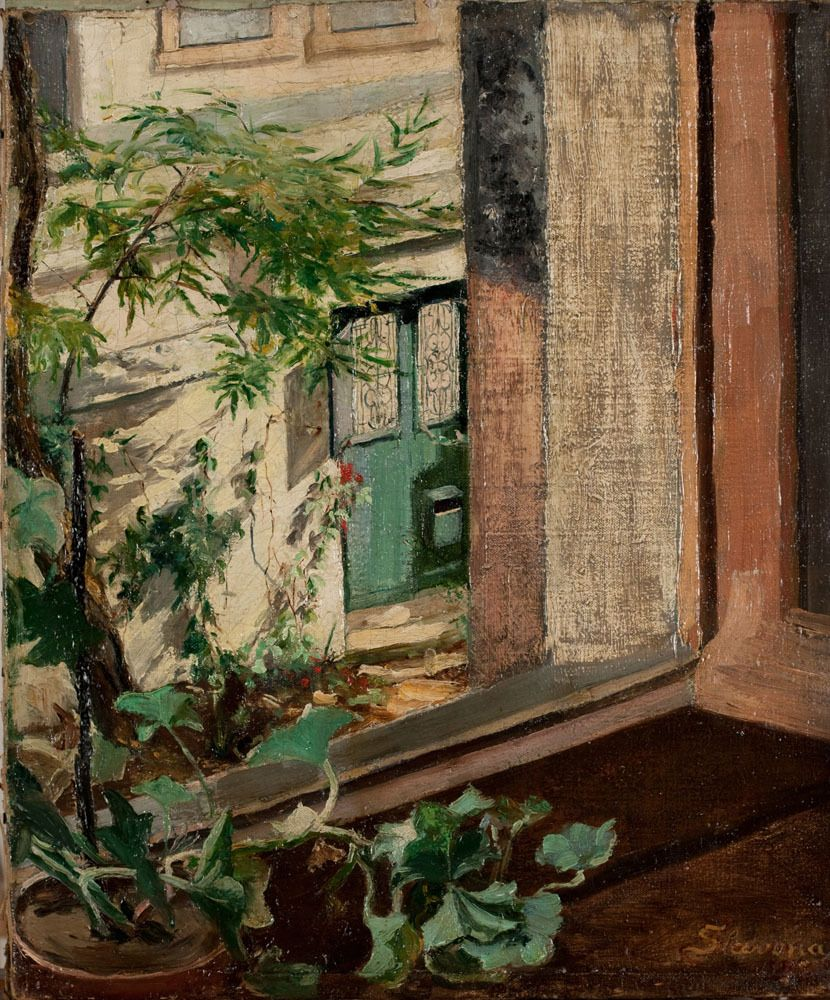
View from Studio Window by Maria Slavona (1899)
One of her favourite subjects was the view from the window of their home. All of her work over those years established her reputation as a talented painter.
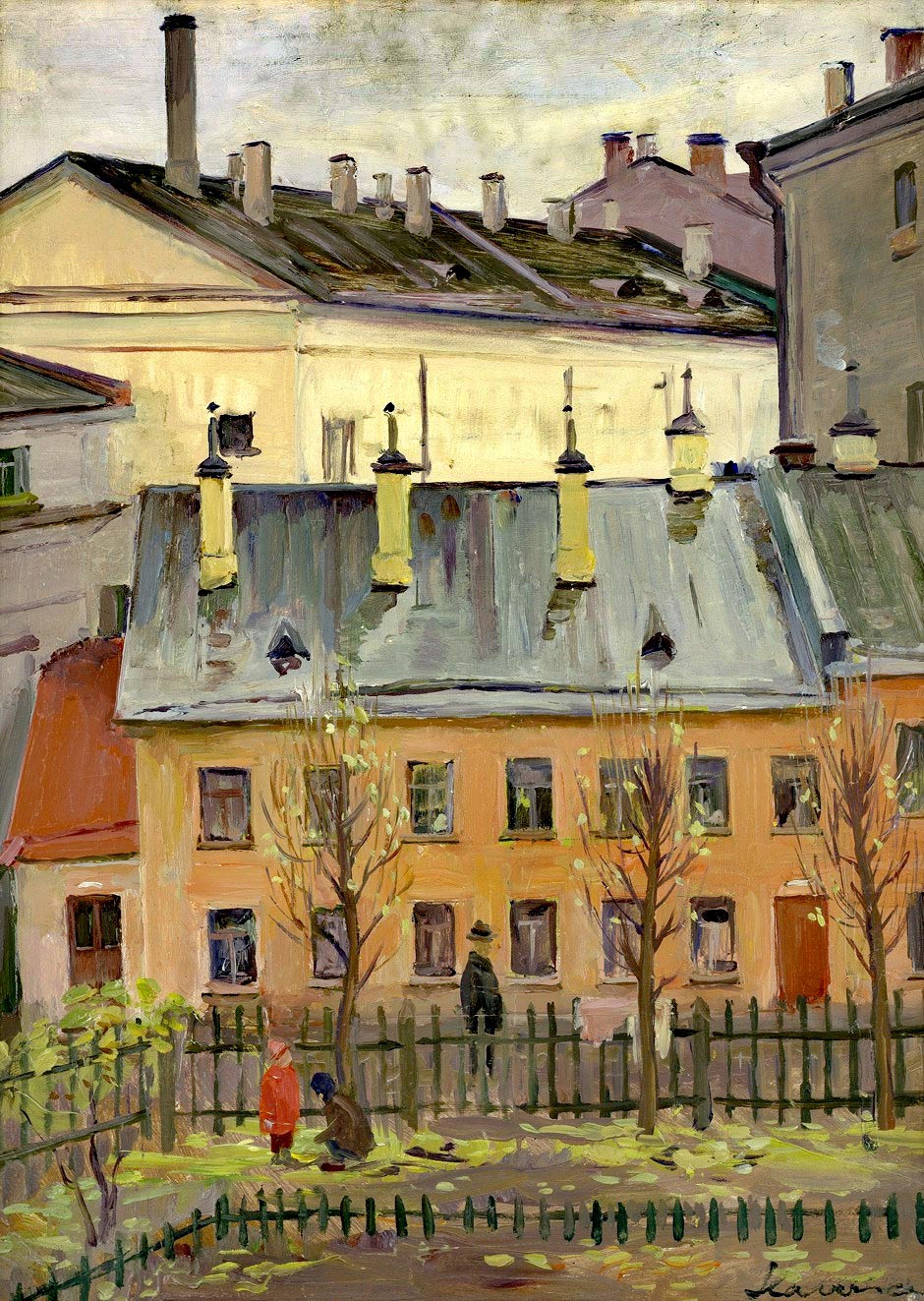
Houses on Montmartre, around 1900 by Maria Slavona

Häuser am Montmartre by Maria Slavona
In 1906 Maria and her family left Paris and returned to her old hometown of Lübeck. During her stay in Lübeck she completed many paintings depicting the town and the surrounding areas.

Villa entrance in Lübeck by Maria Slavona
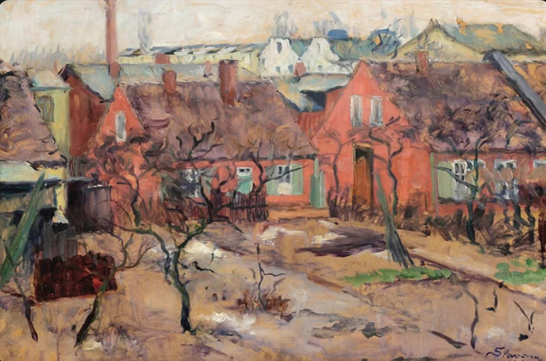
Spring Thaw near Lubeck by Maria Slavona (1913)
Unfortunately, the bourgeois, art-hostile atmosphere that pervaded the old Hanseatic city had a negative effect on her husband’s art trade business and sadly this gave them no alternative but leave Lübeck in 1909, and move to Berlin. It was in the German city of Berlin that she was once again artistically active and from 1913 she became a member of the Berlin Secession. This was one of the last art Movements of 19th century German art. It was a breakaway group of artists, who in 1898 ‘seceded’ from the city’s arts establishment, led by the eminent painter Max Liebermann. It was a reaction to the Association of Berlin Artists, and the restrictions on contemporary art imposed by Kaiser Wilhelm II. Sixty-five artists “seceded,” demonstrating against the standards of academic or government-endorsed art. The group established an independent exhibition society, in order to champion new forms of modern art – rather than continue to churn out the old-fashioned academic art favoured by the art establishment.

Bouquet of field flowers by Maria Slavona (c.1900)
Following the end of the First World War Maria’s health began to deteriorate. Added to that with a decrease in the sale of her paintings, the financial circumstances of the family took a substantial dip. To try and rectify both her health and cut back on their financial outgoings the family moved to the countryside village of Munsing in Upper Bavaria. From that time on, Maria mainly created floral still life works.
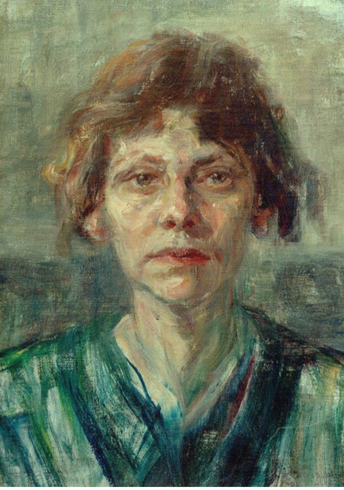
Self portrait by Maria Slavona (1910)
Maria Slavona died in Berlin on May 10th 1931 aged 66. Unfortunately, a large part of her work was lost during the Second World War, and also, for many years, her remaining works were branded by the Nazi government as Entartete Kunst (Degenerate Art) in 1933 and it was mainly ignored outside of her hometown Lübeck. Slavona is now known and famous as a representative of German Impressionism. Although she was unable to build on the artistic successes of her Paris years in Berlin, she was one of the best-known painters of her time, along with Dora Hitz and Käthe Kollwitz.
On the occasion of the 50th anniversary of her death in 1981, the Hanseatic City of Lübeck honoured its once famous and forgotten citizen with a large exhibition in the St. Anne Museum.

 my daily art display
Some of these are outstanding